
The Engineering Behind Retractable Baby Gates: How the Mechanism Works

About 93,000 children under 5 are treated in U.S. emergency rooms each year for stair-related injuries, per a Nationwide Children’s Hospital analysis of CPSC NEISS data. That number is why a gate at the top of the stairs is one of the few baby-proofing purchases I’d call non-negotiable. But not all gates are built the same, and retractable models, with their spools and springs and latch mechanisms, are a different engineering proposition than a simple pressure-mounted bar gate. Most parents install them without ever thinking about what’s happening inside that housing. That’s worth changing.
The Spool
The core of a retractable gate is a spring-loaded spool housed inside the wall-mounted casing. When you pull the gate across the opening, you’re unrolling the barrier material from that spool against the resistance of a torsion spring. When you release the latch on the far side, the spring drives the spool to rewind, pulling the barrier back into the housing.
The torsion spring is what makes the mechanism useful. It stores rotational energy as you extend the gate and releases it on retraction. Without it, you’d have a limp panel that needed to be manually fed back into the housing every time. With it, the gate retracts cleanly and reliably, hundreds of times over the product’s lifespan.
That lifespan matters. Spring metal fatigues. The torsion spring in a retractable gate is doing real mechanical work every single time the gate opens and closes, and over months of daily use, the stored tension can weaken. I’ll come back to what that means for maintenance.
The Barrier Material
Most retractable gates use one of two barrier types: a rigid plastic panel or a mesh/fabric panel. The distinction has real safety implications beyond aesthetics.
Mesh panels are lighter and more flexible, which makes them easier to spool and unspool. The mesh must meet flammability standards under CPSC regulations, a requirement that limits how quickly the material can ignite and spread flame. That’s a meaningful protection in a home where a gate might be near a kitchen or fireplace. The trade-off is visibility. A fine mesh can obscure your sightline through the gate, and the weave pattern matters for entrapment risk. Any opening in the mesh large enough to catch a small finger or a shoe buckle is a problem.
Rigid plastic panels offer better visibility and are easier to inspect for damage, but they introduce different concerns. A rigid panel has less give under impact force, and the edges where the panel meets the housing or doorframe become pinch points if the geometry isn’t designed carefully.
On both types, the gap between the barrier and the mounting surface is critical. ASTM F1004 is the federal safety standard for expansion gates and expandable enclosures. The standard addresses entrapment gaps, and the underlying principle aligns with the CPSC’s crib slat guidance: slats must be no more than 2 3/8 inches (6 cm) apart, a threshold established specifically to prevent head entrapment. Any gap at the edge of a retractable gate should be well below that threshold.


The Latch System: Two Locks, Not One
A retractable gate’s latch is more complex than it looks. Most quality models use a dual-locking system, and understanding how it works helps you recognize when it’s failing.
The first element is a magnetic catch on the receiving post (the side of the doorframe where the gate clips in). This catch holds the gate closed during normal use. It’s convenient and fast, but it’s not the primary structural lock.
The second element is a mechanical lock that engages when the gate is fully extended and clipped into the receiver. This lock is what provides real resistance to a child pushing or leaning against the barrier. ASTM F1004 sets the force requirements for this: the gate must resist a minimum horizontal push-out force without opening. The standard’s specific test values are what separate a certified gate from an uncertified one, and they’re the reason you should never buy a retractable gate that doesn’t carry third-party certification to ASTM F1004.
In my experience, an adhesive strap lock can fail under repeated pulling, whereas a properly certified gate with a mechanical lock provides reliable resistance.
| Feature | Manual Spring Gate | Motorized Gate |
|---|---|---|
| Power required | None | Battery or cable |
| Retraction consistency | Spring-dependent | Motor-controlled |
| One-handed operation | Harder on wide openings | Easier |
| Failure modes | Spring fatigue, latch wear | Power loss, motor failure |
| Long-term reliability | Higher | Lower |
The Damper: Why the Gate Doesn’t Snap Back
Here’s a component most parents never think about: the friction brake, or damper, built into the spool mechanism.
Without a damper, a fully extended gate under torsion spring tension would snap back at speed the moment you released it. That’s a real hazard. A fast-retracting panel can strike a child’s face, a caregiver’s ankle, or a pet before anyone has time to react.
The damper is a friction element, sometimes a rubber pad, sometimes a fluid-filled cartridge, that applies resistance to the spool’s rotation during retraction. It slows the rewind speed to something controlled and predictable. You can feel it when you operate a well-designed gate: the barrier draws back smoothly rather than jerking inward.
In my experience, damper quality is one of the clearest differentiators between gates. A weak damper retracts fast and loud, while a well-engineered one retracts at a consistent speed whether fully extended or halfway in.
Mounting: Where Most Failures Start
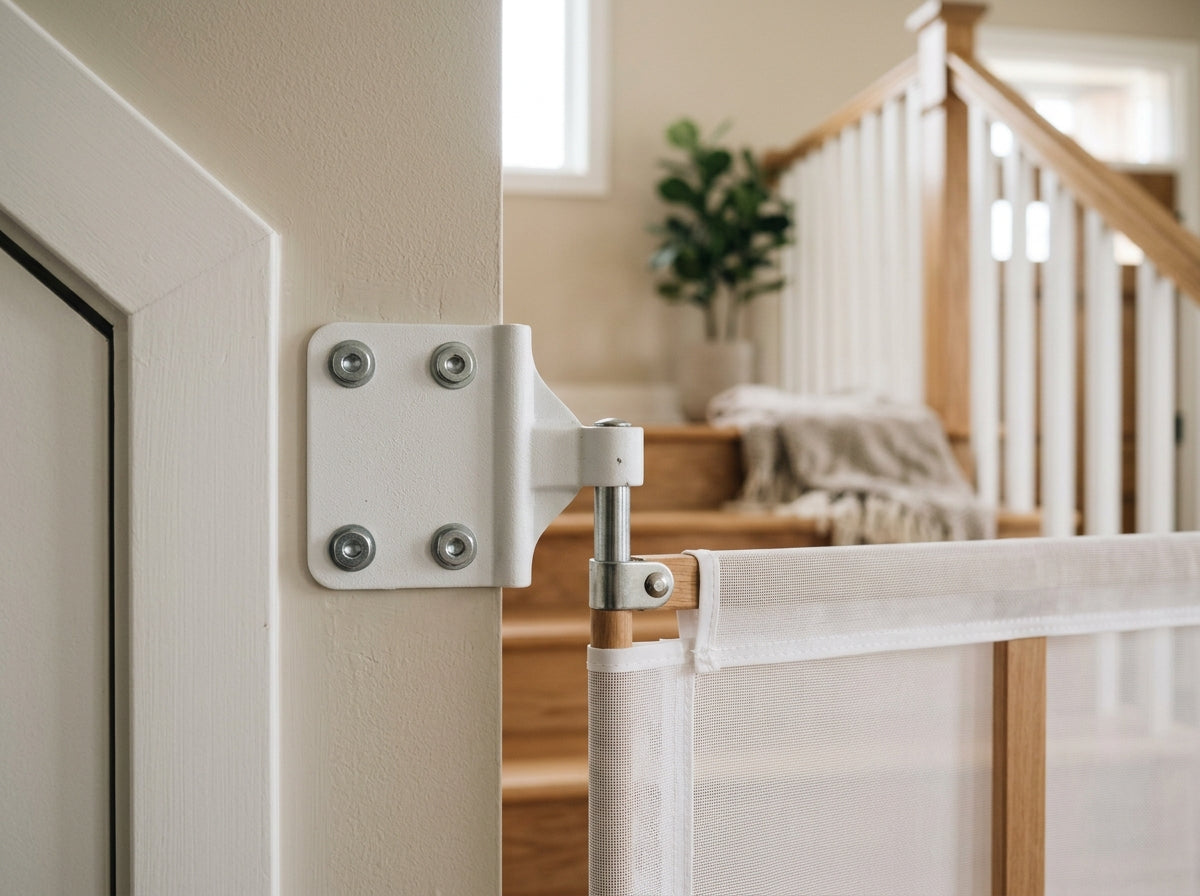
The housing bracket is the structural anchor for everything else. When the gate is extended and a child leans against it, the force transfers through the barrier, through the latch, through the receiver post, and through the housing bracket into the wall. If the bracket isn’t properly anchored, none of the gate’s other engineering matters.
Hardware mounting into wall studs is the correct installation for any gate at the top of stairs. Studs are typically spaced 16 inches apart, and most gate brackets are designed to hit at least one stud on each side of the opening. If your doorframe doesn’t align with studs, use the manufacturer’s provided wall anchors rated for the gate’s load requirements, and verify the anchor rating against the gate’s specified test force.
Pressure-mounted retractable gates exist, and they use friction pads and angled brackets to distribute force against the doorframe without drilling. They’re convenient for bottom-of-stairs installations or room dividers where a fall risk is lower. But the friction system is inherently less stable than hardware mounting, and I wouldn’t use one at the top of stairs. The retraction mechanism generates real force on the housing every time the gate snaps back, and that cumulative load on a pressure-mounted bracket adds up.
My younger daughter once emptied the entire under-sink cabinet in the time it took me to answer the doorbell. That was a magnetic cabinet lock failure, not a gate. But the lesson was the same: the mounting matters as much as the lock.
Motorized vs. Manual: A Practical Comparison
Some retractable gates use a motorized spool rather than a pure torsion spring. The motor assists retraction, making the gate easier to operate one-handed (useful when you’re carrying a child) and more consistent in retraction speed.
The trade-offs are real. A motorized gate requires power, either batteries or a charging cable. Batteries die. Charging cables get unplugged. A gate that requires power to retract properly is a gate that can fail in a way a mechanical spring never will. If you choose a motorized model, build battery checks into your monthly safety walkthrough.
Manual spring-loaded gates require more physical effort to extend, particularly on wider openings where the torsion spring is under greater load. But they have no electrical components to fail and no power dependency. For most households, a well-damped manual gate is the more reliable long-term choice.
Spring Fatigue and Long-Term Maintenance
The torsion spring doesn’t last forever. With daily use, the metal fatigues and the stored tension decreases. A weakened spring means two things: the gate retracts more slowly (or not fully), and the latch may not seat with the same positive engagement it had when the gate was new.
Test your gate’s latch resistance every month. With the gate fully extended and latched, push against the barrier with steady horizontal force. It should not flex significantly or disengage. If the latch releases under moderate pressure, the spring tension or the latch mechanism has degraded.
Also inspect the spool housing for visible wear. Look for fraying at the point where the barrier material exits the housing, cracks in the plastic casing, and any play in the housing bracket. A gate that wobbles at the wall mount needs to be re-anchored or replaced before it’s used again.
ASTM F1004 certification means the gate passed these tests when new. It doesn’t mean the gate will pass them indefinitely. Wear is real, and a gate that’s been in daily use for two or three years deserves a thorough inspection.
Monthly Gate Inspection Checklist
What Third-Party Certification Tells You
A gate that carries ASTM F1004 certification has been tested by an independent laboratory for latch strength, entrapment gaps, barrier integrity, and durability under repeated use cycles. The certification mark on the packaging is the manufacturer’s claim that an outside party verified those results.
Certification has limits. Certification testing happens on new products under controlled conditions. It doesn’t account for improper installation, wear over time, or use outside the product’s rated opening width. A certified gate installed incorrectly is still an incorrectly installed gate.
Read the installation instructions fully before mounting. Verify the gate’s rated width against your actual opening. Confirm the mounting hardware is appropriate for your wall type. And register the product with the manufacturer so you receive recall notices. The CPSC issues recalls on baby gates when field failures reveal a safety problem that lab testing didn’t catch, and you want to know about those.
The Bottom Line on Mechanism Quality
A retractable gate is a mechanical system with several interdependent components: the torsion spring, the spool, the damper, the latch, and the mounting bracket. Each one can fail independently, and a failure in any one of them can compromise the whole system.
Buy a gate certified to ASTM F1004 by a recognized third-party lab. Mount it in hardware to studs or rated anchors. Test the latch monthly. Inspect the spool and bracket annually, or sooner if the gate sees heavy use. Replace the gate if the spring tension has noticeably weakened or if the latch no longer engages with firm, positive resistance. A gate that almost works is not a gate that works.