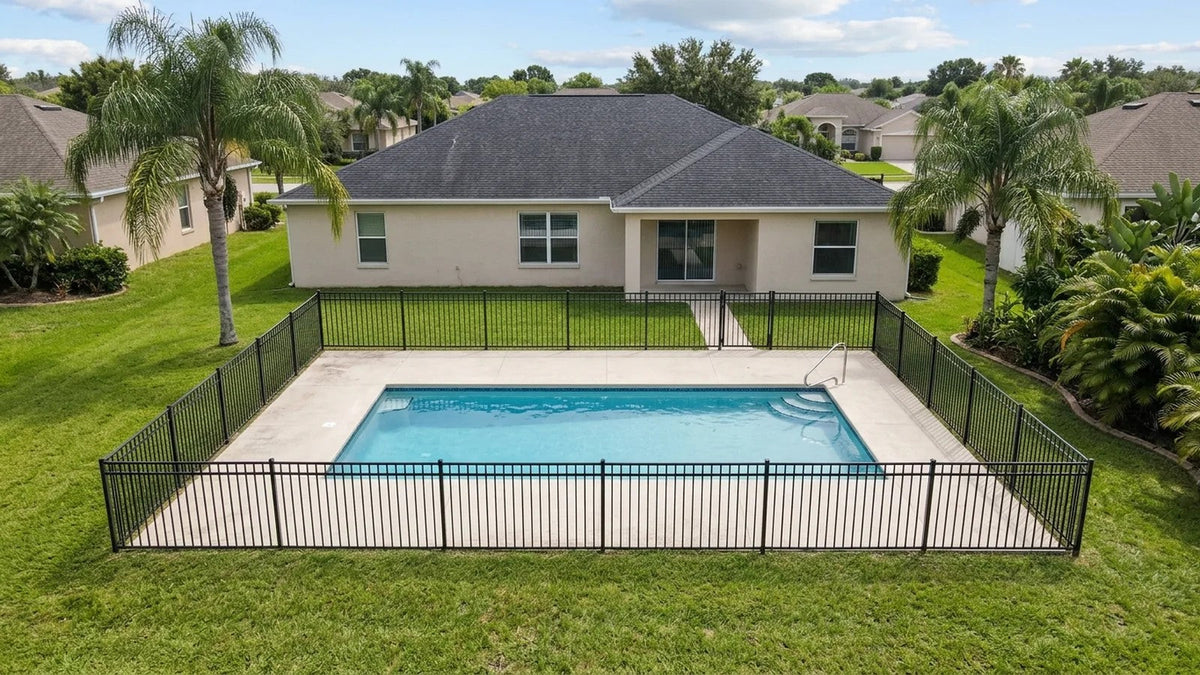

Florida Pool Fence and Barrier Requirements for Homes With Young Children
What Florida’s Residential Swimming Pool Safety Act requires for fences, gates and other pool safety features, and where CPSC and AAP advice goes further.

Florida pool fence requirements start with a choice. A new residential pool must have at least one of five listed safety features under s. 515.27(1), and a fence is only one of them. If you choose the fence option, the barrier must be at least 4 feet high on the outside and leave no gaps a young child could crawl under, squeeze through or climb over. Any gate to the pool must open outward and be self-closing and self-latching (s. 515.29).
This page reflects chapter 515 of the Florida Statutes as read in October 2026, and it is reviewed once a year. Local rules may be stricter than the state Act. Nothing here is legal advice, so confirm the current text with the Florida Statutes or a local official.
Florida Pool Fence Requirements at a Glance
The table puts each Florida rule next to the section that states it and the federal or pediatric guidance that goes further. The right-hand column is guidance. It is not Florida law.
Florida rules next to CPSC and AAP guidance
| Requirement | Florida statute section | CPSC or AAP guidance |
|---|---|---|
| New residential pool feature | s. 515.27(1) | AAP: layers work together |
| Height, 4 feet on the outside | s. 515.29(1)(a) | CPSC: 5 feet preferable |
| Openings and gaps | s. 515.29(1)(b) | CPSC: 4-inch sphere limit |
| Space under barrier | s. 515.29(1)(b) | CPSC: 4 inches maximum |
| Sides enclosed | s. 515.29(1)(c) and (4) | CPSC, AAP: fence all 4 sides |
| Gate | s. 515.29(3) | AAP: latch 54 inches up |
What the Act Requires for a New Residential Pool
The Florida Residential Swimming Pool Safety Act is chapter 515. In its findings, the Legislature states that "constant adult supervision is the key" to reducing submersion incidents. It then calls for all new residential swimming pools, spas and hot tubs to have at least one pool safety feature.
The Act defines a young child as anyone under the age of 6 (s. 515.25(12)). To pass final inspection and receive a certificate of completion, a new residential pool must meet at least one of these five options under s. 515.27(1):
- An enclosure that isolates the pool from access to the home and meets the barrier rules in s. 515.29.
- An approved safety pool cover.
- Exit alarms on all doors and windows that give direct access from the home to the pool.
- Self-closing, self-latching devices on all doors that give direct access to the pool, with the release mechanism no lower than 54 inches above the floor.
- A pool alarm that sounds when it detects an accidental or unauthorized entrance into the water.
The first option is the fence. The other four are real alternatives under the statute, and families weighing a cover or an alarm instead of a fence will want to read up on pool alarms and safety covers before deciding.
Florida Pool Fence Law: Barrier, Gate and House-Wall Rules
The statute defines a barrier as a fence, dwelling wall or nondwelling wall, or any combination, that completely surrounds the swimming pool and obstructs access to it (s. 515.25(2)). Section 515.29 then sets the details.
The barrier must be at least 4 feet high on the outside (s. 515.29(1)(a)). It may not have any gaps, openings, indentations, protrusions or structural components that could let a young child crawl under, squeeze through or climb over (s. 515.29(1)(b)).
It must run around the perimeter of the pool. It must also be separate from the yard fence, unless the yard fence sits on the pool’s perimeter and meets the same rules (s. 515.29(1)(c)). And it must stand far enough from the water’s edge that a young child who gets past it cannot immediately fall in (s. 515.29(1)(d)).
Picture this: you walk the fence line and find the pool equipment sitting right against the outside of the fence. Section 515.29(5) says a barrier may not be located where a permanent structure, equipment or similar object can be used to climb it. A fence that meets the height rule can still fail if something beside it works as a step.
Gates get their own rule. A gate that gives access to the pool must open outward, away from the pool, and must be self-closing with a self-latching locking device. The release mechanism must be on the pool side and placed so a young child cannot reach it over the top or through any opening or gap (s. 515.29(3)).
The house can serve as part of the barrier too. A wall of the house counts only if it has no door or window that opens to give access to the pool (s. 515.29(4)). A back door that opens onto the pool deck means that wall cannot be your fourth side.


Above-Ground Pools, Ladders and Steps
An above-ground pool does not escape the barrier rules. Under s. 515.29(2), the pool’s own structure can serve as its barrier, or a barrier can be mounted on top of the structure. Either one must meet all the barrier rules in that section.
Ladders and steps are the weak point. Any ladder or steps used to get into an above-ground pool must be capable of being secured, locked or removed to prevent access, or must be surrounded by a barrier that meets the same rules (s. 515.29(2)). A removable ladder only helps if it is removed when the pool is not in use.
Exemptions for Public Pools and Kiddie Pools
Section 515.37 says the Act does not apply to public swimming pools. It also does not apply to small, temporary pools without motors, commonly known as kiddie pools.
That exemption is about the statute, not about risk. A kiddie pool is still one of the water hazards in the home that calls for close, constant supervision, and the same is true of bathtubs and buckets. The AAP says a child can drown in very little water, so a pool being exempt from the Act says nothing about whether it needs watching.
Local Ordinances and the Penalty Provision
The Act also contains a local-law clause. Under s. 515.37, it does not apply to a city or county that has adopted a residential pool safety ordinance equal to or more stringent than chapter 515. A local rule may therefore be stricter than anything above.
The CPSC likewise tells pool owners to check with local authorities on what their area’s building code requires. Your city or county building department can tell you which pool fence requirements apply at your address.
Under s. 515.27(2), a person who fails to equip a new residential swimming pool with at least one of the listed safety features commits a second-degree misdemeanor. The same subsection says no penalty is imposed if, within 45 days of the arrest, summons or notice to appear, the person equips the pool with a listed feature and attends a drowning prevention education program.
CPSC and AAP Guidance That Goes Beyond the Statute
Everything in this section is guidance, not Florida law. The CPSC’s Safety Barrier Guidelines for Residential Pools say they are not a CPSC standard and not mandatory requirements. They still describe a stricter fence than the statute’s wording.
The guidelines call for the top of the barrier to be at least 48 inches above grade. They call for vertical slats no more than 1¾ inches apart when horizontal rails are less than 45 inches apart. The guidelines also say 5 feet or higher is preferable to the 4-foot minimum. They add that openings should be small enough that a 4-inch sphere cannot pass through.
The gap under the fence gets a number here. The clearance at the bottom of a barrier should not exceed 4 inches above the surface, measured on the outside. Industry recommends no more than 2 inches when the bottom rests on grass or gravel.
On layout, the CPSC says a barrier that completely surrounds the pool is better than a three-sided fence with the house as the fourth side. The AAP agrees. It recommends a pool be completely surrounded by a fence on all 4 sides, at least 4 feet high.
When the release mechanism of the gate’s self-latching device is less than 54 inches from the bottom of the gate, the CPSC says it should be at least 3 inches below the top of the gate on the pool side. The gate and barrier should have no opening greater than half an inch within 18 inches of the release.
The CPSC calls a gate that fails to close and latch completely "the weak link in the strongest and highest fence." Picture this: you hurry through the gate with a pool float under one arm, and it swings shut but never clicks. The CPSC says a gate must be in proper working order to close completely every time.
The AAP’s version of this advice includes a self-closing, self-latching gate that opens away from the pool, with a latch at least 54 inches from the ground. It also stresses that barriers work together with supervision, water safety skills and life jackets, which is where swim lessons and pool supervision fit alongside the fence.
A Fence Is One Layer, Not the Whole Plan
The CDC reports that more children ages 1–4 die from drowning than any other cause of death. Chapter 515 opens with a similar finding about young children in Florida (s. 515.23).
A fence adds time and distance when attention lapses. It does not replace attention. The CPSC says barriers can never replace adult supervision, and the AAP calls for close, constant, attentive and competent supervision around water.
Read the pieces as a stack. The statute sets the floor for a new residential pool. Federal and pediatric guidance raises the fence, closes the gap underneath and puts the latch out of reach. Supervision, water safety skills and life jackets cover what a barrier cannot. The same layered thinking runs through any evidence-based guide to home safety, from the pool deck to the rest of the house.
Before you rely on any of it, read the current text of chapter 515 on the Florida Legislature’s website and call your local building department to ask whether a stricter ordinance applies to your pool.