
How to Baby Proof a Window Air Conditioner
The gap beside the unit, the furniture under it and the blind cord: CPSC’s window rules for a room with a window air conditioner.

A window air conditioner is not a window guard or a window stop. To baby proof a window air conditioner, treat the window the way CPSC tells you to treat any window in a home with young children. Use window stops or guards, keep openings to 4 inches or less, and keep anything a child could climb away from the glass.
A unit in the window makes the window feel handled. It isn’t.
Why a Window With an AC Unit Still Carries a Fall Risk
CPSC reports that about 3,300 children age 5 and younger are treated in U.S. emergency rooms each year for window fall injuries. That is the pattern to keep in mind, whatever is sitting in the frame.
CPSC’s same release describes how these falls happen. Children push themselves against window screens, or they climb onto furniture located next to an open window. Neither of those situations goes away because an air conditioner is in the opening. A toddler can still lean on the screen beside the unit or climb up to look out.
CPSC does not address air conditioners in its window safety guidance.
Are Window AC Units Safe for Babies?
To child proof a window air conditioner, the unit itself is one question, and the opening around it is another. The installed unit has to be mounted according to the maker’s instructions. Weight, brackets and sizing belong with the manufacturer’s manual.
The fall question is about the window. CPSC says never to depend on screens to keep children from falling out of windows. Its childproofing guide says window screens are not effective for preventing falls.
CPSC names two safeguards: window guards and window stops. An air conditioner’s side panels or foam fill-ins are neither. Treat those parts the way CPSC treats screens: they are not fall protection.
That doesn’t make the unit a problem. It means the unit and its filler pieces shouldn’t be what you count on as a window AC guard when a child is near the window.


Baby Proof a Window Air Conditioner by Closing the Gaps
Start with the number. CPSC recommends that windows open no more than 4 inches, and its childproofing guide says to limit window openings to 4 inches or less.
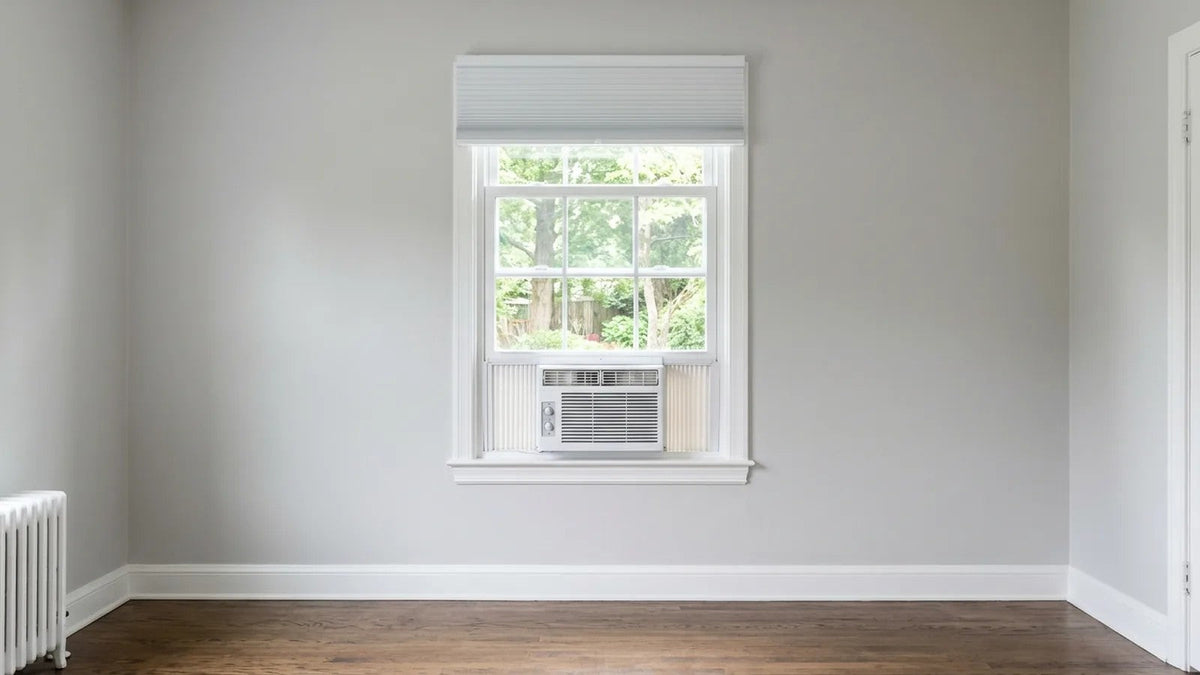
Then look at the window the way a child would. Is there open space beside the unit? Is there space above it? Any gap you can see through is an opening. Treat it like any window opening: CPSC’s 4-inch limit is the line, and a gap wider than that deserves attention.
CPSC says to install window stops so that windows open no more than 4 inches. If the window where the unit sits has a sash that can still slide open wide, a stop is the first thing to look at. For the unit itself, follow the maker’s instructions for how it is installed, and don’t improvise.
When you want to air out the room, CPSC says to open windows from the top, not the bottom, whenever possible. Apply that to the other windows in the room.
Choosing among ways to baby-proof windows depends on the window type and the rest of the room. A sash window, a casement and a sliding window each work differently, so the right device may differ from one window to the next.
Furniture and Climbing Near the Unit
CPSC says to keep furniture away from windows to discourage children from climbing near windows. That applies to the window where your unit sits. Keep a chair, toy box, crib or step stool from standing under or beside it.
Picture this: you have just set up a window air conditioner in the bedroom, and a toddler who has learned to climb is in the room. You can’t assume the unit changes how they see the window. The useful check is to stand where the child stands and ask three questions. What can be stepped on? What can be pushed against? What can be reached?
A dresser next to the window, a laundry basket, a beanbag, a pile of pillows: any of these can be a step. A crib next to the window deserves a second look too.
Sofas and side tables often sit under living room windows, and living room window guards are one layer to consider in that room.
Moving furniture costs nothing. It is also easy to undo by accident, so check again after you rearrange a room, clean, or bring in a new piece.
Window Guards and the Fire-Escape Question
CPSC says to install window guards to keep children from falling out of windows. Guards are the device that does the work a screen or an AC panel cannot. For windows on the 6th floor and below, CPSC says to choose guards that adults and older children can open easily in case of fire.
That fire note matters, because a guard that nobody in the home can open cannot serve as the escape route in a fire. CPSC’s childproofing guide adds that if you have window guards, at least one window in each room should be easy to use for escape in a fire.
A window filled by an air conditioner is worth counting when you check that in the room. If the unit’s window is the only one in the room, ask whether another window can serve as the escape route. If it can’t, the layout deserves a closer look.
CPSC’s guidance also covers the space between guard bars: it should be 4 inches or less. Reading about window guards and limiters will help you compare the types. They differ in how they open and how easily an adult can use them.
The Blind Cord at the Same Window
Windows often have blinds or shades beside them. Cords there are a separate risk from falls, and they are easy to overlook.
CPSC’s childproofing guide asks for cordless window coverings in homes with young children. It also says dangling pull cords should be made as short as possible. About 9 children under age 5 die each year from window-covering cord strangulation, per CPSC GoCordless data.
CPSC also reports that nearly half of more than 200 corded-window-covering incidents involving children up to age 8 (2009–2021) resulted in a death. Since December 2022, a federal CPSC rule has required stock (ready-made) window coverings to be cordless or to have short or inaccessible operating cords (16 CFR 1120.3(e)). Older blinds in your home may pre-date that rule.
So check the cord at the window where the unit sits. Look for loops, long pull cords, and any cord that hangs within a child’s reach. Cordless coverings are the option CPSC points to. If you keep corded ones, shorten what dangles.
Cord checks belong on the same list as window stops and furniture placement. They are part of the child-safe home basics that every room needs, and the unit’s window is no exception.
Check Your Devices and Keep Watching
CPSC’s childproofing guide says to check safety devices frequently to make sure they are secure, properly installed and maintained. Window stops loosen. Guards can be bumped. Furniture can end up back near the window.
A simple routine helps. Look at the window, the gap, the stop or guard, the furniture and the cord each time you clean the room or change the season. Each step adds a layer, and none of them replaces watching your child.
For the sash itself, window locks for child safety are the next thing to read about.