
How to Childproof a Hot Tub: Cover Locks, Straps and Rules for Little Kids
Lock the cover every time, add a fence and a door alarm, stay within arm’s reach, and see what the AAP says about little kids in hot tubs.

More children ages 1–4 die from drowning than from any other cause of death, the CDC reports. If you want to child proof a hot tub, start with the AAP’s point that the biggest drowning threat for families with toddlers is unexpected, unsupervised access to water. The AAP names hot tubs and spas in that list alongside swimming pools and bathtubs, so the tub belongs in the same plan as a pool.
The AAP also says a child can drown in as little as an inch or two of water, and that it can happen quickly and silently. A tub full of water is far deeper than that. A toddler who slips in will not necessarily splash or call out.
Can a Baby Go in a Hot Tub? What the AAP Says About Age
No. HealthyChildren.org, the AAP’s parenting site, says children less than 3 years old should not use hot tubs. Its reasons are poor heat tolerance and an increased risk of rapid onset of high body temperature. It adds that babies are less able to sweat when hot.
That age line shapes hot tub safety for toddlers in a practical way. A child under 3 should not be in the tub, so the job is keeping that child from reaching the water at all. To baby proof a hot tub, think of it as an access problem first.
If you have a question about heat and your child, call your pediatrician. The AAP’s HealthyChildren.org page on heat exposure is the place to read more.
How to Child Proof a Hot Tub With a Safety Cover
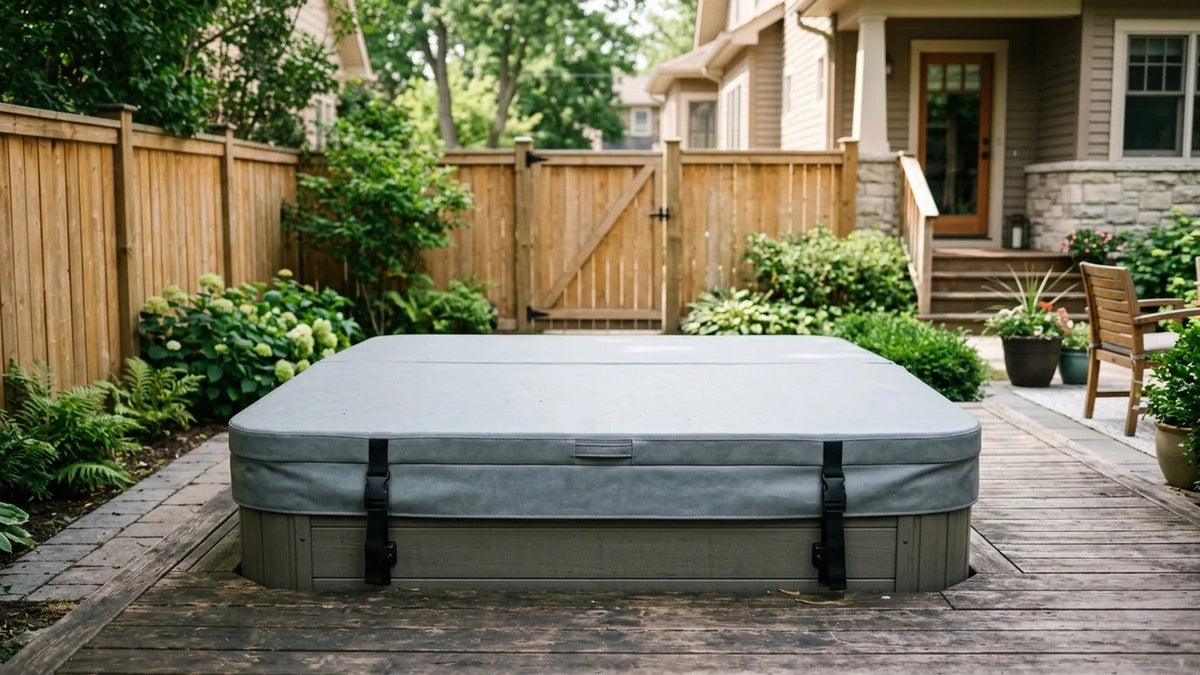
The AAP’s hot tub advice is short and direct: always cover and lock hot tubs, spas and whirlpools right after using them. That sentence only works if the cover is built to be a barrier.
ASTM F1346 is the standard performance specification for safety covers for swimming pools, spas and hot tubs, and it sets labeling requirements for all covers. Under it, a safety cover is intended to reduce the risk of drowning by inhibiting access to the water by children under 5. That applies when the cover is correctly installed and used according to the manufacturer’s instructions. It describes an intent under specific conditions, not a guarantee.
The standard separates safety covers from covers in general. So a cover is not automatically a safety cover. Check the label and the manual, or ask the tub’s maker, whether yours is sold as one.
If your yard has a pool as well, pool alarms and safety covers follow the same layered logic, and it helps to treat both bodies of water as one plan.


Hot Tub Cover Lock, Latches and Straps: Use Them Every Time
A lock is a layer only if it is used every time. Make "cover on, lock on" the last step of every soak, before anyone heads inside for towels.
Picture this: a guest finishes a late soak, pulls the cover over, and leaves. The latches stay open. The next morning, a toddler who has learned to open the back door finds a cover that anyone could slide aside.
You can close that gap with habit. Tell every adult who uses the tub that locking is part of using it. Then check the lock yourself before bed.
The manufacturer’s instructions are the guide for any lock, latch or strap. Here is a short routine:
- Read the manual for both your tub and your cover.
- Check that every lock or strap the maker supplies is fitted and engages.
- Ask the maker about any part that is missing, loose or worn.
- Keep the cover itself in working order. CPSC’s Pool Safely steps list this for pool and spa covers.
Which lock or strap fits your tub is a question for the tub’s maker.
The same habit of removing easy access runs through drowning prevention at home, from bathtubs to buckets.
Layers Around the Tub: Fence, Gate and Door Alarm
A locked cover is one layer. CPSC’s Pool Safely steps list a fence around the perimeter of the pool and spa at least four feet high. They also list self-closing and self-latching gates, and a door alarm from the house to the pool area.
For homes with a pool, the AAP calls a 4-sided fence that completely surrounds the pool and isolates it from the house the most important safety measure. That statement is about pools. It still shows the goal for a tub area: put a barrier and a latch between a toddler and the water.
Picture this: you are folding laundry, and your two-year-old slips out the back door while you are in another room. A door alarm gives you a warning. A fence with a latched gate gives you more time.
The AAP’s Sarah Denny, MD, says many toddler drowning deaths happen when children have unanticipated access to water. That is why she says other strategies, such as pool fencing and door locks, are needed. The AAP recommends multiple layers of water safety protection because no single method protects against every drowning. It says barriers can help during non-swim times and during the "inevitable, brief lapses in supervision." Linda Quan, MD, puts it plainly: "we need multiple layers."
For a hot tub, those layers are:
- A lockable cover that is locked after every use
- A fence or locked gate around the tub area
- Door locks or door alarms between the house and the yard, both named by the AAP
- An adult who is watching
If your yard has a pool too, pool fences, alarms and covers work together with the tub’s cover as one system.
Touch Supervision Within Arm’s Length
The AAP recommends that when infants or toddlers are in or around the water, a supervising adult with swimming skills stays within arm’s length. The AAP calls this constant "touch supervision." The adult focuses on the child and is not engaged in other distracting activities.
Remember that HealthyChildren.org, the AAP’s parenting site, says children under 3 should not use hot tubs at all. This guidance still applies when a toddler is on the deck beside the tub while you take the cover off or put it back.
A locked cover does not replace the adult. Barriers cover the lapses, which the AAP calls inevitable and brief. The adult covers everything else.
Phone calls, texts and conversations pull your eyes away. If you need to step away, take the child with you or hand the job to another adult who knows they are on duty. The same standard applies to pool safety for toddlers.
Hot Tub Drains and Suction Outlets
Drains are a separate hazard from open water. CPSC says children should not play or swim near drains or suction outlets, especially in spas and shallow pools.
CPSC lists how entrapment happens:
- Hair can get caught in a faulty drain cover.
- Arms, legs and fingers can become lodged in a suction opening.
- Any body part that can cover a drain can be held down by suction.
CPSC says never to enter a pool or spa that has a loose, broken or missing drain cover. It says such a pool or spa should be closed until a licensed professional makes repairs. For your own tub, that means no soaking until the drain cover is fixed.
The federal Virginia Graeme Baker Pool and Spa Safety Act requires drain covers that meet the safety standard the Act names on every drain of operating public pools and spas. That rule has applied since December 19, 2008. It is a public pool and spa rule, not a rule for home tubs.
CPSC’s advice for families is to make sure all pools and spas your family uses have compliant drain covers. When you visit a hotel, gym or community spa, ask the operator whether its drains comply with the Act.
Rules for Older Kids and Where to Turn
Older children can soak, with limits. HealthyChildren.org, the AAP’s parenting site, gives these rules:
- Limit hot tub use to 15 minutes.
- Use a buddy system in case a heat reaction suddenly occurs.
- Skip the hot tub if the child has a fever.
- Skip it right after hard work or sports, because the body needs to get rid of heat.
Post these where kids will see them, near the cover or the back door. Rules that sit in your head only work when you are the one standing there.
For a child in trouble in the water, or any life-threatening emergency, call 911. For a question about heat, call your pediatrician. To read more about heat exposure, use the AAP’s HealthyChildren.org page.
Your Layers at a Glance
Home safety basics for babies rest on the same idea as this list: several layers, none of which replaces watching. For a hot tub, put these in place:
- A cover sold as a safety cover, locked after every soak using the maker’s own latches or straps
- A fence at least four feet high around the tub area, with a self-closing and self-latching gate
- Door locks or a door alarm between the house and the yard
- Touch supervision within arm’s length whenever a young child is near the water
- Drain covers that are intact on every tub and spa your family uses
- No hot tub use for children under 3, per HealthyChildren.org, the AAP’s parenting site