
Pack and Play Safety: The Mattress, Sheets and Sleeping in One Every Night
What the AAP and CPSC say about a play yard as a sleep space: the maker’s mattress, a fitted sheet only, nothing extra inside, on the back.

Use the mattress that came with the play yard. Put a fitted sheet on it and nothing else. That short answer sits at the center of pack and play safety, and it comes straight from CPSC and AAP guidance. A play yard looks simple, which is why the small mistakes slip in.
Pack and Play Safety Starts With the Standard
The AAP says to place your baby in a crib, bassinet, portable crib or play yard that meets the safety standards of the Consumer Product Safety Commission (CPSC). It also says a product that does not meet federal safety standards should not be used. That is the first check, before any sheet or mattress question.
The AAP’s checklist for cribs adds that you should not use a crib that does not have instructions, is missing hardware or is broken. That wording is written about cribs. A play yard with lost parts or no manual deserves the same check. Look for the instructions, all the hardware and anything broken before a baby sleeps in it.
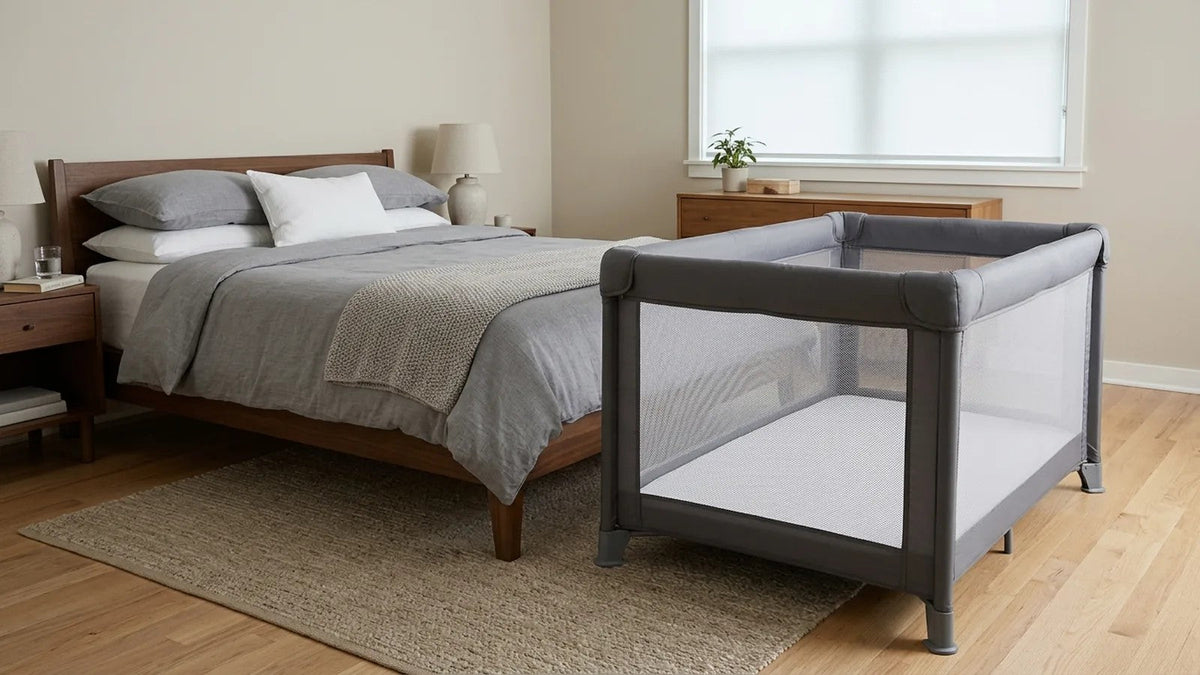
CPSC describes a play yard as a framed enclosure with a floor and mesh or fabric sides that provides sleeping and playing accommodation for a child who cannot climb out and is less than 35 in. (890 mm) in height. You may know the same product as a Pack and Play, a playpen or a portable crib. CPSC also says inflatable play yards are not covered by its play yard regulation.
Because a play yard serves for both sleep and play, the sleep rules on this page are separate from daytime use. How much time in a playpen is reasonable during the day is its own question.
Is a Pack and Play Mattress Safe for Newborn Sleep? Only the Supplied One
CPSC says a play yard’s instructions should specify that only the mattress supplied with the play yard be used. The reason is head entrapment and suffocation between the mattress, the sides and the floor structure. CPSC also says the instructions should stress securing the mattress to the play yard floor.
That wording is about the play yard itself, so it applies on the first night with a newborn as much as on any later night.
Picture this: the play yard floor looks thin to you, and a folded pad is sitting in the closet. CPSC staff advises consumers of play yards not to use supplemental mattresses, because supplemental mattresses may create a gap and lead to an entrapment hazard. The AAP lists mattress toppers and non-fitted sheets among the soft objects and loose bedding to keep out of a baby’s sleep area. An extra layer is a gap risk and a loose-bedding item, not an upgrade.
A mattress sold on its own is not a shortcut either. The AAP says mattresses sold separately from cribs, bassinets and play yards are usually not tight enough to keep infants from suffocating or getting trapped. CPSC’s crib mattress guidance for manufacturers says an after-market play yard mattress shall be tested with each brand and model of product it is intended for. It also says generic compatibility based on a size measurement cannot meet these requirements.
That is a rule for makers. For a parent, the instruction stays the one from CPSC: the mattress supplied with the play yard, secured to the floor.


The Fitted Sheet and a Bare Sleep Space
The AAP says to use a fitted sheet only, with nothing else in the crib with your baby. It also says the mattress should be designed for your specific crib and fit tightly. In a play yard, the sheet goes on the maker’s mattress. Nothing is layered under it or over it.
The AAP says there should be no blankets, pillows, stuffed toys or bumper pads in your baby’s bed. Its reason is that soft objects and loose bedding can increase the risk of entrapment, suffocation or strangulation. The AAP also says not to use weighted blankets, sleepers, swaddles or other weighted objects on or near your baby.
A play yard follows the same bare-space rule as the rest of a safe nursery setup for sleep. That holds every night, including nights away from home when the play yard stands in for the usual bed.
The surface matters too. The AAP says a firm surface should not indent when your baby is lying on it, and that any surface inclining more than ten degrees is not safe for sleep. On its registry-items page, the AAP says a portable play yard is acceptable when fitted with a flat, firm mattress.
Here is the night setup in one view:
Play Yard Night Setup
| Item | At night | Source |
|---|---|---|
| Supplied mattress, secured to floor | In | CPSC |
| Fitted sheet only | In | AAP |
| Baby on their back | In | AAP |
| Supplemental mattress | Out | CPSC staff |
| Topper or non-fitted sheet | Out | AAP |
| Blankets, pillows, toys, bumpers | Out | AAP |
| Weighted blankets and objects | Out | AAP |
Back to Sleep for Every Nap and Every Night
The AAP says to place your baby on their back for all naps and at night. It says babies who sleep on their backs are much less likely to die suddenly and unexpectedly. A play yard gets the same rule as a crib or bassinet.
That includes the short afternoon nap. The AAP safe sleep guidelines name naps alongside nighttime, so a quick rest in the play yard gets the same setup as bedtime.
Habits like these lower risk. They do not replace a parent’s attention.
Where the Play Yard Goes at Night
The AAP says to share a room with your baby for at least the first 6 months of life. It advises room sharing without bed sharing because it can decrease the risk of SIDS by as much as 50%. A play yard is one of the sleep spaces the AAP lists, so the point is its place in your room, not a different set of rules.
Anyone setting up a safe nursery can treat the play yard as one sleep space within the plan. It can live in your room at night and move elsewhere only if the sleep rules travel with it.
Picture this: you are staying at a relative’s house, and the only open floor is in a spare room down the hall. The AAP’s room-sharing advice points toward setting the play yard up in the room where you sleep.
Not Everything That Holds a Baby Is a Sleep Product
The AAP says not to use products for sleep that are not specifically marketed for infant sleep. On its registry-items page, the AAP says swings, rockers, bouncers and gliders are safe for play but not for sleep. Its reason is that they hold babies upright or inclined, and a sleeping baby’s head can fall forward or sideways.
Babies fall asleep in all kinds of places. The AAP says that if your baby falls asleep in a car seat, stroller, swing, infant carrier or sling, you should move them to a firm sleep surface on their back as soon as possible.
The play yard is the firm surface in that picture, as long as the mattress and sheet follow the rules above. Parents weighing it against other sleep spaces may also be choosing between a bassinet and crib.
Can Baby Sleep in Pack and Play Every Night? The AAP’s Conditions
The AAP lists a play yard that meets safety standards among the places to put a baby. Its registry-items page says a portable play yard fitted with a flat, firm mattress can be used. The conditions are the ones already covered:
- The play yard meets safety standards.
- The mattress is flat and firm.
- Your baby is on their back for all naps and at night.
- The sheet is a fitted sheet only.
- Nothing else is in the sleep space.
The AAP and CPSC pages set conditions here, not a count of nights. The answer depends on whether every condition is met on the night in question. For the maker’s own limits and assembly, use the product’s own instructions. CPSC says those instructions should cover which mattress to use and how to secure it.
Used play yards need extra care. The AAP warns that banned sleep products such as inclined sleepers and crib bumpers can still turn up in thrift, consignment and resale shops, garage sales and online marketplaces. It adds that friends and family might offer gently used or homemade versions without knowing they could be dangerous. The AAP also says to check the CPSC website to make sure your crib has not been recalled, especially if it is not new.
Picture this: a neighbor offers a play yard from a basement, with no manual and a bag of loose parts. The check from the first section comes before the first nap. That means standards, instructions, all the hardware, nothing broken, and a look at the CPSC website for recalls.
Every night’s setup is the same short list from CPSC and the AAP: the supplied mattress secured to the floor, a fitted sheet only, nothing else inside, and your baby on their back in your room. Ask your pediatrician about your own baby’s sleep setup.