Magnetic Cabinet Locks vs Adhesive Locks: Head-to-Head Comparison

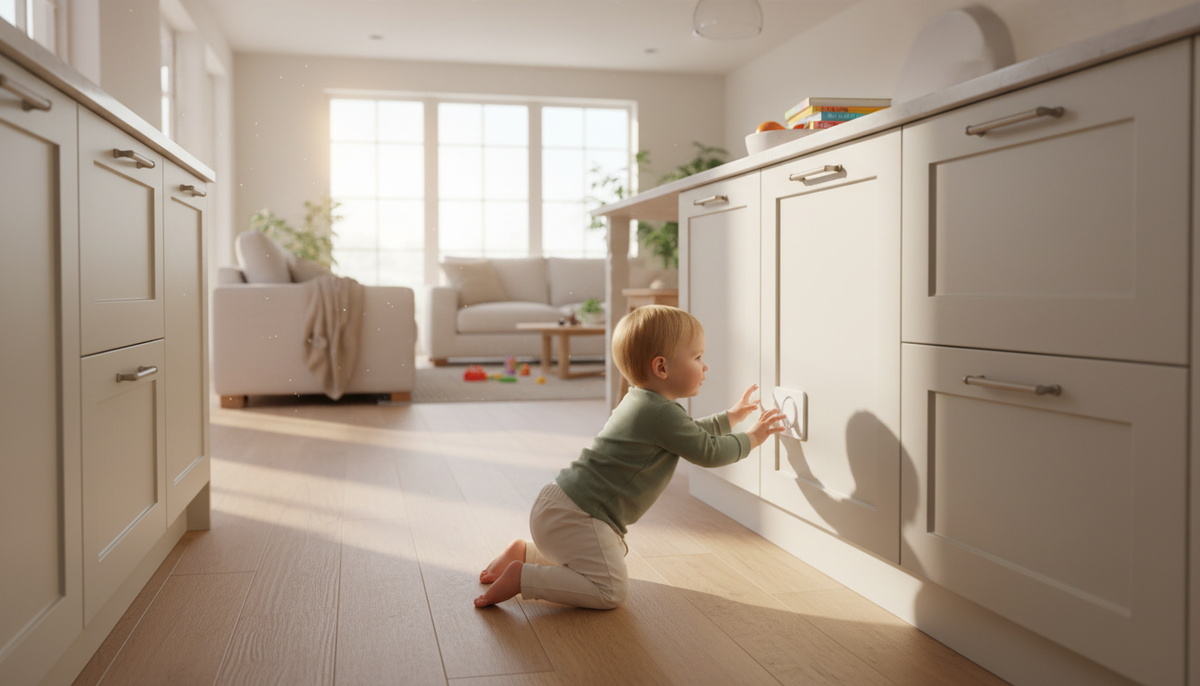
Every parent has a moment that resets their threat assessment. Mine was a Tuesday afternoon. I answered the doorbell, exchanged maybe ninety seconds of pleasantries with a neighbor, and came back to find my younger daughter sitting on the kitchen floor surrounded by everything that had been under the sink. Dish soap, a scrub brush, a bottle of drain cleaner. She was two. The cabinet had a spring-loaded latch I thought was working fine. It wasn’t.
That afternoon I started testing locks in earnest. I’ve since installed, lived with, and deliberately stress-tested both magnetic systems and adhesive locks across two homes, multiple cabinet types, and several years of active toddler use. Here’s what I found.
How Each System Works
Magnetic locks mount inside the cabinet. A plastic catch mechanism screws into the interior wall of the cabinet and holds the door or drawer closed. To open it, you press a magnetic key against the outside of the cabinet door at the right spot, which releases the catch. No visible hardware on the exterior. No key to turn, no button to push. Just a smooth cabinet face.
Adhesive locks attach directly to the outside of the cabinet. A flexible strap or rigid latch bonds to the cabinet door and the frame (or the drawer front and the cabinet body) using industrial-grade adhesive. You open it by pressing a release button or sliding a tab, then pulling the strap free. The hardware is visible. The mechanism is entirely self-contained.
These are two fundamentally different engineering approaches. One is mechanical and hidden. The other is adhesive and exposed. That difference cascades into almost every practical consideration: installation, durability, daily use, and failure modes.
Installation: Time, Tools, and Reversibility
Magnetic locks require a screwdriver and about 10–15 minutes per cabinet. You’re screwing a strike plate and catch mechanism into the interior cabinet wall, so you need enough clearance inside the cabinet to position the hardware. Once installed, the lock is reversible. Remove the screws, fill the holes if you care to, done. For renters or anyone with furniture they plan to move, this matters.
Adhesive locks are faster to open the package and slower to use. The adhesive needs 24–48 hours to cure before you stress the bond. That means you’re either leaving the cabinet unlocked during that window or taping it shut manually. The surface must be clean, dry, and smooth. And removal often damages finishes. I’ve pulled adhesive locks off painted MDF cabinets and taken the paint with them. On laminate, the residue can be stubborn.
Neither system works well on textured or curved surfaces. Adhesive locks are worse here because the bond depends on full surface contact. Magnetic locks sidestep this entirely since the exterior hardware is just your hand and a key.
Durability: Where Each System Fails
My older daughter defeated an adhesive strap lock at 26 months. She didn’t figure out the release mechanism. She just pulled, repeatedly, until the adhesive gave way. The cabinet was in our kitchen, near the stove, and the combination of steam, heat, and daily use had degraded the bond over about four months.
This is a documented failure mode, not a fluke. Heat and humidity break down adhesive bonds. Kitchen cabinets near dishwashers, stoves, or sinks are the worst environment for adhesive locks. Bathroom cabinets with steam exposure are nearly as bad. Adhesive locks in these locations need to be checked monthly and replaced when the bond softens.
Magnetic locks don’t have this problem. The mechanism is mechanical engagement, not chemical bonding. Heat and humidity don’t affect the catch. The failure modes are different: misaligned strike plates, a weakened magnet, or the key going missing. But in high-traffic, high-heat environments, magnetic locks are the more reliable choice.
ASTM F3492–21 is the voluntary U.S. consumer safety standard for cabinet and drawer locks mounted inside the door, such as magnetic locks; it does not cover locks mounted on the outside of the door, which includes most adhesive strap locks. Locks that meet this standard must withstand an average breaking force of at least 45.3 lbs across a 30-sample test. That’s the benchmark to look for on packaging. It’s a voluntary standard, not a federal mandate, so verify compliance before you buy rather than assuming it.


The Key Problem (and the Choking Risk)
Magnetic locks require a key. This is both their strength and their most serious liability.
The key is typically a palm-sized plastic disc with a magnet embedded inside. It’s small enough to be a choking hazard for infants and toddlers. You need to store it somewhere accessible to adults but out of reach of children, which in practice means you’re adding another item to the mental inventory of things that must live in a specific place. If the key gets lost, you’re either reaching into the cabinet from underneath to manually release the catch, or you’re buying a replacement key and hoping it’s compatible with your specific lock brand.
Adhesive locks have no separate key component. There’s nothing to lose, nothing to store, nothing that poses a secondary hazard. For households with infants, this is a real advantage.
The tradeoff is daily friction. Adhesive locks require a deliberate manual action every time you open the cabinet: press the release, pull the strap, hold it while you access the contents, close it. If you’re opening that cabinet twenty times a day, the cumulative annoyance is real. Magnetic locks let any adult who knows where the key lives open the cabinet in one smooth motion.
Aesthetics and Visibility
Magnetic locks are invisible from the outside. The cabinet looks exactly as it did before installation. If you have furniture you care about, or a kitchen where the cabinetry is part of the design, this matters.
Adhesive locks are visible. The strap or latch sits on the exterior of the cabinet door and frame. Some are designed to be low-profile, and the better ones are, but they’re never invisible. On painted or stained wood cabinetry, they’re noticeable.
This is a legitimate consideration, not a vanity one. Visible locks can also signal to an older child exactly where the locking mechanism is, which is relevant if you have a determined four-year-old who watches you open it every day. My older daughter knew exactly how every adhesive lock in our house worked by the time she was three and a half.
Cost Over Time
Adhesive locks cost less upfront. A pack of eight typically runs $8–$15. Magnetic lock systems start around $25–$40 for a starter kit covering two to four cabinets, with additional catches sold separately.
But adhesive locks have ongoing costs. Bonds degrade. Locks need replacement. In a kitchen with four or five cabinets, you may be replacing adhesive locks every six to twelve months in high-use areas. Over two or three years, the cost difference narrows considerably.
Magnetic lock systems have no recurring cost once installed, assuming you don’t lose the key. The hardware is durable. The only replacement scenario is a failed magnet or a lost key, both of which are infrequent.
| Feature | Magnetic Locks | Adhesive Locks |
|---|---|---|
| Installation time | 10–15 min, screwdriver | 5 min + 24–48 hr cure |
| Reversible | Yes, no damage | Often damages finish |
| Heat/humidity resistance | Strong | Poor |
| Visible hardware | None | Exterior strap/latch |
| Separate key required | Yes | No |
| Upfront cost | $25–$40 starter kit | $8–$15 per pack |
| Ongoing replacement cost | Rare | Every 6–12 months |
| ASTM F3492–21 compliance | Verify on packaging | Not covered (exterior mount) |
What’s in Those Cabinets
The choice of lock type matters less than the choice of what you store where. In 2024, household cleaning substances topped the list of substances kids under 6 got into, accounting for roughly 1 in 10 (10.1%) of all pediatric poison center cases (America’s Poison Centers). More than 99% of poison exposures in children under 6 in 2024 were unintentional, according to America’s Poison Centers. These are not children making bad decisions. They are children being children, in homes where the hazard was accessible.
A 2012 CPSC recall pulled 900,000 Safety 1st Push 'N Snap cabinet locks after reports of children as young as 9 months opening them. Three children reached toxic cleaning products. The locks failed. The cleaning products were still under the sink.
The CPSC’s guidance on cabinets containing hazardous items is consistent: cabinet locks are one layer of protection, not the only layer. Cleaning products, medications, and sharp objects belong in high, locked locations whenever possible. The lock on the under-sink cabinet is your backup, not your primary defense.
CPSC ED-treated ibuprofen injuries in children under 5 rose from 2,000 to 3,600 between 2021 and 2022, and narcotic-related ED injuries more than doubled (1,200 to 2,500). These are medications that live in bathroom cabinets and kitchen drawers in most homes. A cabinet lock on those spaces is not optional.
Which Lock for Which Cabinet
The right answer depends on the cabinet, the environment, and your household.
Use magnetic locks for:
- Cabinets containing cleaning products, medications, or sharp objects
- Kitchen and bathroom cabinets with heat or steam exposure
- Furniture in rental homes where you need reversible installation
- Any cabinet where aesthetics matter to you
Use adhesive locks for:
- Low-traffic cabinets in dry, temperate environments
- Temporary childproofing situations (visiting grandparents, short-term rentals)
- Cabinets where drilling isn’t feasible and the surface is smooth and flat
- Households where key management feels like too much overhead
Whatever you choose, test the lock on your specific cabinet before relying on it. Press the adhesive bond firmly and check it again after 48 hours. Verify the magnetic catch engages cleanly when the door closes. For magnetic and other inside-mounted locks, check the packaging for ASTM F3492–21 compliance. And then check the lock again in three months, because installation is not a one-time task.
Before You Decide
Both systems work when installed correctly on appropriate surfaces and checked regularly. Both fail when they’re the wrong tool for the environment, or when they’re installed and forgotten.
The lock you maintain is better than the lock you trust without verifying. Whatever system you choose, build a monthly check into your routine. Press on the bond. Test the catch. Confirm the key is where you left it. The AAP reports that about 3 million people are exposed to a poisonous substance every year, and many are children under 5. Most of those exposures happen in ordinary homes with parents who thought the cabinet was secure.
Check the lock. Then check what’s behind it.