
SIDS Prevention: Evidence-Based Tips to Reduce Risk

Every year, the American Academy of Pediatrics notes that around 3,500 U.S. babies die suddenly and unexpectedly while sleeping. Most of these deaths are preventable, yet the rate has remained largely unchanged. The gap between what the research supports and what happens in nurseries across the country costs lives.
Someone gifted us a beautiful crib set with a quilted bumper, a coordinating pillow, and a thick blanket when my older daughter was born. It looked like a magazine photo. I should have returned all of it. The science on what belongs in a crib is not ambiguous, and understanding it is the most important thing you can do before your baby comes home.
What SIDS Is and Why It Still Happens
Sudden infant death syndrome (SIDS) is the sudden, unexplained death of an infant under one year of age that remains unexplained after a thorough investigation. It is not the same as accidental suffocation, though both fall under the broader category the CDC calls sudden unexpected infant death, or SUID. According to the CDC, about 3,700 sudden unexpected infant deaths occurred in the United States in 2022. Of those, 41% were classified as SIDS, 31% as unknown cause, and 28% as accidental suffocation and strangulation in bed.
The distinction matters because the risk factors overlap significantly. Soft bedding, unsafe sleep surfaces, and overheating are associated with both SIDS and suffocation deaths. Addressing them reduces risk across the entire category.
Researchers believe SIDS involves a combination of a vulnerable infant, a critical developmental period, and an environmental stressor. No single cause has been identified. But the environmental factors are the ones parents can control, and the evidence for controlling them is strong.
Back Sleeping Is the Foundation
The single most effective thing you can do is place your baby on their back for every sleep, every time, from birth through the first year. The "Back to Sleep" campaign, now called "Safe to Sleep," established this as the primary evidence-based SIDS prevention strategy. Before the campaign launched in 1994, front sleeping was common. The shift to back sleeping correlated with a steep decline in SIDS rates over the following decade.
Back sleeping applies to naps and nighttime, in your home and everywhere else. It is not optional when the baby seems fussy, or when a caregiver thinks the baby sleeps better on their stomach. The AAP is clear on this.
One important note: tummy time is still essential, just not during sleep. The AAP’s 2022 safe sleep policy statement recommends supervised, awake tummy time beginning soon after hospital discharge, building to at least 15–30 minutes total daily by 7 weeks of age. This supports development and helps minimize positional plagiocephaly. The key word is awake. The moment your baby falls asleep during tummy time, move them to their back.
The Sleep Surface Matters as Much as the Position
Back sleeping on an unsafe surface is still dangerous. Your baby needs a firm, flat surface in a crib, bassinet, or play yard that meets current CPSC safety standards. Soft surfaces, including couches, armchairs, adult mattresses, and car seats used outside the car, significantly increase risk. A baby placed on a soft surface can sink into it, and an infant does not yet have the motor control to reposition their airway.
The Safe Sleep for Babies Act (2022) bans padded crib bumpers and infant inclined sleep products with a sleep surface angle greater than 10 degrees. If you have an older inclined sleeper or a padded bumper set, stop using it. These products were associated with infant deaths before the ban, and the ban exists for that reason.
A safe sleep surface should feel firm to an adult. If it compresses noticeably under your hand, it is too soft for an infant.


A Bare Crib Is a Safe Crib
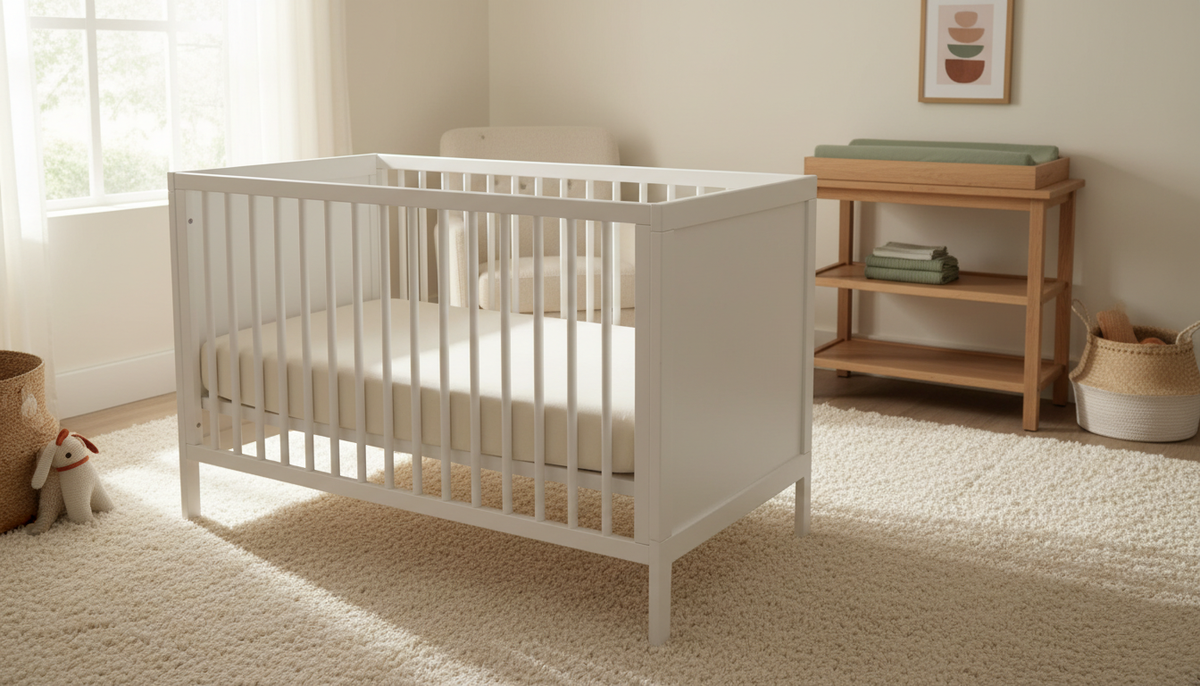
Remove everything from the sleep space except a fitted sheet that fits snugly on the mattress. No pillows. No blankets. No stuffed animals. No bumper pads, padded or mesh. No positioners or wedges. The AAP does not recommend any of these items for infants under 12 months.
An infant’s airway is small, their neck muscles are weak, and they cannot reliably move their head away from an obstruction. Soft objects in the sleep space can block breathing or trap heat, both of which are associated with SIDS risk.
For warmth, use a wearable blanket or sleep sack sized appropriately for your baby. These keep the baby warm without creating loose fabric near the face.
Room Sharing Without Bed Sharing
The AAP advises room sharing without bed sharing because it can decrease the risk of SIDS by as much as 50%. The recommendation is to keep your baby’s separate sleep surface in your room for at least the first six months, and ideally through the first year.
Room sharing works because proximity allows you to respond quickly to your baby’s sounds and movements, and some research suggests that parental breathing and movement may help regulate an infant’s arousal. Bed sharing is different. Sharing a sleep surface with an adult introduces soft bedding, gaps, and the risk of overlay, all of which increase rather than decrease risk.
A bedside bassinet allows parents to respond quickly to their baby during night feeds without bed sharing.
Temperature, Overheating, and Air Circulation
Overheating is a recognized SIDS risk factor. Keep your baby’s room at a temperature that feels comfortable to a lightly dressed adult, generally somewhere in the range of 68–72°F (20–22°C), though the goal is comfort, not a specific number. Dress your baby in no more than one layer more than you would wear yourself in the same room.
Signs of overheating include sweating, a hot chest, flushed skin, and rapid breathing. If your baby feels hot to the touch on the chest or back, they are likely too warm.
A fan is fine for comfort, but the AAP says there is not enough evidence to recommend one as a way to lower SIDS risk. The steps that do lower risk are the ones above: back to sleep, a bare, flat surface and avoiding overheating.
Pacifiers, Breastfeeding, and Vaccination
The AAP recommends offering a pacifier at nap time and bedtime. Research links pacifier use during sleep with reduced SIDS risk, though the mechanism is not fully understood. One theory is that pacifier use promotes a lighter sleep state that makes it easier for infants to arouse. If you are breastfeeding, wait until feeding is well established, typically around one month, before introducing a pacifier. If the pacifier falls out after your baby is asleep, you do not need to replace it.
Breastfeeding is associated with lower SIDS rates. The protective effect appears to be dose-related: exclusive breastfeeding offers more protection than partial, and longer duration is associated with greater benefit. The immune factors in breast milk and the more frequent arousals associated with breastfeeding are both thought to contribute. If breastfeeding is not possible or sustainable for your family, that does not mean your baby is unprotected. The other safe sleep practices remain fully in effect and effective.
Vaccination also matters. Immunized infants have a lower SIDS risk. The mechanism is thought to involve a stronger immune response and reduced vulnerability to infection-related triggers. Keeping your baby on the recommended vaccination schedule is part of a complete SIDS prevention approach.
Safe Sleep Setup Checklist
Smoke, Alcohol, and Drug Exposure
Prenatal and postnatal exposure to cigarette smoke, alcohol, and illicit drugs all increase SIDS risk. The relationship between smoke exposure and SIDS is particularly well-documented. Secondhand smoke in the home during the first year is harmful. If anyone in your household smokes, keeping smoke entirely out of the home and car is essential, not just smoking in a different room.
Alcohol and sedating drugs, including some prescription medications, impair the arousal response. This is one reason bed sharing is especially dangerous when a parent has consumed alcohol or taken sedating medication. The impaired adult is less likely to respond to the infant’s movements or sounds.
Products That Do Not Help
The market for infant sleep products is enormous, and a lot of it is not regulated the way parents assume. Home cardiorespiratory monitors, marketed as devices that detect when a baby stops breathing, have not been shown to reduce SIDS risk. The AAP does not recommend them for healthy infants. They can create false security and may distract from the practices that work.
Wedges, positioners, and devices marketed to keep babies on their backs or sides during sleep are also not recommended. Many have been associated with deaths. The Safe Sleep for Babies Act addressed some of these, but products continue to appear in new forms with new marketing claims. If a product promises to prevent SIDS, that claim is not supported by evidence. Stick to a firm, flat, bare surface.
Consistency Across Every Caregiver
Safe sleep practices only work if they happen every time, with every caregiver. Grandparents, babysitters, daycare providers, and anyone else who puts your baby down to sleep needs to know the same rules. Inconsistent sleep environments are a real risk factor. A baby who sleeps safely at home but is put down on a soft surface at a relative’s house is still at risk.
Have the conversation directly. The research has changed since previous generations were parenting, and the people who love your baby will want to know. Bring a printed copy of the AAP’s safe sleep guidelines if it helps. The goal is to make sure every sleep is a safe one.