
Toddler Hand Washing: Reaching the Sink Safely (Step Stool, Tower or Extender)
How to get a toddler to the bathroom sink for hand washing: check sink height and water temperature first, then compare a stool, a tower and an extender.

Check the water temperature and the sink height first. Then teach the CDC’s five steps with a 20-second song, and pick the reach aid that fits your sink. A toddler step stool for bathroom sink use is one answer, a tower and an extender are others, and none replaces an adult standing beside the child. The AAP says the hottest water at the faucet should be no more than 120°F (49°C), so that number comes before any platform does.
Why the Sink Question Matters for Hand Washing
The AAP says hand washing may be the single most important act you and your child have for disease prevention. It urges you to get your child into the habit of washing their hands often and thoroughly, as early as possible.
A habit needs repetition, and repetition needs a sink the child can reach. The AAP lists examples of times to help or remind your child to wash:
- Before eating, including snacks
- After a trip to the bathroom
- Whenever they come in from playing outdoors
- After touching an animal like a family pet
Each of those moments ends at the sink.
Picture this: your toddler runs in from the yard, you call "wash up," and they stand in front of the vanity looking up at a faucet they cannot see, let alone touch. The habit stalls right there. Whatever reach solution you choose has to handle those visits day after day, which is worth a few minutes of measuring.
So start with a plain look at your own sink. Where is the faucet, where do your child’s hands need to end up, and what is in the space around them? Those answers drive the choice of reach aid.
Check the Water Temperature Before Any Stool
Lifting a toddler closer to the tap also lifts them closer to the hot water. The AAP says to adjust your water heater so the hottest temperature at the faucet is no more than 120°F. The AAP also says to test the water with your wrist or elbow to check that it feels warm, not hot. When your child is old enough to turn the faucets, the AAP says to teach them to start the cold water before the hot.
The AAP’s figure is the hottest temperature at the faucet, so the check belongs at the faucet itself. Make that test part of the routine before your child steps up, not something you do after the water is already running over small hands.
Until your child can turn the faucets, you control the handles. Once they can, the AAP’s cold-before-hot lesson is easier to teach if you point out which handle or direction is the cold one each time.
The CPSC says the majority of injuries and deaths involving tap water scalds are to the elderly and children under the age of five. The CPSC urges all users to lower their water heaters to 120°F. Even at that setting, the CPSC says a five-minute exposure could result in third-degree burns, so a lower setting is not a reason to relax.
The AAP’s water-temperature advice for preventing bathroom scalds starts at the water heater, not the sink. Make that adjustment first.
Then there is supervision. The CPSC says leaving a child unsupervised in the bathroom, even for a second, could cause serious injuries. It adds that your presence at all times is the best defense against accidents and scalding to infants and young children.
Picture this: the phone buzzes while your toddler is mid-wash. Under the CPSC’s guidance, the call waits or the child comes with you. The CPSC’s wording covers even a second, so a towel out of reach is a reason to bring your child along. A stool, tower or extender changes how a child reaches the tap. It does not replace being beside them.


How to Teach Toddler to Wash Hands: The CDC Steps and a 20-Second Song
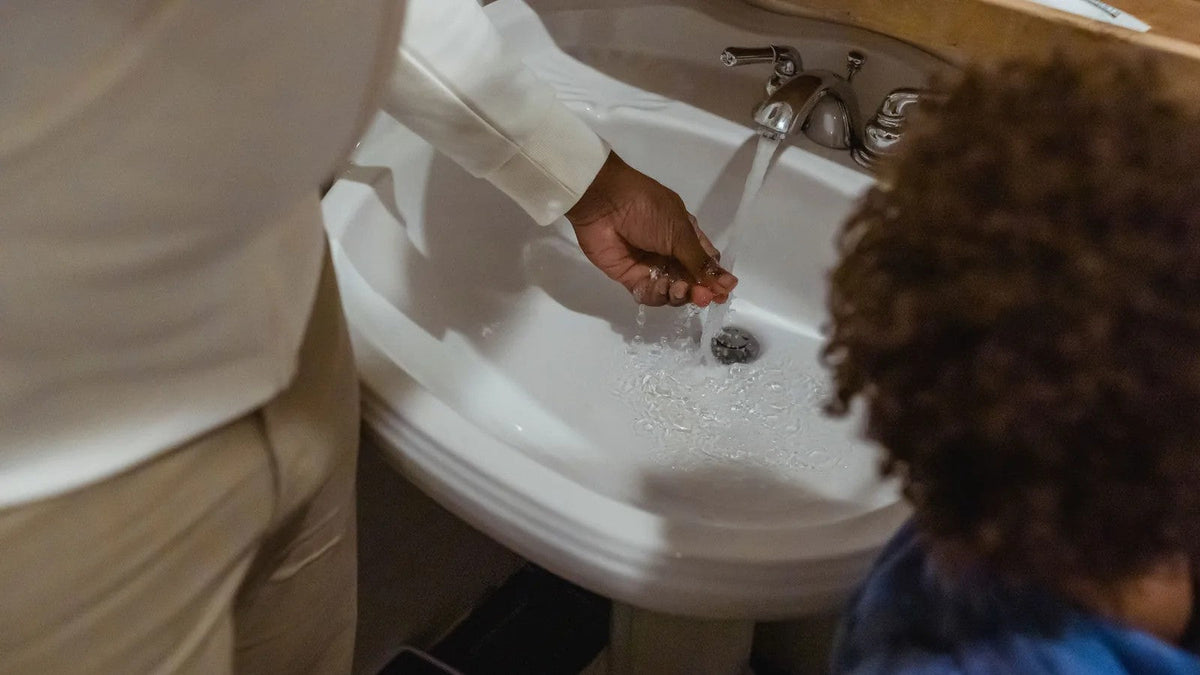
Teaching a toddler to wash hands starts with the CDC’s five steps. Say them out loud as you do them, one at a time, and let your toddler copy your hands.
The CDC’s Five Steps
-
Wet
The CDC says to wet your hands with clean, running water (warm or cold), turn off the tap and apply soap. -
Lather
The CDC says to lather by rubbing your hands together. -
Scrub
The CDC says to scrub for at least 20 seconds. -
Rinse
The CDC says to rinse well under clean, running water. -
Dry
The CDC says to dry with a clean towel or an air dryer.
The scrub is where toddlers rush. The AAP says 20 seconds sounds like an instant but is much longer than you think. Its advice is to pick a song that lasts 20 seconds and sing it while you wash. The AAP also says to watch your child while they are washing, to make sure they are developing good hygiene behaviors. Watching means standing at the sink with them.
Picture this: it is 5 p.m., and your toddler comes in for a snack. You both stand at the sink, you start the song, and by the second line a wet hand is already reaching for the towel. You keep singing and keep scrubbing until the song ends.
Use the same order every time.
For the water and soap, the AAP says to wash your child’s hands with warm water and ordinary soap that does not contain antibacterial substances. The CDC’s wording allows warm or cold water, while the AAP’s advice for your child’s hands is warm. Warm water that you have tested on your wrist is the combination to aim for.
The AAP says regular use of soap and water is better than hand sanitizer rubs when your child’s hands are visibly dirty. When there is no sink available, as in the car, the AAP says hand rubs can be a useful alternative.
Toddler Step Stool for Bathroom Sink, Tower or Extender
A step stool, a tower and a sink extender are three different answers to the same question: how does a toddler get their hands to the water? Compare them with questions you can answer standing at your own sink. Parents weighing safe standing options for toddlers can ask the same questions in any room of the house.
Questions to Answer at Your Sink
| Question at the sink | Step stool | Tower | Sink extender |
|---|---|---|---|
| Faucet height from floor? | Compare with stool height | Compare with platform settings | Compare water position and hands |
| Where does child stand? | Check floor space behind | Check floor space behind | Check floor space behind |
| Can an adult stand beside? | Check room beside sink | Check room beside sink | Check room beside sink |
Take the questions one at a time. For the first, use a tape measure and write the number down. Measure from the floor to the faucet, and note where your child’s hands need to be to reach the water. Then hold that number against the height of whatever you are considering.
The second question deserves a slow look. The spot where your child stands, and the floor behind it, are part of the setup. Look past the sink to the toilet, the tub edge and the swing of the door. Think about where your child would end up if they turned around or stepped back.
The third question is the firmest. If you cannot stand beside your child at that sink, none of the three fits yet. A narrow bathroom or a vanity wedged in a corner can answer this question before any product does.
Sink Extender Toddler Option: Where It Differs
A sink extender takes a different approach. It brings the water toward the child instead of lifting the child toward the water. Whether it suits your sink depends on the same three questions, plus the maker’s own instructions for your faucet.
The first question changes shape here. Instead of asking how high a platform must be, you ask where the water ends up compared with where your child’s hands naturally reach. The second and third questions stay exactly as they were. A child still stands somewhere, something is still behind them, and an adult still needs room beside them.
The Montessori Standing Tower: Heights, Ages and Listed Features
Baby Proof Me’s Montessori Standing Tower has three height settings: 9.8, 13.7 and 17.7 inches. Its product page says it suits children aged 18 months to 5 years and gives a weight capacity of 150 lbs. The page lists handwashing, teeth brushing and countertop activities among its everyday uses. Kitchen use is a separate question, and a learning tower buying guide is the place to weigh it.
Those numbers matter only next to your own measurement. A child’s sink reach is a matter of platform height against sink height. Measure the sink at home, then decide whether any of the three settings brings your child’s hands to the water with you beside them.

Your answer may change over time. The product page’s age range covers a wide stretch of growth, so measure again as your child grows.
The product page lists these features: a safety rail at the back with detachable safety bars that have knob screws, six anti-slip strips and four non-slip pads. Follow the maker’s instructions when you assemble and adjust the tower, and check each part against the page’s list.
The tower is one way to reach a sink. It is not a promise that your child will wash alone. An adult standing beside the child is still the rule at the sink.
Sink-Readiness Checklist for Your Bathroom
These items sit inside the wider job of baby-proofing the bathroom, and each one comes from the AAP or the CPSC.
Sink-Readiness Checklist
The faucet cover and the lid lock are the AAP’s general bathroom tips for slips and falls.
Walk through the list at the sink itself. Turn on the tap and test the water, look at the faucet from your child’s eye level, and glance at the toilet lid on your way out. The last item is the one that no product can complete for you. The CPSC’s line about your presence at all times is the item you check every time your child is in the room.
Your Next Step: Measuring From Floor to Faucet
Take a tape measure to the sink and write down the distance from the floor to the faucet. Compare it with the platform height of any option you are considering, and check that you have room to stand beside your child. Look at what is behind the spot where your child would stand.
Before the first wash, test the water on your wrist or elbow, as the AAP advises. Then start the 20-second song, and stay at the sink until the towel comes out.