Baby Proofing for Working From Home Parents

The moment you close your laptop lid at 5pm used to mean the workday was over. Now your office is also your living space, and "closing time" is a concept your toddler has never respected.
Working from home with a baby or toddler nearby is one of the more underestimated safety challenges in modern parenting. Your workspace was designed for productivity, not child safety. Cords run everywhere. Medications sit in desk drawers. Bookshelves stand unanchored. And the thing that makes WFH feel manageable, being close to your child, is exactly what creates the illusion that close is the same as supervised.
It isn’t.
Create a Physical Boundary Between Your Work Zone and Your Child’s Space
The most important thing you can do is draw a clear, physical line. Not a rule. Not a verbal boundary. An actual barrier.
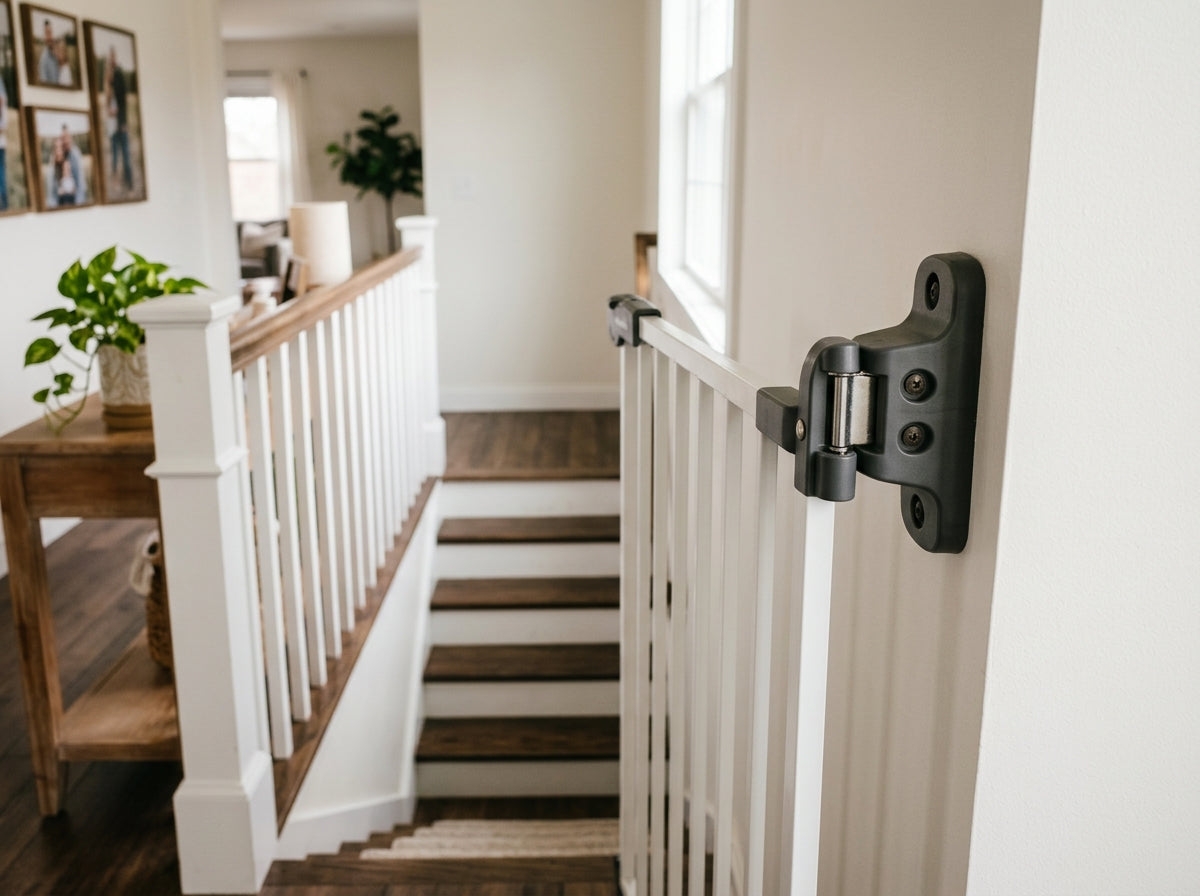
If you have a dedicated room, use it. A door with a knob cover or a simple hook-and-eye latch at adult height keeps a curious toddler out while you’re on a call. If your workspace is a corner of the living room or a desk in the bedroom, a baby gate creates that same functional separation. Gates used to block room access should meet ASTM F1004, the federal safety standard for expansion gates and expandable enclosures, made mandatory under 16 CFR Part 1239 (effective 2021). Look for that certification on the packaging.
Pressure-mounted gates are not appropriate for the top of stairs. The CPSC requires hardware-mounted gates only at stair tops. Pressure-mounted gates are fine for doorways and room boundaries, but they can be pushed out by a determined toddler with enough leverage. A gate that pops loose is not a gate.
Tame Every Cord in Your Workspace
In my experience, a toddler will head straight for the power strip under your desk. They’re not trying to electrocute themselves, they’re just curious about the blinking light. A workspace is a hazard map you need to read before your child becomes mobile.
Computer cords, monitor cables, phone chargers, desk lamp wires, and USB hubs create a tangle that looks like an invitation to a toddler. Bundle cables with velcro ties and route them behind furniture or through cord covers mounted along the baseboard. Power strips belong inside a locked cabinet or in a cord box with a secure lid, not sitting open on the floor or hanging off the back of a desk.
Window blind cords and shade pulls deserve their own mention. Replace corded blinds in your home office with cordless alternatives immediately. If replacement isn’t immediate, use cord cleats mounted well above your child’s reach to keep cords secured and off the floor. A looped cord at a child’s head height is a strangulation hazard.


Set Up a Play Yard Within Your Sightline
A play yard positioned so you can see it from your desk is one of the most practical tools available to WFH parents. You’re not caging your child. You’re creating a safe, defined space where they can play independently while you maintain visual supervision without standing over them.
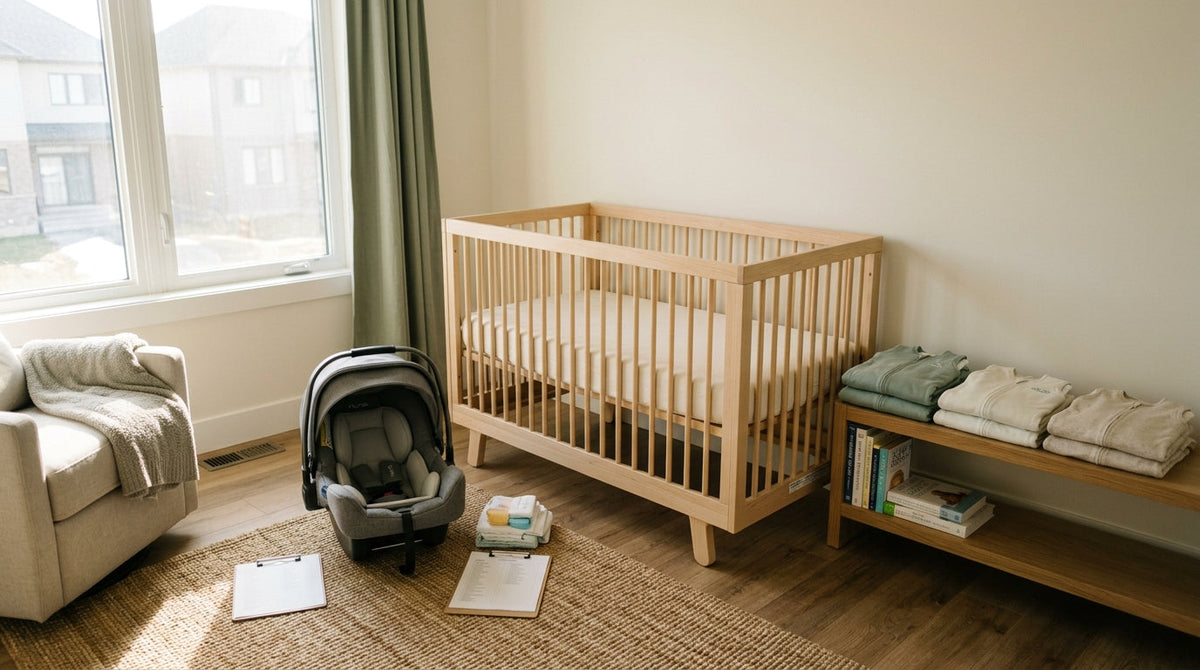
ASTM F406 is the safety standard for non-full-size cribs and play yards, made mandatory under 16 CFR Part 1221. When you’re shopping, look for that certification. Check that any slats are no more than 2 3/8 inches (6 cm) apart and that mesh sides have openings smaller than 1/4 inch, with no tears, holes, or loose threads.
Position the play yard away from windows, cords, and any furniture your child could grab to pull themselves up and over the side. Rotate the toys inside it every few days. In my experience, a child will spend significantly more time with toys they haven’t seen recently than with toys in constant view.
Anchor Your Office Furniture
Bookshelves, filing cabinets, and tall storage units look stable until a 25-pound toddler uses the bottom shelf as a step stool. The CPSC recommends anchoring all freestanding furniture to wall studs to prevent tip-over injuries. This applies to your home office just as much as your child’s bedroom.
Use anti-tip straps rated for the weight of the piece, and anchor into a stud, not just drywall. A filing cabinet full of paper is heavy. A climbing toddler can still destabilize it. Do this before your child is mobile enough to reach the office, not after.
Desk chairs with wheels are a separate issue. A child who climbs onto a rolling chair and shifts their weight can tip it or roll it into a hard surface. When you step away from your desk, push the chair fully under and consider a chair mat that limits rolling range.
Lock Away Medications, Supplements, and Small Supplies
Home offices are where medications end up. A bottle of ibuprofen in a desk drawer. Melatonin gummies on a shelf. Vitamins next to the monitor. These are poisoning risks, and they’re easy to overlook because they don’t feel like "medicine cabinet" items.
Every medication and supplement in your workspace needs to be in a locked drawer or cabinet. Not a high shelf. Locked. Toddlers climb and watch you open things.
Desk supplies present a different hazard: choking. Paper clips, binder clips, thumbtacks, rubber bands, and small USB drives are all sized to be swallowed. Keep them in closed containers on high shelves, not in open cups on the desk surface. The same goes for small electronics like earbuds and SD cards.
Establish a Do-Not-Disturb Routine That Keeps Your Child Safe
Here’s where the safety piece and the workflow piece overlap. When you’re pulled away from your desk unexpectedly, your child is left in whatever situation they were in when you left. If that situation is "playing near the open office door" or "sitting next to the power strip," an interruption becomes a hazard.
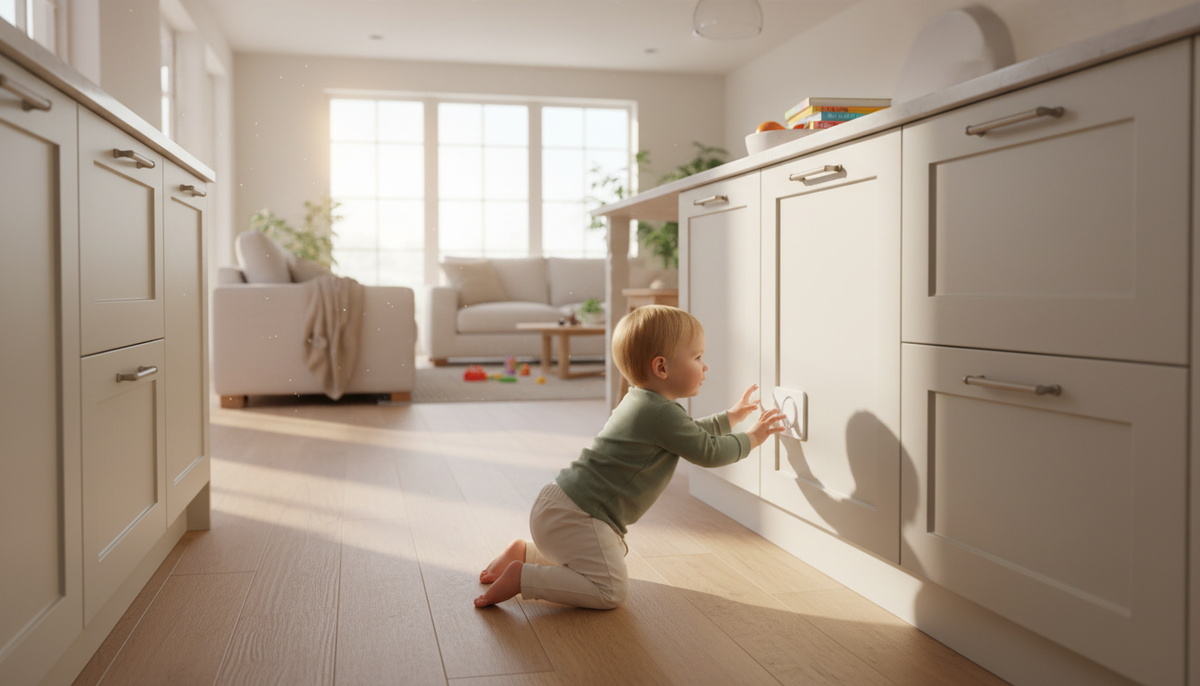
A child can empty an under-sink cabinet in the time it takes to answer the doorbell. Quiet is the problem.
Build a system. A physical signal on your office door (a sign, a colored card) tells your partner or caregiver that you’re in a call and cannot respond. Establish clear handoff times so your child has dedicated, attentive supervision outside your focused work blocks. Passive monitoring, glancing up from your laptop every few minutes, is not supervision for a toddler. It’s the gap where things go wrong.
Address Standing Desks and Treadmill Desks Separately
If you use a standing desk with a motorized lift mechanism, lock it at a fixed height when your child is in the room. The pinch points on a moving desk frame are real. Powered furniture mechanisms carry pinch risks similar to those of door injuries.
Treadmill desks should be treated like any other exercise equipment in a home with young children: unplugged and locked when not in use. The safety key should be stored out of reach. Moving belts and exposed electrical controls are not something a toddler can understand as dangerous.
WFH Office Safety Checklist
Build a Quiet Play Station Away From Your Desk
The goal of a separate play station is simple: give your child something more interesting than your workspace. A low shelf or basket with a rotating set of age-appropriate toys, puzzles, building blocks, or sensory bins near your desk but clearly not at your desk creates a pull toward safe engagement rather than toward your cords and supplies.
Rotate what’s available every two to three days. Keep the selection small, four toys hold attention better than fourteen. Pair the play station with a consistent schedule: outdoor time before your first call, a snack break at mid-morning. This regulates your child’s body and attention before you need focused quiet.
A predictable rhythm doesn’t eliminate interruptions, but it reduces the frequency. When your child does wander toward your desk, it’s more likely to be boredom than an unmet need.
The Bigger Picture
Working from home with a young child is a logistics problem and a safety problem at the same time. The solutions overlap: physical barriers, anchored furniture, locked storage, and a clear supervision handoff plan address both. The mistake most parents make is treating the workspace as already safe because it’s inside the home. It isn’t. It’s a room full of cords, heavy furniture, small objects, and medications that was never designed with a toddler in mind. Treat it like the hazard zone it is, and then build your workday around that reality.