Baby Proofing When You Have Older Kids: Balancing Freedom and Safety

The house that worked perfectly for one child rarely works for two. When my older daughter was a toddler, I had a system. Gates up, locks on, outlet covers in, done. Then her sister arrived, and I discovered something nobody had warned me about: my older daughter was my biggest safety liability. Not out of malice. She just knew how every lock worked.
That’s the central tension of baby-proofing a multi-age home. Your older child has earned some independence, and they deserve it. But that same independence, the ability to open the pantry, pour a glass of water, grab their own backpack, creates gaps that a crawling baby will find immediately.
Here’s how to close those gaps without turning your home into a prison for your school-age kid.
Why Standard Baby-Proofing Falls Short With Older Siblings
Most baby-proofing guides assume a single developmental stage. Lock everything a toddler can reach. Done. But when you have a five, six, or seven-year-old in the house, you’re managing two different sets of abilities simultaneously.
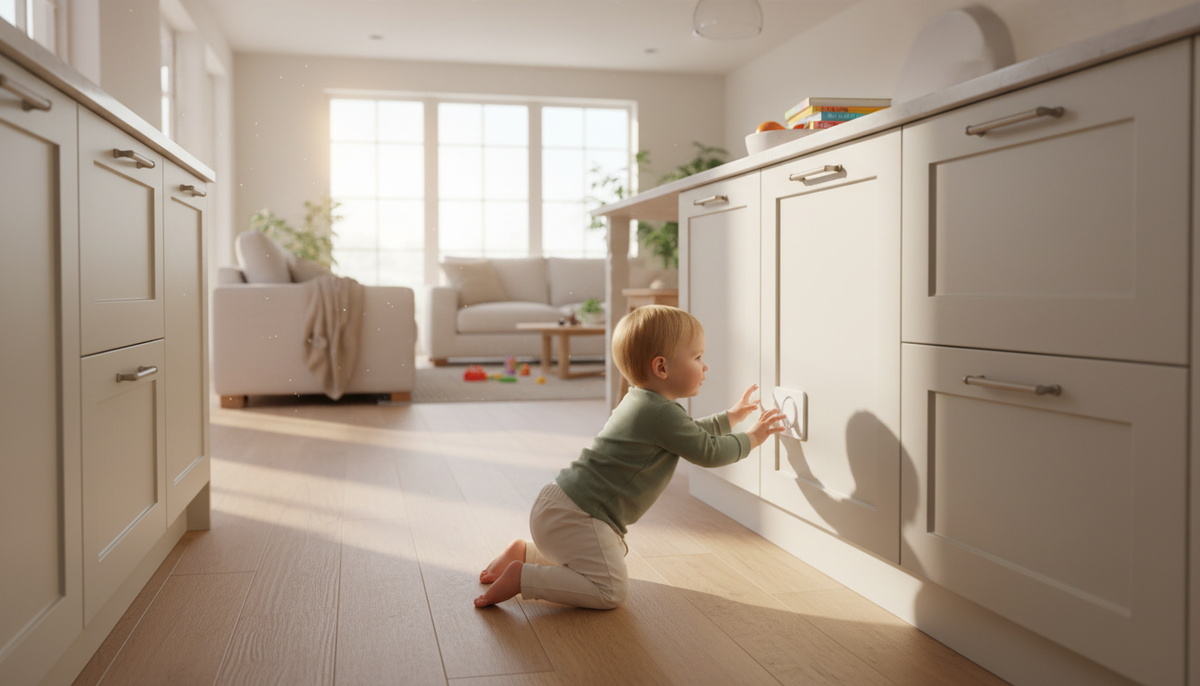
Your older child has watched you open every lock in the house dozens of times. Simple lever-style cabinet locks, single-push latches, even some magnetic systems become learnable for a child who is motivated and paying attention. A 2012 CPSC recall pulled 900,000 Safety 1st Push 'N Snap cabinet locks after reports of children as young as 9 months opening them.
Choose mechanisms that require two simultaneous actions, like pressing and lifting at the same time, or reaching through a small opening to squeeze a release. These are harder to teach, harder to mimic, and harder for a baby to replicate even if an older sibling figures it out.
Gates: The Problem Is Not the Gate, It’s Who Leaves It Open
About 93,000 children under 5 are treated in U.S. emergency rooms each year for stair-related injuries, according to Nationwide Children’s Hospital analysis of CPSC NEISS data. Gates exist for exactly this reason. But in a multi-age home, the gate is only as good as the last person who used it.
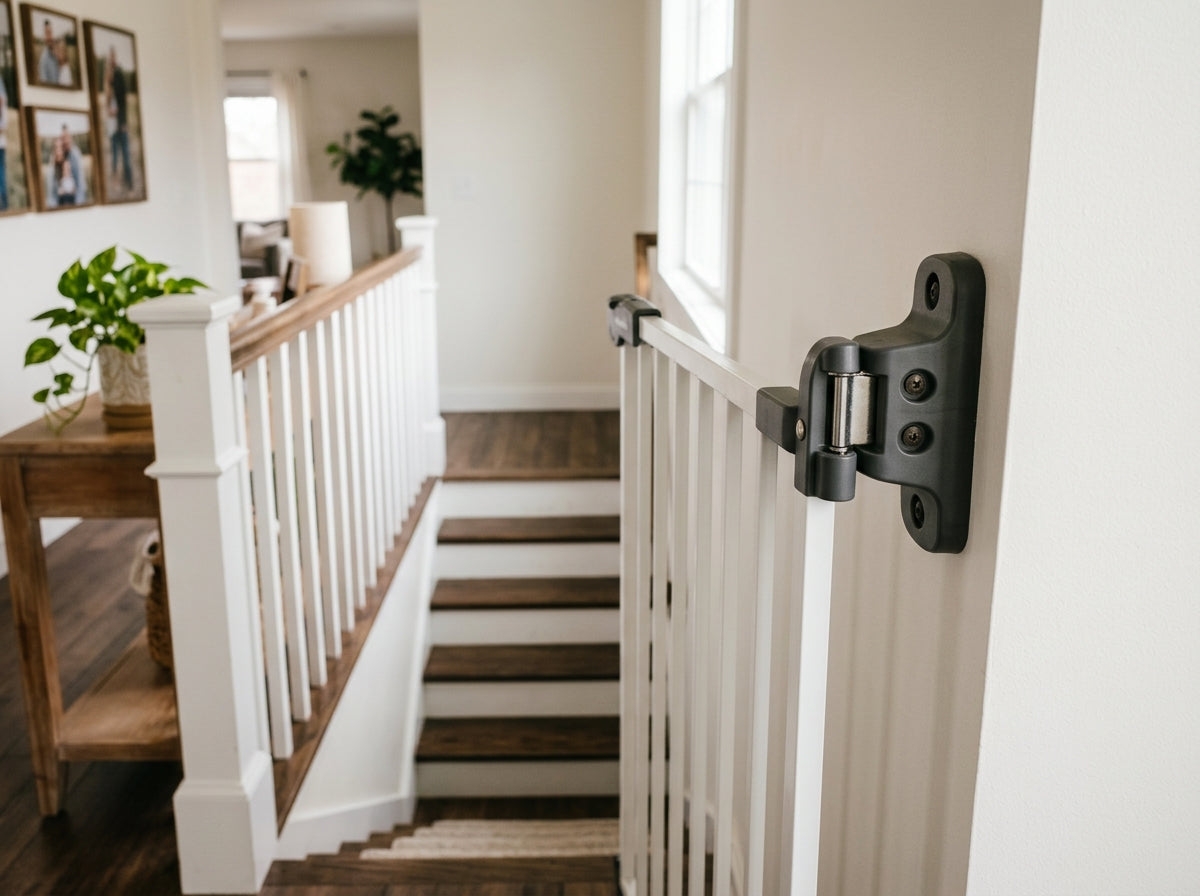
Older children move fast. They pass through a gate, think about something else, and leave it unlatched or propped open with a shoe. This is not carelessness in the moral sense. It is just how kids operate. The solution is hardware-mounted gates at the top and bottom of every staircase, full stop. Pressure-mounted gates are not adequate for stair tops under any circumstances, and in a home with older kids who open and close gates repeatedly throughout the day, hardware mounting is the only option that holds.
ASTM F1004 is the federal safety standard for expansion gates and expandable enclosures, made mandatory under 16 CFR Part 1239 effective 2021. Look for that certification on any gate you buy. Beyond certification, look for a self-closing, self-latching mechanism. The gate should close and latch behind your older child automatically, not rely on them remembering to push it shut.
Medications, Vitamins, and the Backpack Problem
This one surprised me when my younger daughter was about ten months old. I had locked every cabinet under the bathroom sink. I had a medicine lock box. What I had not accounted for was my older daughter’s school backpack, sitting on the floor of her bedroom, containing a travel-size bottle of children’s ibuprofen and a pack of gummy vitamins.
Medications and supplements stored in older children’s rooms or backpacks are a real poisoning risk. Gummy vitamins look like candy to a baby. Iron supplements in particular are dangerous in overdose. The rule in our house became simple: anything that goes in a mouth for medical or nutritional reasons lives in a locked box, not in a bag on the floor.
Brief your older child on why this matters. They don’t need a lecture. They need one clear sentence: "If your sister gets into your medicine, it could make her very sick." Most kids that age respond to concrete stakes.


Small Toys, Craft Supplies, and the Toilet Paper Tube Test
My older daughter was deep into LEGO at 26 months after her sister was born. We had bins of it. We also had a baby who was pulling to stand and putting everything in her mouth.
The toilet paper tube test is a standard way to identify choking hazards: if an object fits inside a toilet paper roll, it is a choking hazard for any child under 3. LEGO bricks, game pieces, craft beads, googly eyes, small figurines, hair ties, coins, all of them fail that test.
The practical solution is a designated play zone for small-item toys, ideally a room with a door the baby cannot open or access unsupervised. Involve your older child in the setup. Let them choose which toys go in the "big kid zone." Frame it as their special space, not a punishment. A daily sweep of common areas before the baby’s floor time is worth building into your routine.
Craft supplies deserve their own mention. Scissors, glue sticks, markers with small caps, paint tubes, all of these need to live in a closed bin that goes back on a shelf after every use. Establish that rule early and hold it consistently.
Bathroom Safety With Multiple Ages
The bathroom is where multi-age baby-proofing gets complicated fast. Your older child needs access to the bathroom independently. Your baby needs to be kept out of it.
The non-negotiable rules: under-sink cabinet locks on every bathroom cabinet, and a closed-door policy whenever the baby is mobile. Not mostly closed. Closed and latched. Hair tools, styling products, cleaning sprays, and personal care items left on counters or in open drawers are hazards at baby height.
Hot tools are a specific concern. A flat iron left to cool on the counter, a curling wand still plugged in, these are burn risks. Teach your older child to unplug and store tools immediately after use, and install a hook or holder that keeps them off the floor and out of reach.
The Visiting Friends Variable
Your older child’s friends have not lived with your safety rules. They will open gates, leave doors ajar, and put things down wherever is convenient. I learned this during a playdate when a visiting seven-year-old helpfully propped the stair gate open so she could "hear better" from the living room.
Before playdates, give visiting kids a thirty-second briefing. Keep it simple: "The gate at the stairs stays closed and latched. The baby’s room is off-limits. If you’re not sure about something, ask me." Most kids respond well to being treated like they can handle the information. And maintain active supervision during the visit. This is not a time to step away to another room for an extended stretch.
Cords, Outlets, and the Electronics Your Older Child Uses
Window blind cords and shade pulls are a strangulation risk in any room where a baby sleeps or spends time. The CPSC recommends cordless blinds throughout the home, or cord cleats installed high on the wall to keep cords out of reach. This applies even in your older child’s room if the baby ever naps or plays there.
Electrical outlets become relevant again when a baby starts pulling to stand. Use tamper-resistant receptacles throughout, or outlet covers rated for the specific outlet type in your home. Gaming consoles, tablets, laptop chargers, and other devices trail cords along floors and furniture edges. Secure them with cord clips or run them behind furniture.
Multi-Age Home Safety Checklist
Entryways, Sports Gear, and the Daily Sweep
Scooters, helmets, cleats, and sports bags in the entryway are trip hazards for crawling babies and toddlers. A baby pulling to stand near a bicycle wheel or scooter handlebar can fall badly. Designate a closed storage area, a garage hook, a mudroom bench with a door, anything that gets equipment off the floor.
Build a daily safety sweep into your older child’s routine. It takes two minutes. Before the baby gets floor time, older sibling does a quick pass of the common areas. This works best when it’s framed as a shared responsibility, not a chore imposed on them. My older daughter takes it seriously because I’ve explained what it protects.
Doors, Locks, and the Rooms You Forget
Kitchen, laundry room, and garage doors are often overlooked because older children have earned access to them. But a baby following a sibling through an unlatched kitchen door reaches the stove, cleaning products, and knives. Self-closing hinges on these doors, combined with locks positioned high enough that your older child can reach them but a toddler cannot, close that gap without restricting your older child’s independence.
The garage deserves special attention. Power tools, lawn chemicals, and car exhaust make it one of the most hazardous rooms in any home. A self-closing, self-latching door between the garage and the living space is worth the installation cost.
Feeding the Pet Without Feeding the Baby
If you have a pet, older children often take on feeding responsibilities. Pet food bowls left on the floor are accessible to a crawling baby. Beyond the choking and bacteria concerns, some pet foods contain ingredients that are not safe for infants to ingest.
Establish a pet feeding zone that the baby cannot reach unsupervised, and a rule that bowls are picked up after feeding time. This is a small change that removes a daily hazard without disrupting your older child’s pet care routine.
The goal throughout all of this is a home that works for everyone in it. Your older child’s independence matters. Your baby’s safety matters. With the right hardware, clear rules, and your older child treated as a real partner in the process, both are achievable at the same time.