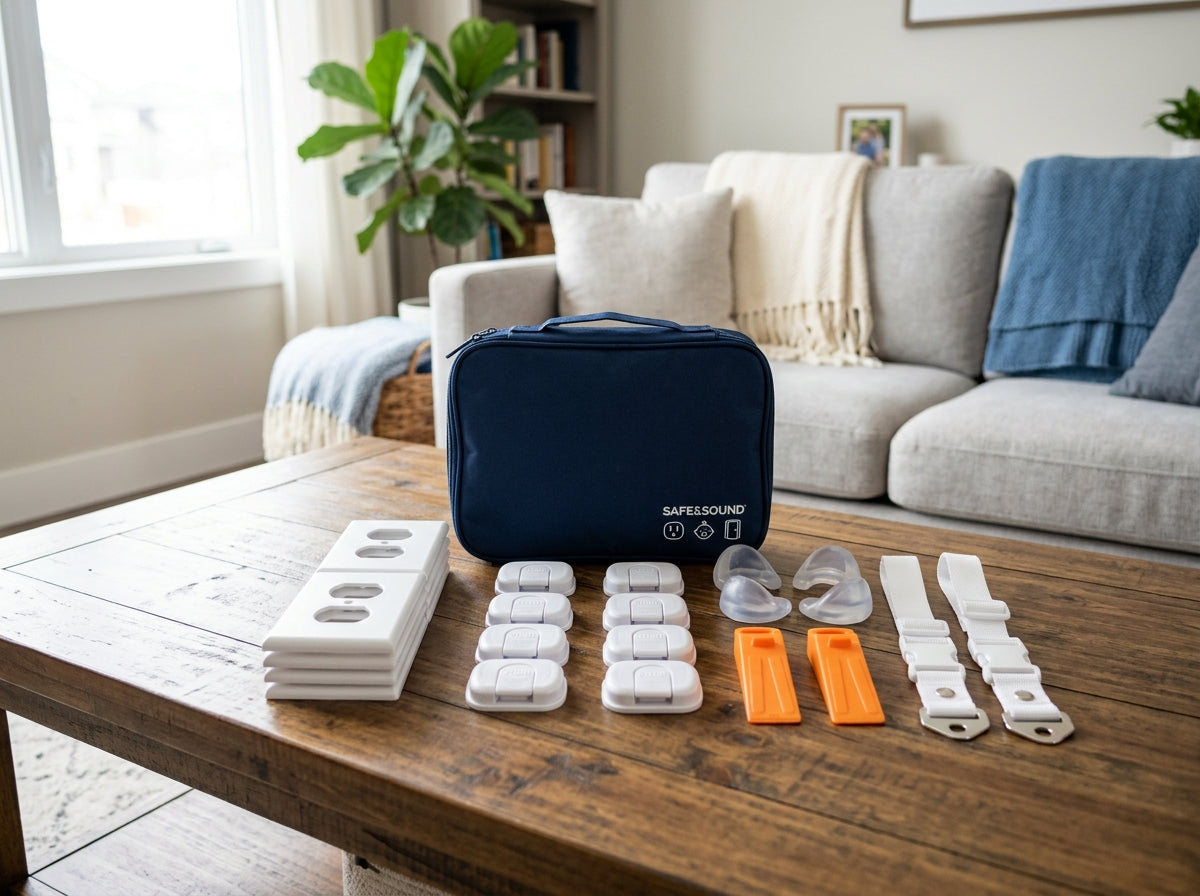

Cord Shortener and Cord Cover Solutions for Baby Safety

Cords are quiet hazards. They don’t look dangerous hanging behind a lamp or trailing from a coffee maker, and that’s exactly why they catch parents off guard.
My younger daughter proved this to me when she was about 14 months old. I had looped the TV power cord behind the entertainment unit and assumed that was enough. It wasn’t. She found the loop, pulled it taut, and had it around her wrist before I crossed the room. Nothing happened. But the image of that cord on her small arm is why I now treat every dangling wire in the house as a problem that needs a specific solution, not just a tuck-and-hope.
Why Cords Are a Higher-Risk Hazard Than Most Parents Expect
A cord is a tripping hazard, and a strangulation risk for infants and toddlers. Those two hazard profiles require different solutions, which is part of why cord management tends to be underdone.
The strangulation risk is most acute with window blind cords. About 9 children under age 5 die each year from window-covering cord strangulation (CPSC GoCordless data). Per CPSC, nearly half of more than 200 corded-window-covering incidents involving children up to age 8 from 2009 to 2021 resulted in a death. That’s not a fringe risk. In 2022, the CPSC adopted federal safety rules requiring most new residential window coverings to be cordless or have inaccessible cords, with the custom window covering standard (16 CFR 1260) taking effect May 30, 2023. New blinds should be cordless by default now, but millions of older corded blinds are still in homes.
The chewing and electrical risk is different. Toddlers mouth cords. A cord with worn insulation, or one a child has chewed through, creates a shock hazard. The American Academy of Pediatrics notes that toddlers experience electric shock most often when they bite into electrical cords or poke metal objects into unprotected outlets.
Both hazards are manageable. But they require you to think about cords systematically, not one at a time.
The Difference Between Cord Shorteners and Cord Covers
These two product types address different parts of the problem, and understanding the distinction helps you pick the right tool.
Cord shorteners bundle excess cable length. Most work by coiling the cord inside a small plastic housing or securing it with a velcro wrap, keeping the slack out of reach. They’re best for lamps, electronics, and appliances where the cord is too long for the distance between the outlet and the device. A cord shortener eliminates the dangling loop that poses a strangulation risk at floor level, but doesn’t protect a child who can reach the cord at counter height.
Cord covers encase the wire itself, usually in flexible plastic or foam tubing, and run it along a baseboard or wall. They address the chewing hazard and the visual temptation. A covered cord running flat against a wall is harder to grab, harder to pull, and harder to mouth than a free-hanging wire. Covers also protect the cord’s insulation from foot traffic and furniture edges.
The CPSC recommends keeping all cords, including those from blinds, appliances, and electronics, at least 3 feet away from cribs and play areas, or securing them with dedicated fasteners rather than relying on furniture placement alone. "Behind the couch" is not a cord management strategy. It’s a delay.


Choosing Between Adhesive and Mechanical Fasteners
This is where most parents get stuck. The right answer depends on your walls, your lease, and your child’s age.
Adhesive-based products (velcro wraps, peel-and-stick cord clips, self-adhesive cable channels) are renter-friendly and reversible. They work well on painted drywall, smooth tile, and finished wood. The limitation is that adhesive performance degrades with humidity, temperature swings, and time. A cord clip in a bathroom or kitchen can start peeling within a few months. Always test adhesive holders before trusting them. Pull by hand with real force. If it comes off the wall, it will come off when your toddler pulls the cord. Replace any adhesive product that shows peeling, cracking, or loss of grip immediately.
Screw-mounted or nail-anchored cord channels are more permanent and significantly more secure. They’re the right choice for high-traffic areas, heavier cords, or any installation you want to last more than a year. Before you install, check your wall material (drywall, plaster, tile) and confirm the anchor type matches. Also check outlet proximity: a cord channel that terminates six inches from an outlet should be paired with a tamper-resistant outlet cover so the child can’t access the plug end.
When selecting any fastener or cover, verify it’s rated for your specific cord gauge. A lightweight cable clip designed for phone chargers will not hold a heavy appliance cord flat against the wall.
Three-Step Cord Safety System
-
Shorten
Coil excess cord length and secure with a velcro wrap or cord shortener to eliminate dangling loops. -
Cover
Run exposed cord through a flexible baseboard channel or tubing to block chewing and reduce visibility. -
Anchor
Clip or mount the covered cord to the wall so it cannot be grabbed and pulled free by a child.
Appliance Cords Deserve Specific Attention
Coffee makers, microwaves, toasters, and space heaters all have one thing in common: their cords are usually longer than necessary, and the excess hangs or pools where a child can grab it. A child pulling a cord attached to a hot appliance can bring the appliance down on themselves.
For countertop appliances, coil the excess cord tightly and secure it with a velcro strap or cable tie behind the unit, flush against the wall. The goal is to leave only enough cord length to reach the outlet with no slack. Don’t use a rubber band; it degrades and can break suddenly. A velcro wrap is reusable, adjustable, and holds reliably.
Space heaters are a specific concern because they’re often placed on the floor, which puts both the cord and the unit within a toddler’s reach. If you’re using a space heater in a room where a young child spends time, the cord should be run along the baseboard in a cover and the heater itself should be behind a barrier. If that’s not practical, a cordless or built-in heating solution is worth considering.
Blind Cords: Shorteners Are Not Enough
This point needs to be direct. For window blind cords, a cord shortener is a partial measure, not a complete solution.
The AAP recommends replacing corded blinds with cordless alternatives entirely. If replacement isn’t immediately possible, the cord should be cut, tied out of reach, or secured with a cord wind-up device that keeps the full length inaccessible, not just shortened. A loop that has been reduced from 24 inches to 12 inches is still a strangulation hazard for a young child.
If you’re purchasing new blinds, the 2022 federal rule (16 CFR 1260) requires most new residential window coverings to be cordless or have inaccessible cords. Check the label. For existing corded blinds, the CPSC’s GoCordless campaign provides specific guidance on retrofit options and replacement programs.
My older daughter’s room had corded blinds when she was born. I replaced them with cordless cellular shades before she was mobile. It was one of the first things I did, and I’d do it first again.
Cord Safety Audit Checklist
Building a Layered Cord Management System
No single product is enough. The most effective approach combines three steps.
First, shorten. Eliminate excess cord length using a shortener, coil, or velcro wrap. This removes the dangling loop that creates a strangulation risk.
Second, cover. Run the remaining exposed cord length through a flexible cover or channel secured to the baseboard or wall. This eliminates the chewing hazard and reduces the cord’s visibility and accessibility.
Third, anchor. Secure the bundled or covered cord to the wall with clips or a mounted channel so it can’t be pulled free. A covered cord that isn’t anchored can still be grabbed and yanked.
Pair this system with tamper-resistant outlet covers at every cord entry point. The cord and the outlet are connected hazards. Addressing one without the other leaves a gap.
Keeping Your System Current as Your Child Grows
A cord management setup that works for a stationary four-month-old will not hold up against a 14-month-old who climbs. Audit your cords every time your child hits a new mobility milestone: rolling, crawling, pulling to stand, climbing.
Specifically, check whether any cord that was previously out of reach is now accessible from a pulled-out drawer, a couch cushion used as a step, or a piece of furniture your child has learned to climb. Adhesive products should be checked monthly regardless of whether your child has reached them. Temperature changes and cleaning products both affect adhesive grip over time.
The goal is a system that doesn’t require you to supervise every moment. Cord covers and shorteners work because they remove the hazard from the environment entirely. A cord your child can’t reach, mouth, or pull is a cord that can’t hurt them.