Fireplace Baby Proofing in the Living Room: Screens Gates and Hearth Pads

Every fireplace in a family home is a heat source, a fall hazard, and a chemical risk compressed into one architectural feature. Most parents think about the flames. Fewer think about the glass.
Glass-front gas fireplace surfaces can reach 500°F minimum and up to 1,328°F, causing third-degree burns in seconds (AAP). My older daughter was 14 months old and pulling to stand on everything in the living room, including the raised brick hearth that framed our gas insert. We had a decorative screen. We had nothing else. Within a week, we had a gate, a full-surround hearth pad, and a CO detector.
Why a Screen Alone Isn’t Enough
A fireplace screen does one thing well: it blocks sparks and direct contact with an open flame. It does not keep a baby out of the hearth zone. Most freestanding screens are lightweight, tip easily, and create a false sense of security that can make parents less vigilant, not more.
The hearth itself is the problem a screen cannot solve. Raised hearths have hard edges and corners at exactly head height for a cruising 10-month-old. Flat hearths are still stone, brick, or tile. Neither surface forgives a fall. And the glass door or surround of a gas unit stays dangerously hot long after you’ve turned the unit off, because the thermal mass of the firebox retains heat. A screen positioned in front of that glass does not reduce surface temperature. It just adds one more object between your baby and the burn.
The right approach layers three things: a safety gate that restricts access to the entire hearth zone, a hearth pad that cushions the hard edges and floor, and a screen or built-in barrier on the fireplace itself. Each layer handles a different failure mode.
Choosing a Fireplace Safety Gate
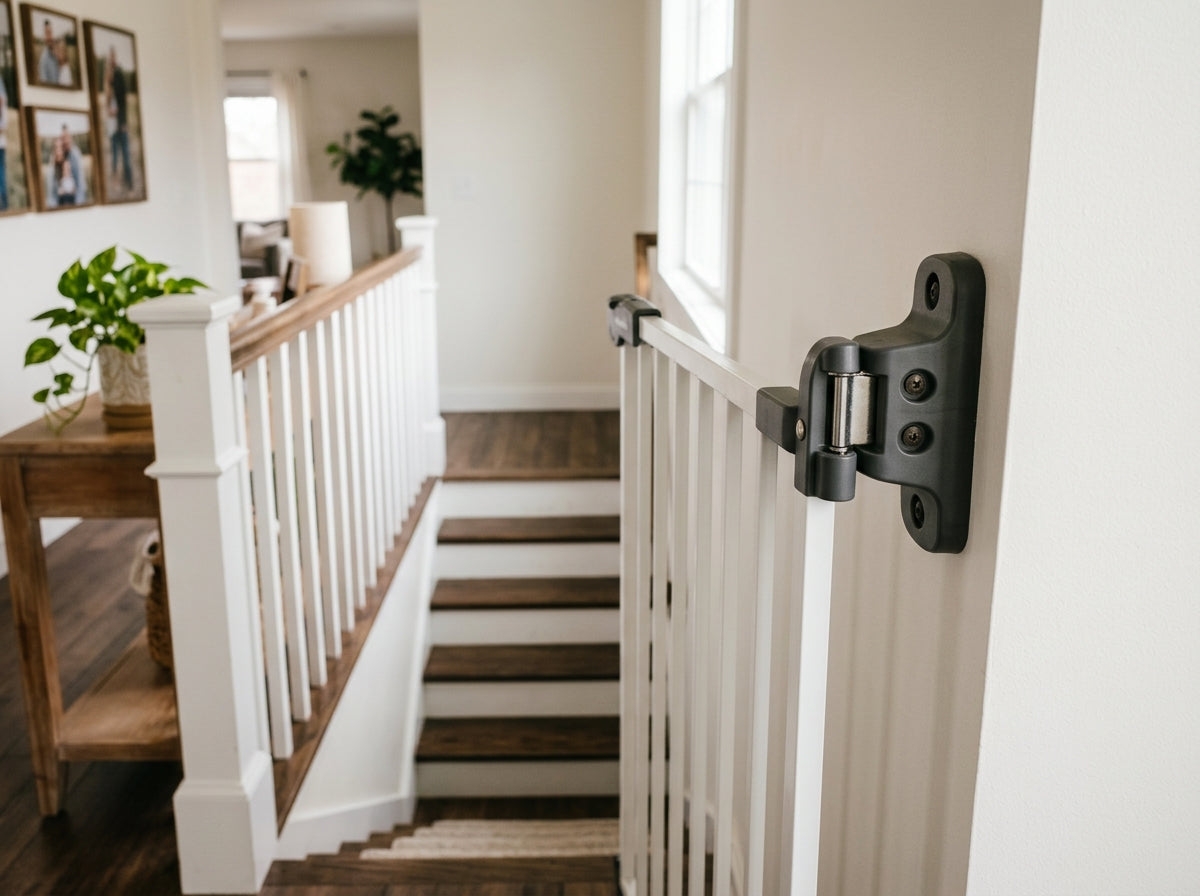
Gates designed for hearth use are not the same as standard doorway gates. They need to wrap around or span the full depth of a fireplace surround, which often projects 12–24 inches into the room. Look for a gate marketed specifically as a hearth gate or fireplace enclosure gate. These typically configure as a freestanding panel system that can be shaped into a rectangle or wide arc.
Hardware-mounted gates are more secure than pressure-mounted versions. Pressure-mounted gates rely on friction against the wall, and a determined toddler who has learned to push and shake a gate can dislodge them. Hardware-mounted gates bolt into studs or masonry and do not move. For a hearth, where the surfaces you’re mounting to may be brick or stone rather than drywall, verify the gate’s hardware kit before you buy. Some manufacturers include masonry anchors; others don’t.
ASTM F1004 is the federal safety standard for expansion gates and expandable enclosures, made mandatory under 16 CFR Part 1239 (effective 2021). Check that any gate you purchase carries this certification. The standard covers structural integrity, slat spacing, and latch requirements. On slat spacing: the 2 3/8 inch threshold prevents head entrapment. Verify that the gate you’re considering meets this spacing, particularly at the corners where panels hinge together.
Before ordering, measure your hearth opening width and depth carefully. Write down the maximum and minimum span the gate can cover, and confirm your measurements fall within that range with room to spare. An ill-fitting gate leaves gaps.


What to Look for in a Hearth Pad
A hearth pad’s job is to transform a hard, unforgiving surface into something that absorbs impact. Babies fall. They fall while learning to stand, while cruising along furniture, while turning to look at something across the room. The hearth edge is where those falls become serious injuries.
Look for high-density foam at least 2 inches thick. Thin foam compresses fully on impact and provides little protection. Gel-filled pads distribute force more evenly than foam alone, though they tend to be heavier and more expensive. Rubber pads are durable and easy to clean but generally offer less cushioning than foam or gel options.
Shape matters as much as material. Corner guards protect only the sharpest edges and are appropriate for a hearth with a simple raised ledge and no extended flat surface. Full-surround pads cover the entire raised platform and wrap around the front corners, which is the right choice for most raised hearths. L-shaped designs work for corner fireplaces. Whichever shape you choose, the pad should extend at least 12 inches from the hearth edge on all sides, covering the floor area where a child would land if they fell away from the hearth rather than into it.
Non-slip backing is not optional. A pad that shifts when a baby grabs it or crawls across it creates its own hazard. Test this before you commit: place the pad, then push it firmly with your foot from multiple angles. It should not slide.
Carbon Monoxide: The Hazard You Can’t See
CO poisoning kills more than 400 people each year and sends more than 100,000 to U.S. emergency rooms (CDC). Fireplaces, both wood-burning and gas, are a contributing source, particularly when dampers are partially closed, flues are blocked, or gas units are not properly vented. Fireplaces, both wood-burning and gas, are a contributing source, particularly when dampers are partially closed, flues are blocked, or gas units are not properly vented.
Babies and young children are more vulnerable to CO than adults because their respiratory rates are higher and their bodies absorb the gas more quickly. Symptoms in infants, including irritability, lethargy, and vomiting, are easy to mistake for illness. By the time a parent suspects CO exposure, the concentration in the room may already be dangerous.
Install a battery-operated CO detector in the living room. Place it at roughly mid-wall height, not directly above the fireplace and not at floor level, following the manufacturer’s placement guidance. Test it monthly. Replace the batteries annually, or use a detector with a sealed 10-year battery. This is not a backup measure. It is a primary safety layer that no gate or pad can replace.
Gas fireplaces also require annual professional inspection to verify that ventilation is functioning correctly and that there are no gas leaks. A malfunctioning gas unit can release unburned gas even when it is not actively running. This is not a DIY check. Schedule it before the heating season begins.
Managing the Hearth Area Itself
The fireplace surround collects objects that become hazards the moment a baby enters the zone. Andirons, fireplace tools, decorative logs, and anything stored on the hearth ledge are all grab-and-pull targets for a child pulling to stand. A poker left leaning against the firebox is a sharp, heavy object at exactly the wrong height. Remove everything.
Chimney dampers and ash cleanout doors deserve specific attention. A toddler who opens an ash cleanout door is exposed to fine particulate matter that irritates airways and skin, and potentially to residual heat. If your damper or cleanout door does not have a built-in latch, add one. Childproof cabinet latches can be adapted for this purpose in many cases.
Mantelpiece items are a secondary concern but worth addressing. Babies who have learned to climb will use the hearth edge as a step. Anything on the mantel becomes reachable earlier than you expect. Move breakables, candles, and anything heavy to a different room until your child is past the climbing phase.
ANSI Standards and Older Gas Fireplaces
ANSI Z21.50–2014/CSA 2.22–2014 took effect January 1, 2015, requiring a protective barrier on new gas fireplaces whose glass can exceed 172°F. If your gas fireplace was manufactured before 2015, it may not have a built-in barrier screen. This is common in older homes, and it matters because the glass on pre-standard units can be touched without any visual warning. There is no glow, no obvious heat shimmer. It simply looks like glass.
If you have an older unit, contact the manufacturer to ask whether a retrofit barrier kit is available for your model. Some manufacturers offer them. If not, your safety gate becomes even more critical, because the glass itself has no first-line protection.
Fireplace Baby-Proofing Checklist
Supervision as the Foundation
Gates, pads, screens, and detectors are all secondary controls. They reduce injury severity and buy time. They do not replace supervision.
Babies and toddlers under age 3 should not be left unattended in a room with an active fireplace. This holds even with a gate in place. A gate that passes every standard can still be climbed by a determined toddler who has been practicing on the furniture.
The CPSC recommends keeping any supplemental heating device, including space heaters placed near the hearth, at least 3 feet from the fireplace opening and at least 3 feet from any fabric, curtains, or furniture. If you use a space heater as a supplement during high-demand periods, treat its 3-foot clearance zone as an extension of the fireplace hazard zone, not a separate concern.
Putting It Together
A complete fireplace baby-proofing setup has five components: a certified hearth gate (hardware-mounted where possible, ASTM F1004-compliant), a full-surround hearth pad with non-slip backing and at least 2 inches of foam or gel fill, a fireplace screen or built-in barrier on the unit itself, a CO detector tested monthly, and a cleared hearth with dampers and cleanout doors latched.
If you have a gas fireplace manufactured before 2015, add a retrofit barrier screen to that list and schedule your annual professional inspection before the unit runs for the season. If you have a wood-burning fireplace, add a damper lock and make sure your flue is inspected and cleaned annually.
None of this is complicated. All of it matters. A fireplace that is safe for adults is not safe for a child who cannot yet judge heat, does not understand burns, and is physically incapable of stopping themselves from touching something interesting. Build the layers, then stay in the room.