How to Baby Proof Your Basement: Stairs Storage and Hidden Hazards

Basements are where the hazards your child will find fastest are the ones you forgot were there. The half-empty jug of driveway sealer. The old shelving unit that wobbles if you look at it wrong. The sump pit you covered with a piece of plywood two years ago and never thought about again. Most parents childproof the kitchen and the living room first, and the basement last, or never. That order is backwards.
The Stairs Come First
About 93,000 children under 5 are treated in U.S. emergency rooms each year for stair-related injuries, according to Nationwide Children’s Hospital analysis of CPSC NEISS data from 1999 through 2008. That works out to roughly one child every six minutes. Basement stairs are particularly dangerous because they tend to be steeper than interior stairs, less finished, and often have open risers that a small foot or head can slip through.
You need a gate at the top and a gate at the bottom. The top gate is non-negotiable. A child who gets past it falls. The bottom gate matters too, because it stops a toddler from accessing the stairs from below and attempting to climb unsupervised.
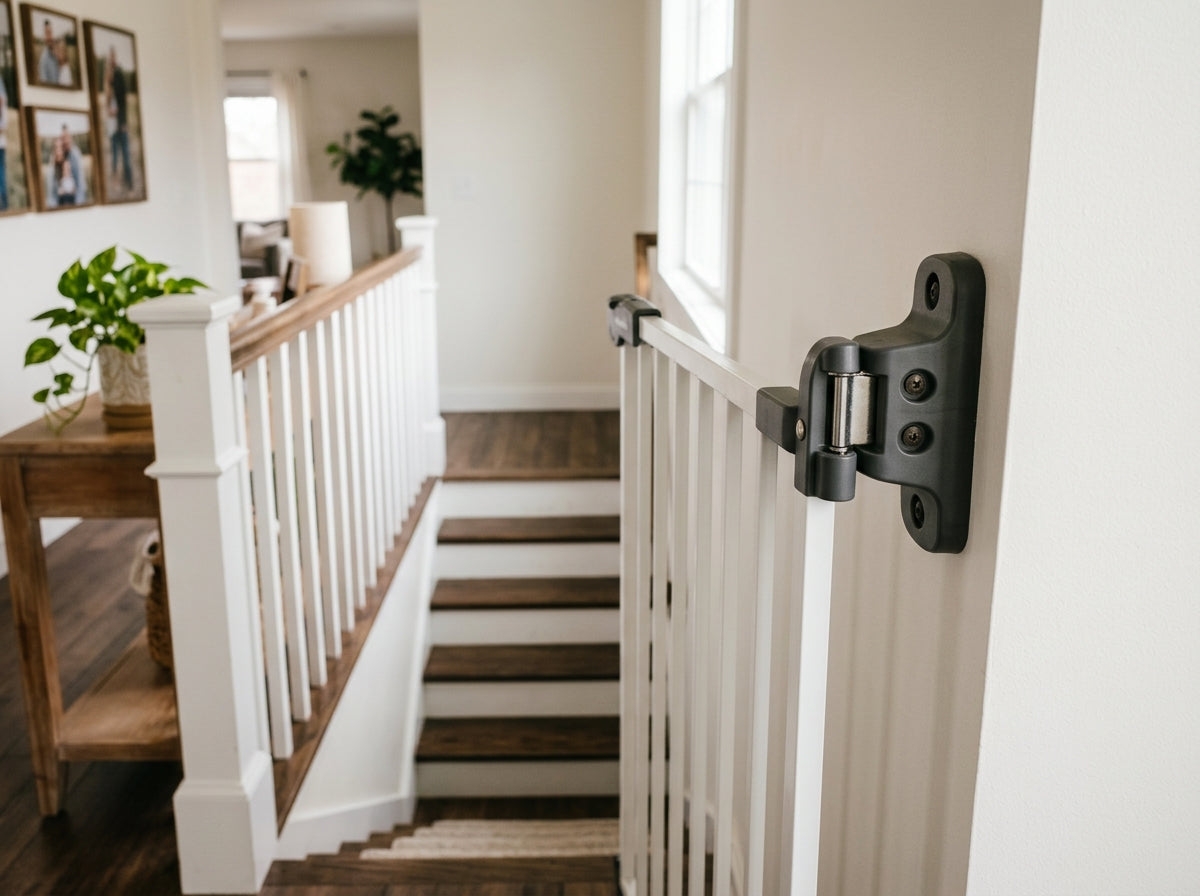
For the top of any staircase, you need a hardware-mounted gate, not a pressure-mounted one. Pressure-mounted gates are designed for doorways where a child pushing against them encounters a wall. At the top of stairs, a child who pushes hard enough can dislodge a pressure gate and go over the edge with it. Hardware-mounted gates bolt into wall studs or a mounted header kit. They do not move.
The current federal safety standard for expansion gates is ASTM F1004, made mandatory under 16 CFR Part 1239 effective July 2021. When you shop, look for that certification on the packaging. It means the gate has passed standardized load and force testing. In my experience, certification is the first thing to check. One gate I tested had a latch that felt solid but failed to re-engage after about 200 open-close cycles. Certification alone is not a substitute for checking your gate every few weeks.
Securing Storage Before It Falls
Basement shelving is almost always an afterthought. A metal utility shelf gets assembled, loaded with paint cans and holiday boxes, and pushed against a wall with no anchor. That is a problem. Tall shelving units and stacked storage can tip onto a child with very little provocation. A toddler grabbing a lower shelf to pull themselves up is enough.
Anchor every tall shelf to a wall stud using L-brackets or furniture straps rated for the combined weight of the unit and its contents. If you are not sure where the studs are, use a stud finder before you drill. Drywall anchors alone are not sufficient for heavy loaded shelving.
Keep heavy items on lower shelves. This lowers the center of gravity and reduces tipping risk. It also means that if something does fall, it falls a shorter distance.
Chemical Storage Is a Priority Hazard
Basements concentrate chemicals. Cleaning supplies, paint and paint thinner, pesticides, automotive fluids, pool chemicals. These often live together in a basement because there is nowhere else to put them, and because adults rarely think of the basement as a child’s space. But children find their way there.
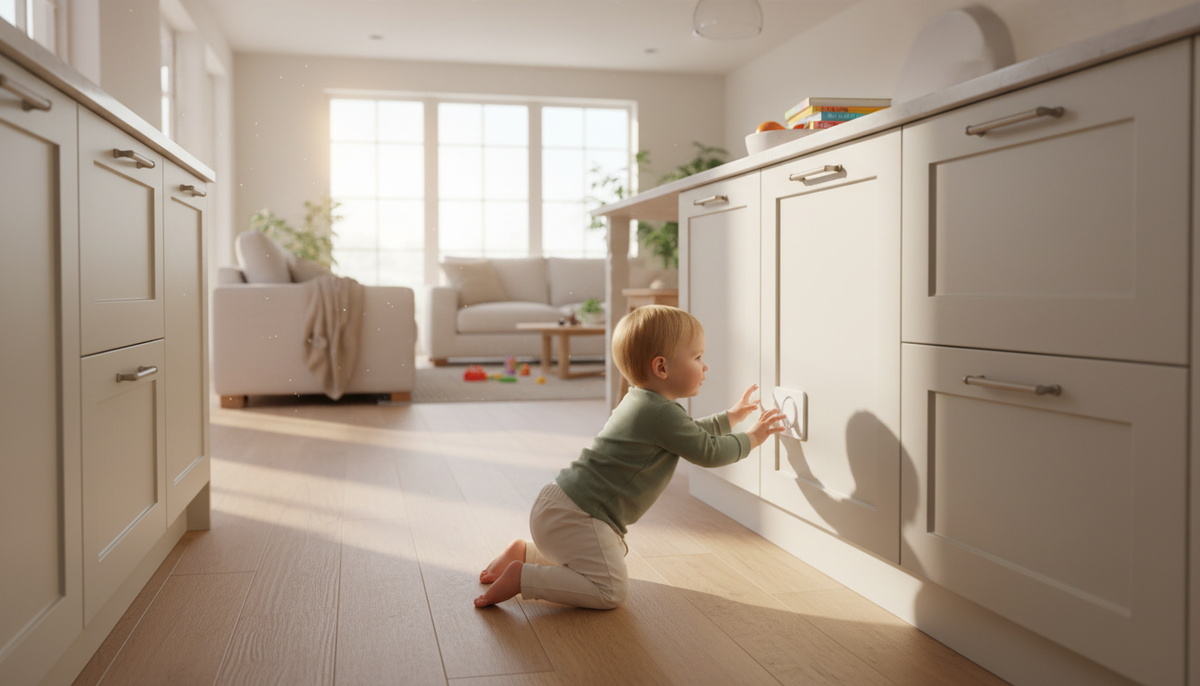
The CPSC treats chemical storage as a priority hazard zone in its home safety guidance. A 2012 CPSC recall pulled 900,000 Safety 1st Push 'N Snap cabinet locks after 140 children defeated them. Three of those children reached toxic cleaning products, including dishwashing detergent, window cleaner, and oven cleaner. The recall covered children as young as 9 months.
Every chemical in your basement should be in a locked cabinet or on a shelf that is out of reach, meaning above 5 feet from the floor. "High shelf" is not a strategy if your child can climb. A locked cabinet with a key or combination lock is the more reliable option. Store chemicals in their original containers with labels intact so that Poison Control can identify them quickly if needed. The national Poison Control number is 1-800-222-1222. Put it in your phone.


Unfinished Ceilings and What Hangs From Them
An unfinished basement ceiling is a collection of hazards at head height. Exposed nails from above, pipe flanges, ductwork edges, junction boxes with sharp corners. For an adult, these are minor inconveniences. For a child running through the space, they are a head injury waiting to happen.
If your basement is unfinished and you plan to let children use any part of it, do a slow walk-through at a child’s eye level, which means crouching down to about 3.5 feet. Look for anything that protrudes, anything sharp, anything low. Pad low-hanging pipes with foam pipe insulation, which is cheap and available at any hardware store. Cover exposed nail points with a dab of epoxy or a nail cap. For any area where clearance is less than 6 feet 8 inches, either restrict access entirely or install padding.
The more honest answer for many basements is to restrict access to unfinished zones. A door with a childproof handle cover or a hook-and-eye latch mounted above 54 inches keeps a toddler out more reliably than trying to pad every hazard.
Windows, Window Wells, and Water
Basement windows sit at or below grade. Window wells collect rainwater. And drowning is the leading cause of unintentional injury death in children ages 1–4 (CDC). The AAP states that a child can drown in as little as one to two inches of water. A window well after a heavy rain can hold several inches.
Cover every window well with a rigid grate designed for the purpose. These are available in plastic and metal and bolt to the foundation wall. They need to be rigid enough that a child cannot push through them, and they need to be secured so a child cannot lift them off.
For basement windows themselves, install window guards that meet ASTM F2090, the standard for window fall prevention devices. One important exception: any window designated as an egress window for fire escape must remain operable by an adult from the inside. Use a guard with a quick-release mechanism on egress windows so emergency exit is still possible.
Check window well covers and guards after every significant storm. Debris, ice, and settling can compromise them.
Moisture, Mold, and Air Quality
Basements are damp by nature. Moisture moves through concrete, condenses on cold surfaces, and accumulates in corners. That moisture feeds mold. For infants and toddlers with developing respiratory systems, mold exposure can aggravate asthma and allergies. A basement that smells musty is a basement with a mold problem, even if you cannot see it.
Keep basement humidity below 50 percent using a dehumidifier. Most units have a built-in humidistat that will cycle on automatically when humidity rises. Empty the reservoir regularly, or run a drain hose to a floor drain. Inspect the perimeter walls, the area under stairs, and any stored cardboard boxes at least twice a year for visible mold growth. If you find it, address the moisture source first, then remediate the mold. Painting over mold does not fix it.
Ventilation matters too. If your basement has no operable windows and no mechanical ventilation, air quality will be poor. A small exhaust fan or a connection to your home’s HVAC return can help.
Sump Pits and Floor Drains
A sump pit is an open hole in the floor with water in it. If your basement has one, it needs a cover. Full stop. Drowning can occur in very little water, and a sump pit can hold enough to be fatal to a small child who falls in headfirst.
The right solution is a fitted, rigid cover that locks or requires two-hand operation to remove. Some sump pump systems come with covers designed for this. If yours does not, a locking sump pit cover is available at hardware stores and costs under $30. It is one of the easiest fixes in this entire guide.
Floor drains are a lower risk but still worth addressing. A child can get fingers or toes caught in an open drain. Standard drain covers with small openings are sufficient. If the drain is in a play area, verify the cover is secured and not easily lifted.
Laundry Appliances and Mechanical Hazards
If your basement has a washer and dryer, keep the laundry area separated from any play space. A door with a childproof handle cover works well here. Running appliances are loud, hot, and have moving parts. A dryer door left open is a climbing opportunity for a toddler. Front-loading washers have been involved in entrapment incidents.
Never leave a child unattended near running laundry appliances. Front-loading washers and dryers present entrapment risks and should be kept behind a childproof door.
Basement Safety Checklist
Electrical Outlets and Cord Management
Basements tend to have more outlets than other rooms, more extension cords, and less organized wiring. Work benches, chest freezers, dehumidifiers, sump pumps, and workshop equipment all plug in somewhere. The result is often a tangle of cords along baseboards and a row of outlets that have never been covered.
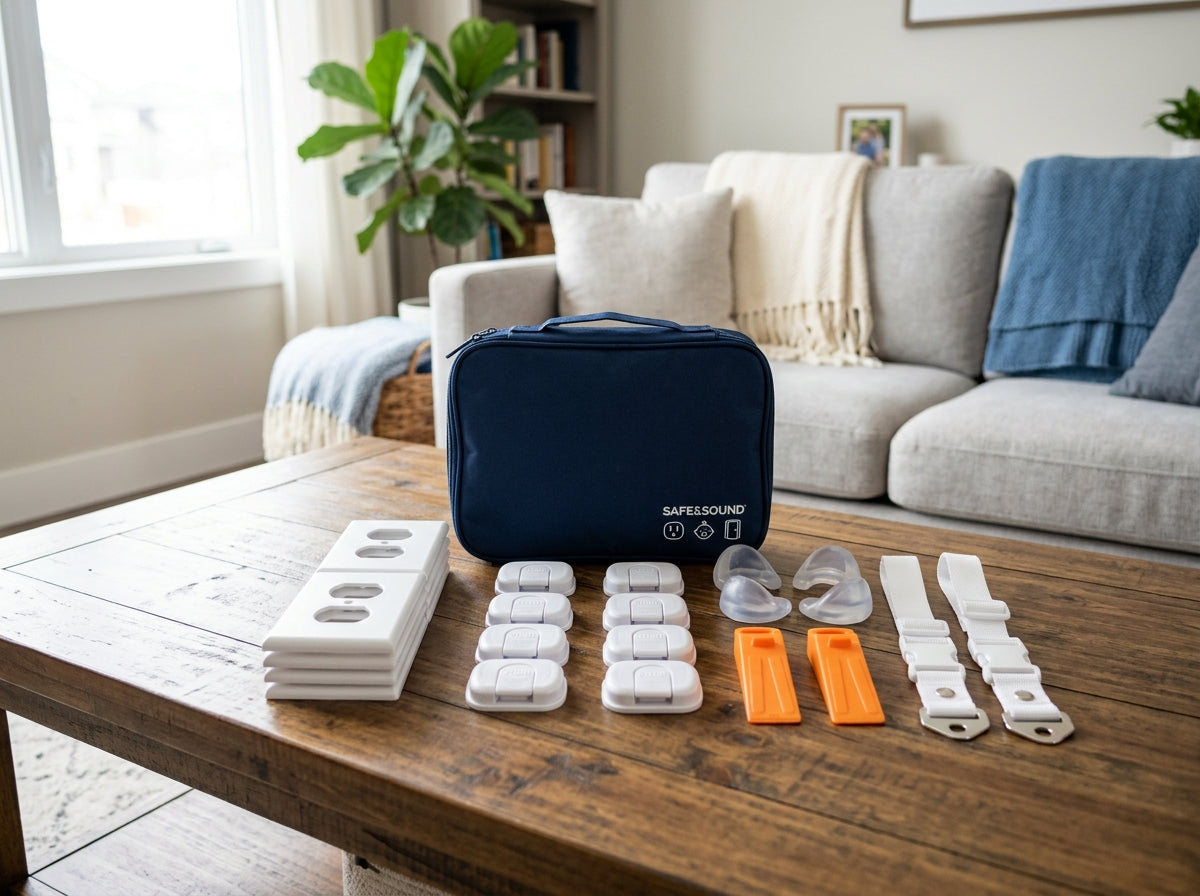
Cover every outlet with tamper-resistant covers. Tamper-resistant outlets (the kind with internal shutters that require simultaneous pressure on both slots to open) are now required in new construction and are a better long-term solution than plug caps, which children can remove. For cords, use cable clips or cord channels to route them along walls and out of reach. Do not use daisy-chained extension cords or power strips plugged into other power strips. This is a fire hazard independent of child safety.
Old Equipment and Unknown Items
Basements accumulate things. Previous owners leave items. Relatives donate equipment. Old toys, hand tools, sporting goods, and hobby supplies end up in corners and on shelves. Before your child has access to any basement space, go through every item in it.
Check older toys and equipment against the CPSC recall database at cpsc.gov. Look for small parts that could be swallowed, sharp edges, and flaking paint. Painted items manufactured before 1978 may contain lead paint. Any item you cannot verify as safe should be stored in a locked area or removed.
This is not a one-time task. Basements change. Things get moved in. Do a full audit any time the space changes significantly, and a quick visual check every few months.
Temperature and Floor Surface in Play Areas
Concrete floors are cold, hard, and unforgiving. For a crawling infant or a toddler who falls often, they present real injury risk. Interlocking foam tiles or rubber play mats provide cushioning and insulation. Cover any area where a child will spend time on the floor.
Keep basement play area temperature above 68°F (20°C) during use. Basements run cold, and infants and young toddlers lose body heat faster than older children. A small space heater with tip-over protection and a cool-touch exterior can help, but keep it out of reach and never leave it running unattended.
The basement can be a useful space for children. It can hold a play area, a craft table, room to move. But it earns that role only after you have worked through every item on this list. Start with the stairs and the chemicals. Work outward from there. The goal is a space where your child can be a child, and where you are not holding your breath every time they head for the door.