How to Baby Proof Your Kitchen: The Complete Safety Guide

Every kitchen tells a story about the people who use it. Mine tells a story about a 22-month-old who, in the time it took me to answer the front door, opened the cabinet under the sink, pulled out a bottle of dish soap, and was working on the spray cleaner by the time I got back. The door was open for maybe ninety seconds.
That was the day I stopped treating kitchen baby proofing as a project I’d get to eventually and started treating it as something I should have finished weeks earlier.
The kitchen is the most hazardous room in the house for young children, and the hazards cluster into three categories: heat, toxic substances, and sharp or heavy objects. A systematic approach works through each category methodically. This guide does exactly that.
Start With a Floor-Level Audit
Before you buy a single lock or latch, get down on your hands and knees and look at your kitchen from a toddler’s perspective. This sounds obvious. Almost no one does it. The view is different from two feet off the ground. You’ll see the handles of pots on the stove, the cord hanging from the coffee maker, the gap under the cabinet where the cleaning spray rolled when it fell. You’ll notice which drawers are at eye level and which cabinets have the most interesting contents.
Do this audit with a notepad and work through the room systematically: floor, lower cabinets, drawers, countertops, appliances, stove and oven, refrigerator, trash. Write down every hazard you see. Then go back and prioritize by severity. A knife drawer and a cabinet full of cleaning products are higher priority than a cabinet full of pots. A stove with front-mounted knobs is higher priority than one with rear-mounted controls.
The audit takes fifteen minutes. It will save you from installing locks in the wrong order and missing something obvious.
Cabinet Locks and Latches: The Foundation
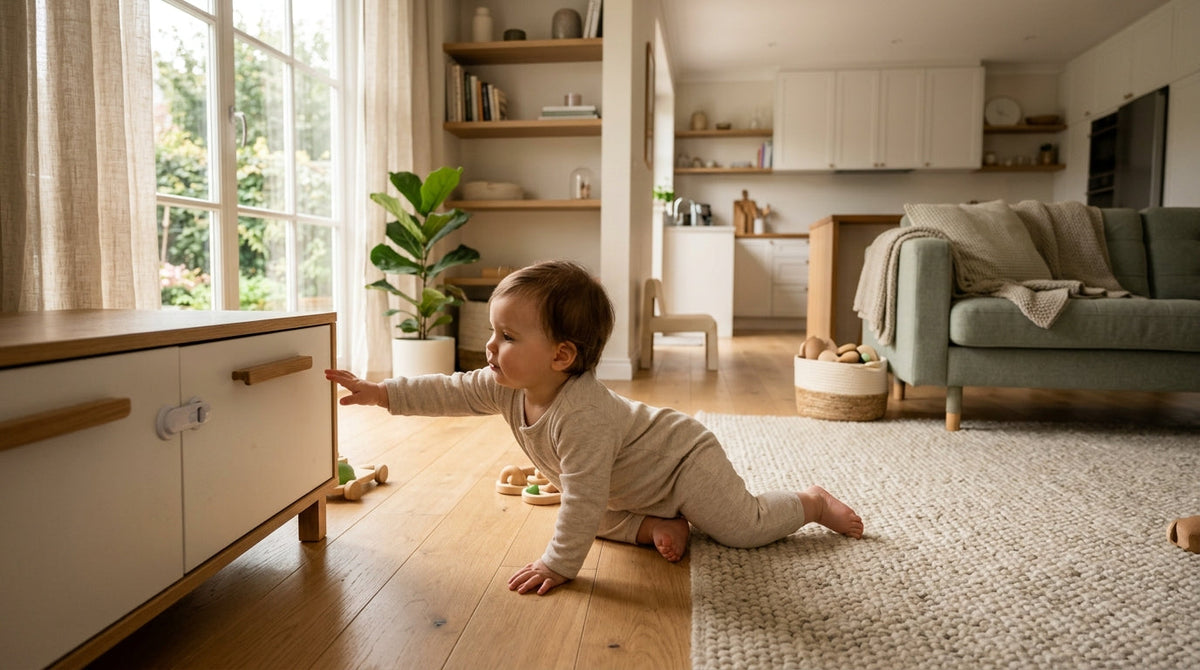
Cabinet locks are where most parents start, and for good reason. The CPSC recommends storing all household chemicals and medications in locked cabinets out of reach, rather than relying on high shelves alone, because toddlers are capable climbers. A bottle of bleach on the third shelf is not safe if your child has figured out how to use a step stool.
There are four main types of cabinet locks worth knowing.
Magnetic cabinet locks mount inside the cabinet and require a magnetic key to open. They’re invisible from the outside, work on most cabinet styles, and are significantly harder for children to defeat than surface-mounted latches. I’ve installed magnetic locks in two kitchens now, and neither of my daughters has ever opened one. The tradeoff is installation: you need a drill, and you need to mount the catch precisely or the magnet won’t release it cleanly.
Spring-loaded latches mount inside the cabinet and require simultaneous pushing and pulling to open. They’re inexpensive and easy to install, but some children figure them out quickly. My older daughter defeated an adhesive-mounted spring latch at 26 months. She didn’t figure it out by accident. She watched me open it twice and then copied the motion.
Adhesive strap locks wrap around cabinet knobs or handles and require squeezing a tab to release. They’re useful for cabinets without a frame for internal mounting. Adhesive quality varies. I’ve had one fail on a painted surface after about four months.
Sliding cabinet locks work on cabinets with two adjacent doors and a center post. A bar slides through both handles. Simple, durable, and hard to defeat without fine motor skills.
The 2012 CPSC recall of 900,000 Safety 1st Push 'N Snap cabinet locks is instructive: it was pulled after 140 children defeated them, and three of those children reached toxic cleaning products. The lesson isn’t that all cabinet locks fail. It’s that no single lock should be your only barrier for cabinets containing bleach, drain cleaner, or dishwasher pods.
For under-sink cabinets and any cabinet containing cleaning products, use a magnetic lock or a sliding bar lock. Spring latches and adhesive straps are not adequate for your highest-risk storage.
Stove and Oven Safety
Burns from contact with hot surfaces or spilled liquids are a leading cause of kitchen injuries in children under five. The stove requires multiple layers of protection because no single measure covers all the ways a child can be burned.
Rear burners first. When you’re cooking, use the back burners whenever possible. Keep pot handles turned inward, not extending over the edge of the stove. This is free, takes no installation, and works immediately.
Knob covers or knob removal. Front-mounted stove knobs are reachable by most toddlers. Knob covers fit over the existing controls and require an adult grip to turn. They’re inexpensive and easy to install. Some parents remove the knobs entirely when the stove isn’t in use and store them in a high cabinet. This is the more secure option, though it adds a step every time you cook.
Oven door locks. Oven doors get hot enough to cause contact burns, and children are drawn to them because they can see through the glass. An oven door lock mounts to the door frame and prevents the door from being pulled open. Look for one with a heat-resistant design; some cheaper versions deform over time near the oven seal.
A safety gate at the kitchen entrance. Keeping young children out of the kitchen entirely during cooking is the most effective stove safety measure available. ASTM F1004 is the federal safety standard for expansion gates and expandable enclosures, made mandatory under 16 CFR Part 1239 (effective 2021). Look for gates that meet this standard. A gate at the kitchen doorway means you can cook without a toddler at your feet, which removes the burn risk almost entirely.
If a gate isn’t practical for your kitchen layout, a play yard positioned near the kitchen keeps a child in your sightline while keeping them away from the stove.
Cleaning Products, Medications, and Toxic Substances
The under-sink cabinet is the most dangerous cabinet in most kitchens. It typically contains drain cleaner, bleach, dish soap, dishwasher pods, and various sprays, all at exactly the height a toddler can reach.
Dishwasher pods deserve specific attention. They’re brightly colored, squishy, and look like toys. They contain concentrated detergent that can cause burns to the mouth, throat, and esophagus if bitten or ingested. Store them in a locked cabinet, not in the dishwasher’s built-in dispenser storage or in an open container under the sink.
The same rule applies to anything under the sink: use a locked cabinet, not a latched one. Use a magnetic lock or a sliding bar lock rated for that cabinet type. If you’re renting and can’t drill, a sliding bar lock through the handles is your best option.
Medications don’t belong in the kitchen at all, but many families keep vitamins, antacids, or daily prescriptions on the counter near the coffee maker. Move them. A locked cabinet or a high shelf with no nearby climbing surface is the minimum. The CPSC’s guidance is clear: locked storage, not height alone.


Drawer Safety: Knives, Utensils, and Pinch Points
The utensil drawer is usually at toddler chest height. It contains knives, peelers, graters, and skewers. The knife block on the counter is at toddler eye level. Both need attention.
Drawer locks for knife and utensil drawers work similarly to cabinet locks. Magnetic drawer locks mount inside and are the most secure. Adhesive strap locks work on drawers with handles. Whatever you choose, every drawer containing sharp implements needs a lock.
Soft-close drawer dampers are worth adding if you’re already installing locks. They slow the closing speed of a drawer, which reduces pinch injuries when a child’s fingers are in the gap. They’re inexpensive, install in minutes, and you’ll appreciate them yourself.
Knife blocks should move to a high shelf or a locked cabinet. A magnetic knife strip mounted high on the wall is a good alternative if you use your knives frequently. Keep it well above reach, not just above counter height.
Appliance Cords and Countertop Safety
A coffee maker cord hanging over the edge of the counter is a pull hazard. A toddler who grabs it and pulls gets a heavy appliance and, potentially, hot liquid. The same is true for blenders, toasters, electric kettles, and food processors.
Push all countertop appliances back from the edge. If the cord still hangs down, use a cord shortener or route the cord along the back of the counter. Cord clips that mount to the underside of upper cabinets keep cords up and out of reach.
Unplug appliances when not in use. A toaster that isn’t plugged in can’t shock anyone. An electric kettle that isn’t plugged in can’t be turned on. This is especially important for appliances that stay on the counter permanently.
The microwave deserves a specific note. If it’s at a low height, either on the counter or in a lower cabinet, a child can open it, pull out hot food, and burn themselves before you cross the room. If your microwave is accessible to your child, add a microwave lock or move the appliance to a higher position.
Refrigerator Locks and Food Safety
Refrigerator locks prevent toddlers from opening the door independently. This matters for several reasons. A child who opens the refrigerator can pull items off shelves, creating spills and falls. They can access choking hazards like grapes, cherry tomatoes, or hard cheeses that have been cut into large pieces. And a child who climbs the refrigerator shelves can fall.
Refrigerator locks come in strap styles that wrap around the door and require pressing a button to release. They’re easy to install and remove when you no longer need them. They’re also useful for the freezer drawer if you have a bottom-freezer model, which is exactly at toddler height.
While you’re thinking about the refrigerator, audit what’s stored at eye level for a small child on the lowest shelves. Move choking hazards up. Keep the bottom shelf clear of anything that could be dangerous if accessed.
Trash and Recycling Bins
Open trash cans are an invitation. They contain spoiled food, sharp can lids, broken glass, small objects, and anything else that went into the bin that day. Children explore with their mouths. A toddler who gets into the trash can ingest something contaminated, sharp, or small enough to choke on.
The cleanest solution is a trash cabinet with a magnetic lock. If that’s not possible, a trash can with a locking lid (a step-open lid that requires foot pressure doesn’t count as locked) or a bin stored behind a locked cabinet door is the next best option. Under-sink trash pullouts can be secured with the same magnetic lock you use for cleaning products.
Recycling bins are often overlooked. They contain sharp metal edges from cans, broken glass, and small items. The same containment rules apply.
High Chairs, Booster Seats, and Mealtime Safety
A high chair tip-over can happen quickly. Children shift their weight, push against a counter or wall, or rock the chair. Every time your child is in the high chair, the harness should be fastened. Every time. Not just when you’re stepping away.
Position the high chair away from walls, counters, and table edges. A child who can push against a surface can tip the chair. Check the base width of your high chair: a wider base is more stable. If the chair has a tray, the tray should be locked in place before you put the child in.
Booster seats attached to dining chairs need to be secured to the chair with the straps provided. A booster that isn’t strapped down can slide off the chair when a child shifts position.
Inspect your high chair and booster seat periodically for loose screws, cracked plastic, or worn straps. These are load-bearing pieces of equipment and they wear out.
Kitchen Baby Proofing Checklist
Flooring, Rugs, and Slip Prevention
Water and food on a kitchen floor create slip hazards for children and adults alike. Children’s socks on a smooth floor are particularly dangerous. Non-slip footwear or grippy socks for children in the kitchen reduce falls significantly.
Area rugs in the kitchen should have non-slip mats underneath. A rug that slides when a child runs across it is a fall waiting to happen. Rubber-backed rugs or rug pads are inexpensive and effective.
Wipe up spills immediately. This sounds obvious, but during meal prep with a child underfoot, it’s easy to step over a spill and plan to get it in a minute. That minute is when the fall happens.
For anti-tip devices on tall furniture near the kitchen, including bookcases, pantry units, or freestanding shelves, anchor them to the wall. The CPSC’s guidance on furniture tip-over applies to any room where children play or eat, and kitchen-adjacent furniture is no exception.
Dishwasher Safety
The dishwasher door, when open, is a step. Children climb it. The door is also a surface covered in sharp utensil tips, hot steam when the cycle ends, and concentrated detergent residue. Keep the dishwasher door closed when it’s not being actively loaded or unloaded.
When loading, place sharp items blade-down in the utensil basket. This protects adults too, but it’s especially important when a child is nearby.
Dishwasher detergent pods are as dangerous as the ones under the sink. Store them in a locked cabinet, not in the dishwasher’s built-in pod storage if that storage is accessible to your child.
After a wash cycle, the interior of the dishwasher is hot. Don’t open it and walk away. If you need to leave the room, close the door.
Supervision Is the Layer That Holds Everything Together
Every lock, gate, and cover reduces risk. None of them eliminate it. A child who is determined, fast, and unobserved will find the gap in any physical system eventually.
The most effective kitchen safety measure is keeping young children in a designated area during meal prep. A play yard near the kitchen, a high chair with a snack, or a safety gate at the kitchen entrance keeps a child in your sightline without giving them access to the hazards. A gate that meets ASTM F1004 at the kitchen entrance means you can cook without managing a toddler’s position every thirty seconds.
When children are in the kitchen with you, keep them away from the stove, assign them a safe task (stirring something cold, handing you ingredients), and maintain awareness of where they are at all times. Cooking with a child present is manageable. Cooking while a child roams unsupervised in the kitchen is where incidents happen.
A Room Worth Getting Right
The kitchen is where families spend real time together. Meals, homework at the table, weekend baking, conversations while someone does the dishes. You want your child in that space with you. The goal of baby proofing isn’t to seal the kitchen off. It’s to make it safe enough that you can cook, eat, and be present without running a constant mental risk assessment.
Work through the categories systematically. Start with the highest-risk items: under-sink cabinet, stove knobs, knife drawer. Add a gate if your layout allows it. Then work through the secondary hazards: appliance cords, refrigerator, trash, dishwasher pods. Check your high chair straps and your rug mats. The whole project, done properly, takes a weekend. The protection it provides lasts through the years when children are most at risk.