Nursery Crib Safety: Placement Mattress and Bumper Guidelines

About 3,500 infants die each year from sleep-related causes in the United States, according to CDC SUID data. Most of those deaths happen in environments that looked safe to the parents who set them up. That’s the part that stays with me. Not negligence. Not carelessness. Just incomplete information, applied to a space where the stakes are absolute.
The crib is where your baby spends more time than anywhere else in the first year of life. Getting the setup right isn’t a one-time task. It’s an ongoing practice, and it starts with placement, mattress fit, and what you leave out of the space entirely.
Where the Crib Goes Matters More Than You Think
Most parents spend time choosing the crib and almost no time thinking about where it lands in the room. That’s backwards.
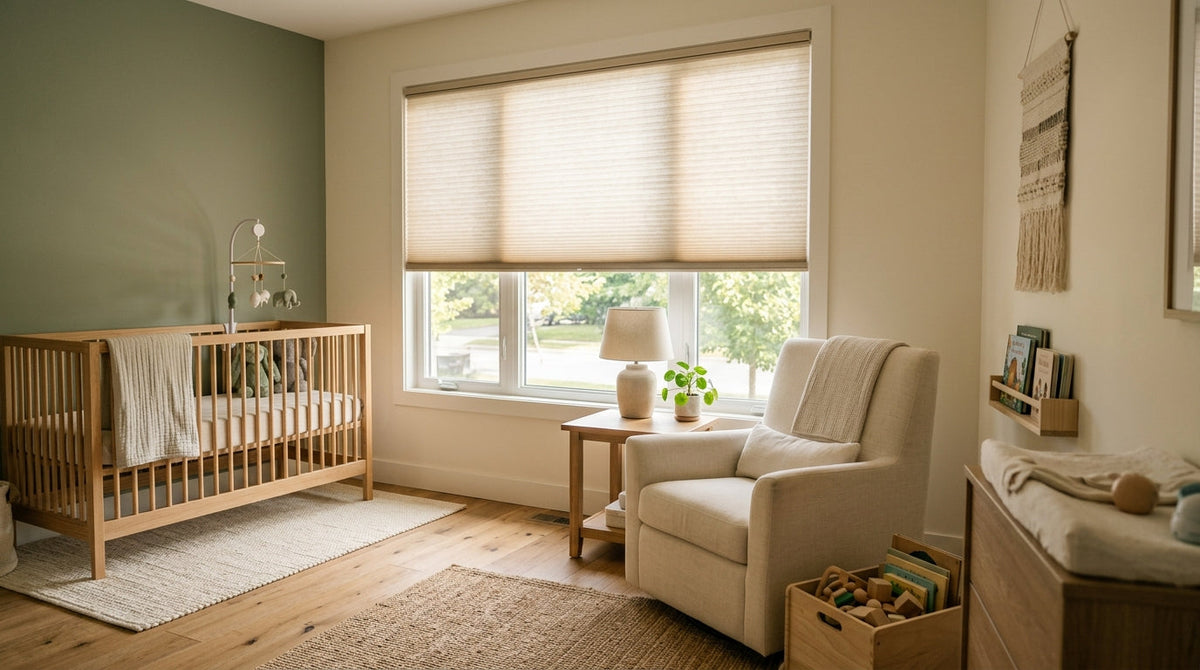
Keep the crib at least 2 feet from windows, blinds, curtain panels, and any furniture your child might eventually use as a ladder. Window blind cords are a strangulation hazard for infants and toddlers. Your baby can’t reach them on day one. By month eight, the math changes fast. Position the crib so no cord, no drape, and no shelf edge is within arm’s reach of the mattress.
Direct sunlight will overheat a sleeping infant quickly. Heating vents blow warm, dry air that disrupts sleep and can raise the ambient temperature in the crib. Neither is where you want your baby sleeping. Place the crib on an interior wall if you can, away from drafts, direct heat, and windows.
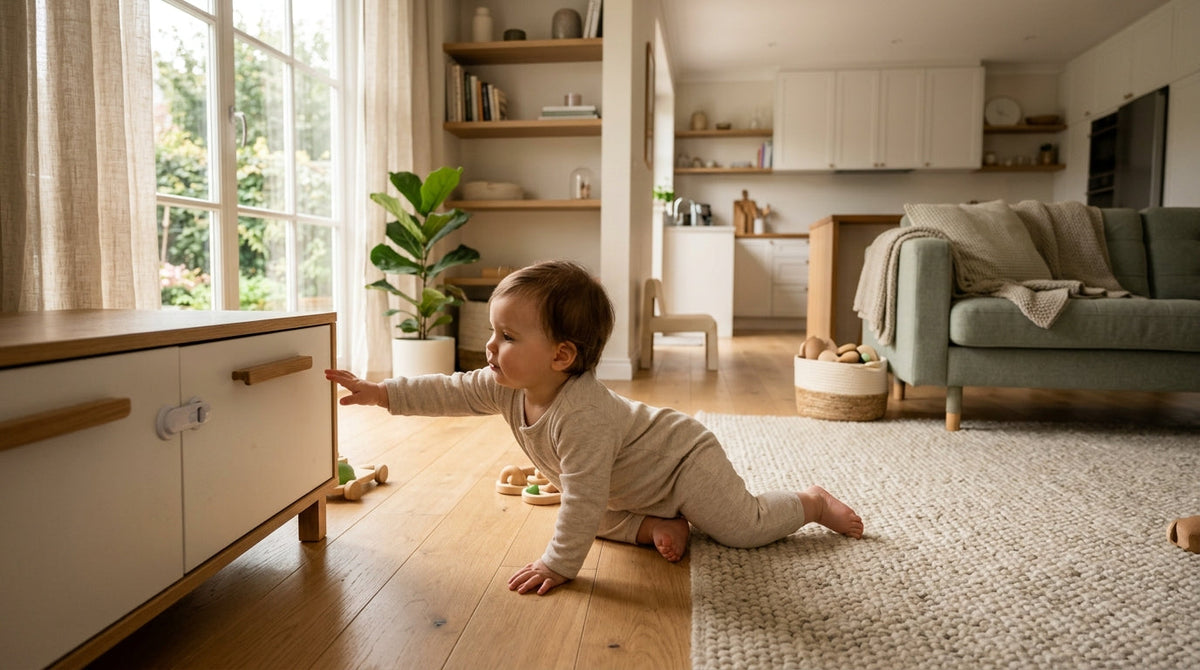
And keep it away from dressers, bookshelves, and changing tables. Once your child can pull to stand, any furniture that’s close enough to grab becomes a climbing structure. I learned this with my older daughter at around 18 months. She wasn’t trying to escape. She was just curious about what was on the dresser. But the dresser was close enough that she had leverage, and I found her standing in the crib holding a tube of diaper cream she’d pulled off the top of it. The crib moved that afternoon.
The Mattress Fit Is a Safety Specification, Not a Preference
A crib mattress that fits loosely is uncomfortable and a structural hazard. The CPSC guideline is clear: no more than two fingers of space between the edge of the mattress and the crib rail on any side. If you can fit more than that, the mattress is too small for the frame, and a baby can slip into that gap and become trapped.
Crib mattresses sold in the U.S. must meet the 2022 CPSC firmness standard (16 CFR 1241). That standard exists because a soft or compressible mattress can conform around an infant’s face during sleep, creating a suffocation pocket. When you press the center of the mattress with your palm and release it, it should spring back immediately. No give. No slow return. If it sags under your hand, it’s too soft.
For standard cribs, a mattress between 5 and 6 inches thick maintains the right firmness profile over time. Thicker isn’t better. A mattress that sits too high in the crib frame reduces the effective height of the rail, which matters more as your child grows.
Use a waterproof cover under the fitted sheet. Moisture that soaks into a mattress creates conditions for mold and mildew, which can compromise the internal structure. If the mattress smells musty, compresses unevenly, or has visible staining that’s soaked through the cover, replace it. This applies to hand-me-down mattresses especially. A mattress that’s been through one baby may not have the firmness to safely support a second.


Why the Crib Should Be Bare
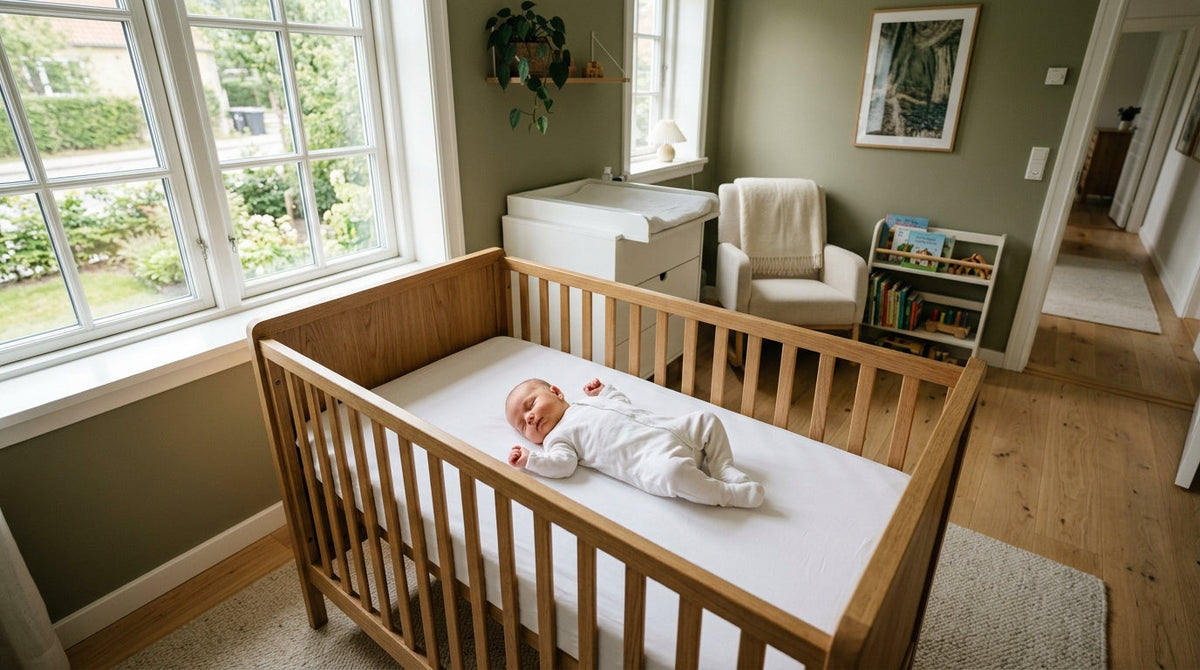
I know the impulse. The crib looks stark without a bumper, a pillow, a little stuffed animal tucked in the corner. It doesn’t look like the nursery photos. But the AAP’s guidance on this is unambiguous: the safest sleep surface for an infant is a firm, flat mattress with a single fitted sheet and nothing else.
No pillows. No blankets. No sleep positioners. No stuffed animals. No rolled towels, no wedges, no nest-style inserts.
Unintentional suffocation kills roughly 1,000 infants under age 1 each year in the United States, according to CDC data. Soft objects in the sleep space are a primary contributor. An infant doesn’t have the motor control to reposition their face away from a soft surface. Soft objects in the sleep space are a suffocation risk.
The Safe Sleep for Babies Act (2022) bans padded crib bumpers and infant inclined sleep products with a sleep surface angle greater than 10 degrees. That federal ban covers the padded bumpers you’ll still see on resale sites and in older nursery setups. But the AAP goes further: mesh bumpers, "breathable" bumpers, and any bumper marketed as a safer alternative are also not recommended. The risks of entrapment and strangulation from ties and fabric apply regardless of the material. A bare crib is the standard. There isn’t a safer bumper. There’s just no bumper.
Checking the Crib Itself
The frame your baby sleeps in needs to be structurally sound, and that’s not a one-time assessment. Crib hardware loosens with use. Wood can crack or splinter. Slats can develop gaps.
Crib slats must be no more than 2 3/8 inches (6 cm) apart per CPSC standard 16 CFR 1219. That measurement exists specifically to prevent head entrapment. Run your hand along every slat before you put a baby in the crib for the first time, and check again weekly. If you can fit more than two fingers between slats, the crib doesn’t meet current standards.
If the crib was made before June 2011, it may have drop-side rails, which are now banned. Used cribs, hand-me-downs, and antique cribs are the most common source of non-compliant hardware. Check the manufacturing date. If you can’t verify it, don’t use it. A crib that’s missing hardware, has repaired slats, or has been painted over with unknown paint is not safe for an infant regardless of how sturdy it looks.
Never leave the side rail down or remove it. The rail is a fall barrier. Without it, a mobile infant can exit the crib unsupervised, and a fall from crib height to a hard floor is a serious injury risk.
Inspect weekly: tighten every bolt, check every slat, run your hand along the top rail for splinters or cracks. If you find structural damage you can’t repair with the original hardware, stop using the crib.
Adjusting Mattress Height as Your Baby Grows
Most standard cribs offer three or four mattress height positions. Start at the highest position for a newborn. You’ll be lifting a sleeping baby in and out dozens of times a day, and the high position protects your back while keeping the baby safe.
Lower the mattress to the middle position when your baby can sit up independently, typically around 4–6 months. Lower it again to the lowest position before they can pull to stand. Once a child can pull to stand, the distance between the top of the mattress and the top of the rail is the only thing preventing them from going over. At the lowest position, that clearance is maximized.
My younger daughter was an early puller. She was standing in the crib at 7 months, which was earlier than I’d anticipated. I had the mattress at the middle position and had to drop it immediately. If I’d waited another week, she would have had enough height to get a leg over the rail. Check the position proactively, not reactively.
Weekly Crib Safety Inspection
Room-Sharing Without Bed-Sharing
The AAP recommends keeping the crib in the parent’s room for at least the first six months, and ideally through the first year. Room-sharing without bed-sharing reduces the risk of sudden infant death syndrome. The baby is close enough for you to hear and respond to, but on a separate, firm sleep surface.
Bed-sharing is a different arrangement and carries its own risks, including entrapment between the mattress and the wall, suffocation from adult bedding, and overlay by a sleeping adult. The crib in your room is the recommended setup, not a compromise.
Avoid crib tents and canopies. They restrict airflow, trap heat, and create entrapment hazards if a child becomes tangled in the fabric. No major safety organization recommends them. If your child is climbing out of the crib and you’re looking for solutions, the right answer is transitioning to a toddler bed with appropriate guardrails, not adding a tent to the existing crib.
Routine and Consistency as a Safety Practice
A consistent sleep routine reinforces the crib as a safe, familiar space. Babies who sleep in the same environment, set up the same way, every night and for every nap, are in a predictable space. That predictability also helps you maintain the setup. When the crib is always bare, you notice immediately if something has been added. When placement is fixed, you don’t have to re-evaluate the hazard radius every week.
Set the crib up correctly once, check it weekly, and adjust the mattress height on schedule. That’s the whole framework. The details above are what make it work.