How to Baby Proof Your Bedroom: A Safe Sleep and Play Space Guide

The bedroom feels like a safe place. It’s quiet, familiar, the room where you’ve rocked a baby to sleep a hundred times. But CPSC data tells a different story: half of all child tip-over deaths happen in the bedroom, compared to 22% in the living room. The room where you keep your tallest furniture, your charging cables, your nightstand medications, and your sleeping infant is also one of the most hazardous rooms in your home. The gap between how safe it feels and how safe it is, that’s exactly where accidents happen.
Furniture Tip-Over: Start Here
Bedroom dressers are the highest-risk unit for tip-over fatalities. The bedroom is where we put all the furniture we assume children won’t bother with. Dressers. Bookcases. Tall nightstands. Armoires. Children climb them like ladders.
The fix is straightforward but requires doing it properly. Every dresser, bookcase, chest, and TV needs an anti-tip strap or L-bracket anchored into a wall stud, not just drywall, whatever its height; the federal dresser tip-over standard covers units as short as 27 inches. A stud anchor holds; a drywall anchor will pull out under a child’s weight. Use a stud finder before you drill. If your walls are plaster over lath, use toggle bolts rated for the load.
In my experience, studs are often not where you expect them. Check twice.
The strap or bracket should attach near the top of the furniture and connect to a stud at roughly the same height on the wall. A low anchor point gives you poor leverage against a forward tip. Follow the hardware instructions for your specific product, and verify the anchor point can hold several times the weight of the furniture piece. After installation, grab the top corners and pull hard. If it moves more than an inch, redo it.
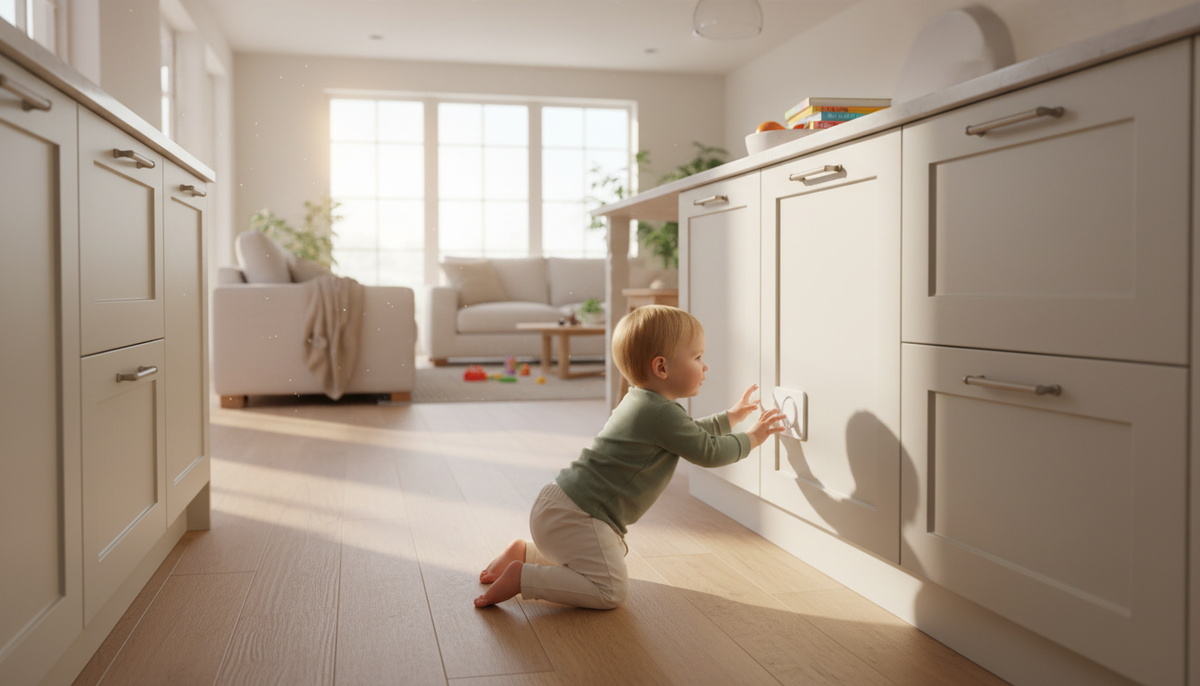
Remove the incentive to climb while you’re at it. Dresser drawers are a built-in ladder. Keep them closed and consider drawer locks if your child has figured out how to open them.
Cords: Blinds, Curtains, and Electronics
A looped blind cord is a strangulation hazard for infants and toddlers. It’s why CPSC and AAP now recommend cordless window coverings in any room where a child sleeps or plays, and why new window covering standards have pushed the industry toward cordless designs.
If you have corded blinds in your bedroom, replace them with cordless or motorized versions. If replacement isn’t immediate, use a cord wind-up device or tie-down anchor to keep the cord out of reach and looped cords separated. Windows in homes with young children should not open more than 4 inches (CPSC and AAP). About 3,300 children age 5 and younger are treated in U.S. emergency rooms each year for window fall injuries. A window stop or guard that limits opening to 4 inches addresses both the fall risk and reduces access to cord hardware mounted near the window frame.
Electronics cords are a separate problem. The charging cable on your nightstand. The lamp cord running along the baseboard. The monitor power cord. Each one is a chewing hazard, a strangulation risk for infants, and a pull-down hazard if it’s attached to something heavy. Route cords behind furniture, use cord clips or cable management channels to secure them to baseboards, and keep anything plugged in near the crib well out of reach. If a cord has to cross open floor, it needs to be covered or rerouted.
The Crib Environment: What Goes In and What Stays Out
About 3,500 infants die each year from sleep-related causes in the United States (CDC SUID data). Unintentional suffocation kills roughly 1,000 infants under age 1 each year in the United States (CDC). Most of the risk factors are things parents can control.
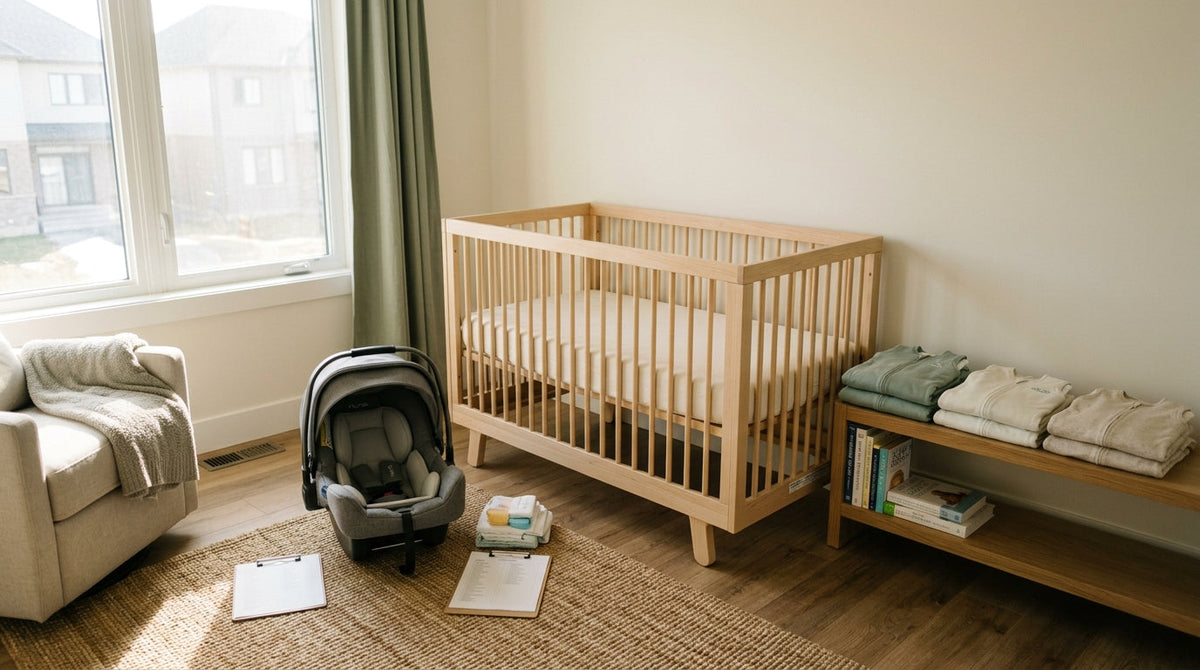
The AAP’s safe sleep guidance is clear: firm, flat sleep surface; fitted sheet only; no pillows, blankets, bumpers, positioners, or soft objects in the crib. The Safe Sleep for Babies Act (2022) bans padded crib bumpers and infant inclined sleep products with a sleep surface angle greater than 10 degrees. If you have a bumper or an inclined sleeper, they’re federally prohibited.
Your crib mattress should fit snugly with no gap between the mattress edge and the crib rail. If you can fit more than two fingers between the mattress and the side of the crib, the mattress is too small. A gap that size is an entrapment hazard.
Keep the crib away from windows and window-covering cords, ideally against a different wall, as the CPSC recommends, and away from any furniture a standing baby could reach or climb onto. Plan this before you finalize your room layout.
Keep the bedroom temperature between 68°F (20°C) and 72°F (22°C). The AAP links overheating to increased SUID risk. A room thermometer helps you monitor this accurately rather than guessing. Dress your baby in one additional layer beyond what you’d wear comfortably in the same room, and nothing more.


Outlets, Cords, and Electrical Hazards
Every outlet in the bedroom needs to be addressed. Tamper-resistant receptacles (TRRs) are the most reliable solution. They have internal shutters that only open when equal pressure is applied to both slots simultaneously, what a plug does and what a child with a single object cannot do. TRRs are now required in new residential construction under the National Electrical Code, and they’re worth retrofitting in older homes. Plug-in outlet covers work as a backup but can be removed by a determined toddler and become a choking hazard themselves.
Extension cords in a bedroom with a young child are a problem waiting to happen. They’re not a long-term solution. If you need more outlets, have an electrician add them. In the meantime, keep extension cords tucked behind furniture, never run under rugs where they can overheat, and never leave them accessible to a crawling child.
Keep charging cables off the floor and off low nightstands. A cable left plugged in at floor level is a chewing hazard and a potential burn hazard if a child manages to plug it into something while chewing the other end.
Safety Gates: Doorways and Hallways
Once your child is mobile, a bedroom doorway gate serves two functions: it keeps them in a safe space when you need a moment, and it keeps them from reaching a stairway in the middle of the night. About 93,000 children under 5 are treated in U.S. emergency rooms each year for stair-related injuries. That’s a significant and preventable number.
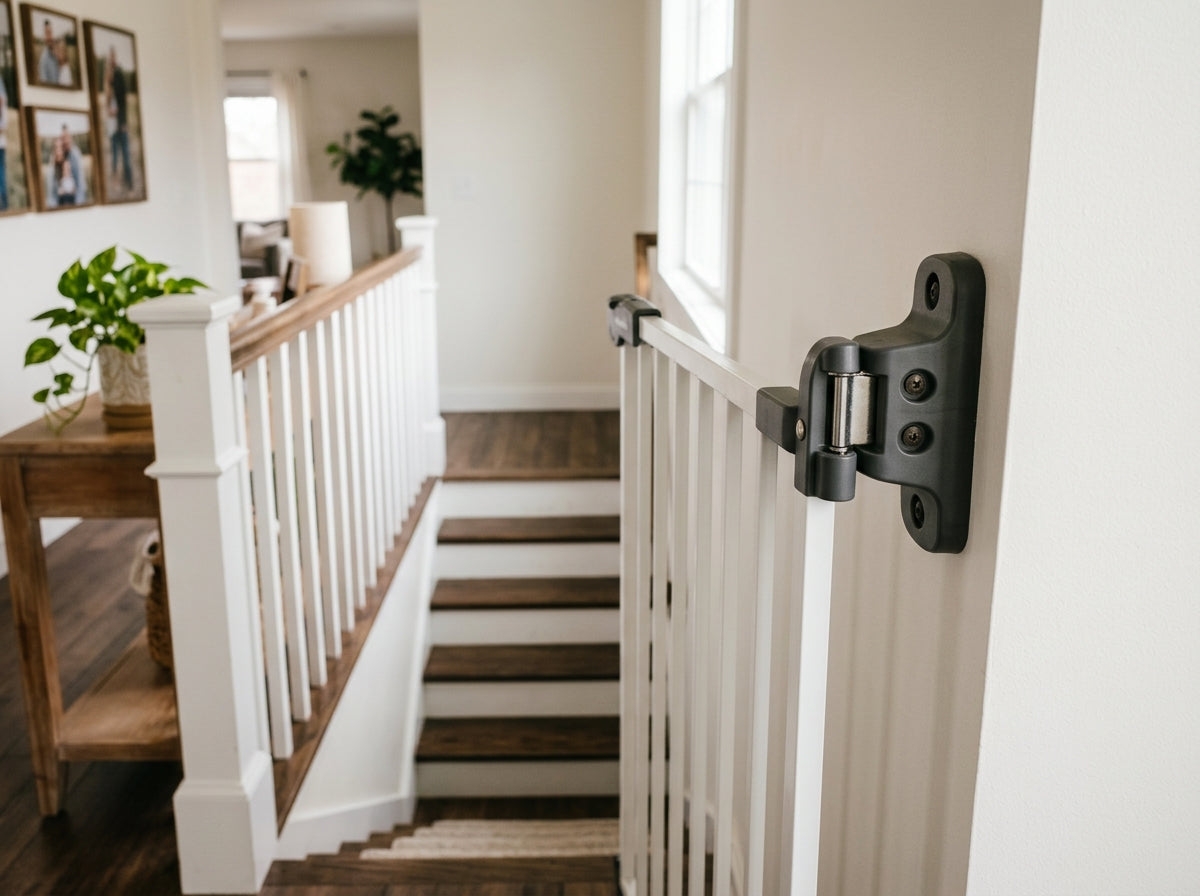
ASTM F1004 is the federal safety standard for expansion gates and expandable enclosures. Look for this certification on any gate you buy. For top-of-stair installation, use a hardware-mounted gate, not a pressure-mounted one. Pressure-mounted gates can be pushed out by a child leaning on them. Hardware-mounted gates bolt into the wall or stud and hold under real force.
Install the gate at the correct height for your child. The top of the gate should be at least three-quarters of your child’s standing height. Check the gate regularly for loose hardware, and replace it if the locking mechanism shows wear.
Medications, Lotions, and Bedroom Poisons
The nightstand is where most adults keep things they use right before bed: melatonin, ibuprofen, prescription medications, hand lotion, lip balm. From a child’s perspective, these are colorful, interesting objects at reachable height.
Every medication, supplement, and personal care product in the bedroom needs to be in a locked drawer or cabinet, or stored somewhere a child cannot reach or climb to. A child who couldn’t reach your nightstand at 14 months can pull a chair over and reach it at 22 months. Locked storage is the only reliable standard.
This includes vitamins and supplements, which often look and smell appealing to young children. Iron-containing supplements are particularly dangerous in overdose. If you’re not sure whether something is hazardous, treat it as if it is.
Choking Hazards at Floor Level
Get down on your hands and knees and look at your bedroom from your child’s eye level. What do you see? Loose change under the dresser. A button that fell off a shirt. A hair tie. A small battery. A plastic bag from dry cleaning. Earring backs. The cap from a pen.
An ingested button battery can cause severe internal burns in as little as two hours (AAP). Button batteries are in remote controls, key fobs, and small electronics that often end up on bedroom surfaces. Keep them locked away and check the battery compartment covers on any device within reach.
Do a floor-level sweep every few weeks, because objects migrate. Things fall off surfaces, roll under furniture, and accumulate in corners. A crawling child will find them before you do.
Plastic bags are a suffocation hazard and should never be on the floor or in a low drawer. Dry cleaning bags, grocery bags, and packaging bags need to go directly to a high cabinet or out of the room entirely.
The Baby Monitor and White Noise Machine
A baby monitor is a safety tool, but the monitor itself can create a hazard if it’s positioned carelessly. The power cord is the main concern. Keep the monitor at least 3 feet from the crib, mounted on the wall or on a high shelf, with the cord routed away from the crib and secured so it cannot be pulled. A monitor sitting on a dresser near the crib with a dangling cord is a cord hazard and a tip-over hazard if the child pulls on it.
White noise machines and humidifiers are useful for masking household sounds and maintaining comfortable humidity. Position them on a stable surface away from the crib, where a standing child cannot reach them. If your humidifier produces warm mist, it’s a burn hazard and should be replaced with a cool-mist model for a child’s room. Keep the cord managed the same way you would any other appliance cord.
In my experience, everything in a child’s room should be either wall-mounted or have its cord secured to prevent pulling.
Bedroom Safety Checklist
Nightlights, Room Layout, and Nighttime Navigation
A bedroom you navigate confidently at 2 p.m. becomes an obstacle course at 2 a.m. when you’re half asleep and responding to a crying baby. Clear pathways matter for your safety as much as your child’s.
Arrange furniture so you can reach the crib from at least two sides without stepping over anything. Keep the floor between the door and the crib clear. A nightlight positioned near the floor gives you enough light to navigate without fully waking a child during a sleep transition. Plug-in nightlights with auto-sensors are practical. Just make sure the outlet they’re in is not the one closest to the crib, where a curious child might try to pull it out.
Avoid nightlights that get hot to the touch. LED nightlights run cool and are the right choice for a child’s room.
Smoke Alarms and Carbon Monoxide Detectors
Three out of five home fire deaths occur in homes with no smoke alarms or non-functioning ones (NFPA). Your bedroom needs a working smoke alarm. Test it monthly and replace the battery annually, or use a 10-year sealed battery model.
Carbon monoxide poisoning kills more than 400 people each year and sends more than 100,000 to U.S. emergency rooms (CDC). Carbon monoxide is colorless and odorless, and children are more vulnerable to it than adults. If your bedroom is on a floor with an attached garage, a gas furnace, or a gas fireplace, a CO detector in or near the bedroom is essential. Combination smoke and CO detectors are widely available and cover both hazards.
Pulling It All Together
A babyproofed bedroom is not a one-time project. Children change fast. A room that was safe for a 6-month-old who couldn’t roll over needs a different configuration for an 18-month-old who climbs everything. Revisit the room every few months as your child hits new developmental milestones. What could they reach last month? What can they reach now? What’s going to be in range in six weeks?
The checklist version of this guide is useful, but the habit is what protects your child. Walk the room at floor level. Check the strap anchors. Confirm the crib is still well away from windows and cords after you rearranged things last month. Make sure the nightstand drawer is still locked. These are five-minute checks that close the gap between a room that looked safe and a room that is safe.