
When to Move Baby to Their Own Room: Room-Sharing Guidance and Nursery Prep
What the AAP and CDC say about room sharing, why neither names a move-out date, and how to prepare the nursery so the sleep space is ready.

The AAP’s safe sleep guide does not name a date for when to move baby to own room. The American Academy of Pediatrics (AAP) recommends that you share a room with your baby "for at least the first 6 months of life." It says to keep the baby’s sleep area in your room, close to your bed but not in the same bed. The CDC gives the same timing: keep your baby’s sleep area, such as a crib or bassinet, in the room where you sleep, ideally until your baby is at least 6 months old.
When to Move Baby to Own Room: What the AAP and CDC Say
Parents asking when to move baby out of parents’ room often expect a calendar date. Neither agency gives one. The AAP sets a minimum, which is at least the first 6 months. The CDC words it as "ideally until your baby is at least 6 months old."
Picture this: the nursery is painted, the crib is assembled, and your baby is 10 weeks old. The room looks ready. But the AAP’s guidance is about where the baby sleeps, not how finished the nursery is, and it asks for the sleep area to stay in your room for at least the first 6 months. Until then, the nursery can be used for diaper changes, feeding and getting ready for the day.
For a fuller walkthrough, see safe sleep practices for newborns. The short version for this question is simple. No month is named as a move-out point, so a specific "right" month is not something either agency provides.


Why the AAP Asks for Room Sharing
The AAP gives a reason for the recommendation. It advises room sharing without bed sharing because it can decrease the risk of SIDS by as much as 50%. That figure belongs to room sharing, meaning the baby sleeps on a separate, dedicated surface in your room. It does not describe sharing a bed.
The AAP also puts the problem in scale. It notes that around 3,500 babies in the United States die suddenly and unexpectedly while sleeping every year. The AAP says most of these deaths are due to SIDS or to accidental suffocation or strangulation.
The CDC uses a related term. It defines SUID as a sudden and unexpected death of a baby aged younger than 1 year. It also says it supports the 2022 recommendations issued by the AAP to reduce sleep-related infant deaths. So the two agencies agree, and a parent does not need to choose between them. For the evidence behind these recommendations, see what research says about SIDS.
Room Sharing Is Not Bed Sharing
The two terms sound alike, and the AAP treats them very differently. Room sharing means the baby’s sleep area is in your room. Bed sharing means the baby sleeps on the same surface as you.
The AAP recommends that parents avoid bed sharing with their baby under any circumstances. It says the risk of sleep-related infant death while bed sharing is 5 to 10 times higher for babies younger than 4 months.
The AAP also says the risk of sleep-related infant death is more than 10 times higher for babies who bed share with someone who is fatigued, has taken medications that make it harder for them to wake up, or has used substances such as alcohol or drugs.
The AAP names another situation where risk is higher: sleeping with someone on a couch, soft armchair or cushion. It also has its own guidance for a baby who falls asleep in a car seat, stroller, swing, infant carrier or sling. That guidance is on the AAP’s safe sleep page, so read it there in the AAP’s own words. A broader look at bed-sharing and sofa-sleeping risks gives more context.
What Stays the Same in a Separate Room
Moving rooms changes where the crib sits. It does not change the sleep rules. The AAP says to place your baby on their back for all naps and at night. It also says to use a fitted sheet only, with nothing else in the crib with your baby.
The CDC asks for a firm, flat sleep surface. That means not at an angle and not inclined. Its example is a mattress in a safety-approved crib covered by a fitted sheet. The CDC also says to keep soft bedding out of your baby’s sleep area, including blankets, pillows, bumper pads and soft toys.
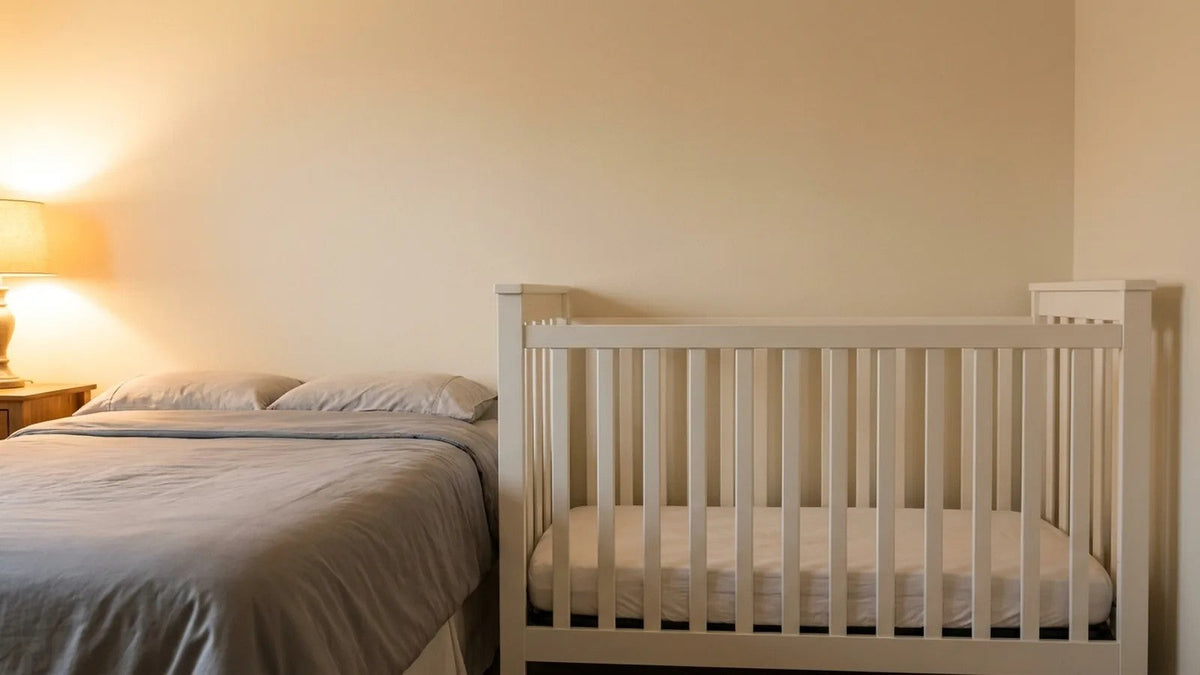
The CPSC calls its message for cribs "Bare is Best." It means nothing but a fitted sheet in a crib, bassinet or play yard, and no pillows or blankets in the baby’s sleep space. The CPSC says many young babies cannot lift their heads to pull away from soft objects that can pose a suffocation risk. Its examples are bumpers, blankets, pillows and sleep positioners.
Picture this: a crib looks bare and plain, and a friend says it seems a little stark and empty. The CPSC and CDC both point the other way. A plain sleep space is what they ask for. For more detail, see SIDS prevention and nursery setup.
Nursery Prep Checklist
This checklist uses only what the AAP, CDC and CPSC already ask for the sleep space. Use it whether the crib is in your room now or the nursery is waiting for later.
- A firm, flat sleep surface. The CDC says to use a firm, flat (not at an angle or inclined) surface, such as a mattress in a safety-approved crib covered by a fitted sheet.
- Nothing else in the crib. The AAP says to use a fitted sheet only, with nothing else in the crib with your baby. The CPSC’s "Bare is Best" says the same for a crib, bassinet or play yard.
- No soft bedding in the sleep area. The CDC says to keep blankets, pillows, bumper pads and soft toys out of your baby’s sleep area.
- A product intended for sleep. The CPSC says to use products intended for sleep, including cribs, bassinets, play yards and bedside sleepers, that meet federal requirements.
- Back to sleep. The AAP says to place your baby on their back for all naps and at night.
You can prepare a safe nursery setup whether the baby sleeps there at 6 months or later. Doing it early means the room is ready when you decide to move. Neither the AAP nor the CDC sets a deadline for getting the nursery ready; their room-sharing guidance is about where the baby sleeps.
The Rules Do Not End at 6 Months
It is easy to read "at least the first 6 months" as the point where the safe sleep rules relax. The AAP’s guide says otherwise. It states that its recommendations are for babies up to 1 year of age unless mentioned otherwise.
So the move to a separate room, if it happens before 1 year of age, comes with the same back-to-sleep, fitted-sheet-only and firm-flat-surface rules. The CDC’s definition of SUID covers babies younger than 1 year, which lines up with the AAP’s age range.
The 6-month figure is the AAP’s minimum for room sharing. It is not an age when you must move out of the shared room. Past that point, the AAP’s guide does not name a month for the move.
Where to Read the Full Guidance
The AAP’s guide, "How to Keep Your Sleeping Baby Safe: AAP Policy Explained," is on HealthyChildren.org. The CDC’s pages on safe sleep and on sudden unexpected infant death are on cdc.gov, and the CPSC’s crib information is on cpsc.gov. The AAP asks for room sharing for at least the first 6 months, and the CDC says ideally until at least 6 months. The AAP, CDC and CPSC all ask you to keep soft items out of the crib.
If you have questions about your baby’s sleep, call your pediatrician. For the AAP’s full recommendations, including its guidance on car seats, strollers, swings, carriers and slings, read that AAP guide on HealthyChildren.org.