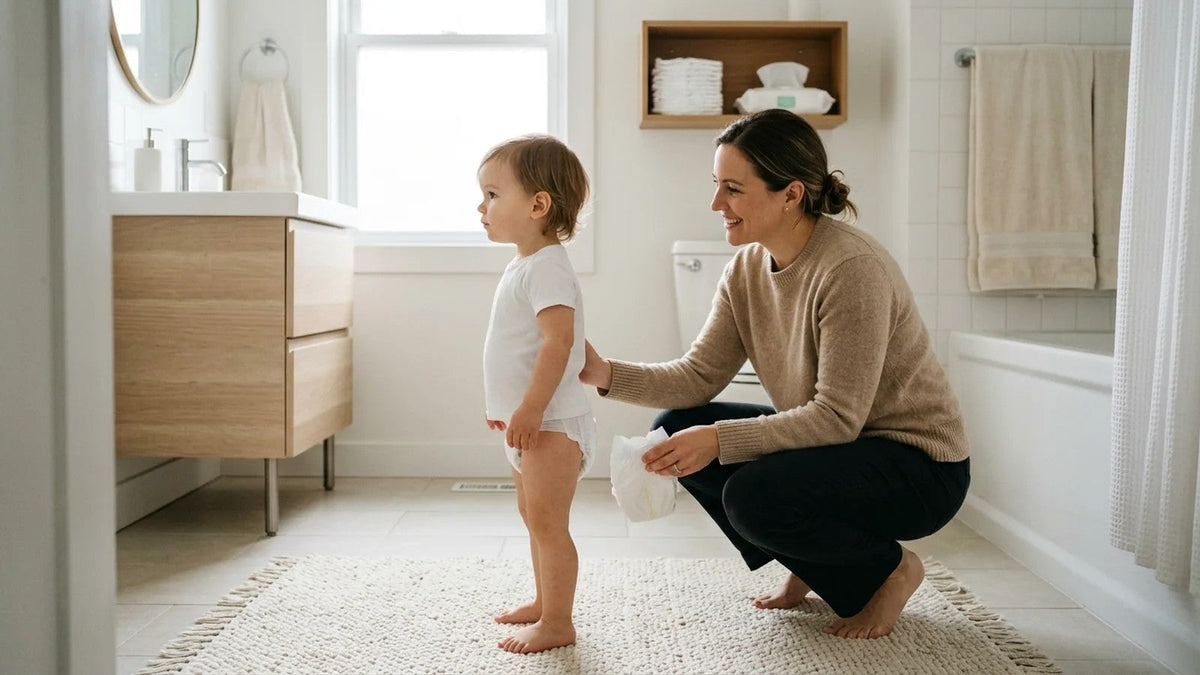

How to Do a Standing Diaper Change: Step by Step for Toddlers Who Won't Lie Down
A standing diaper change that applies CDC hygiene steps and AAP tips, with one hand on your toddler and no changing table involved.

Some toddlers treat the diaper change like a race. The moment the tabs come undone, they are ready to go.
If you are looking up how to change a diaper standing up, start with an honest limit. The AAP’s Changing Diapers page and CDC’s home diaper-changing steps both describe a child placed on a diapering surface. CDC’s first step reads "Place the child on diapering surface and unfasten diaper." Neither source describes a standing diaper change. What follows applies their sourced principles to a toddler on their feet: a hand on the child, supplies ready, front-to-back wiping, safe disposal and handwashing. Treat it as an application of their steps, not as something either organization has endorsed.
Keep a Hand on Your Toddler From the Very First Step
CDC’s home diaper-changing steps open with a reminder: "Keep a hand on the child for safety at all times." In a standing change, that means one hand stays on your toddler from the first step until your toddler is in a safe, supervised area.
Not after the diaper is open. Not once the wiping starts. From the beginning.
Your hand on your toddler is CDC’s safety reminder in action, and it does not replace paying attention. Steps 1 through 6 below assume that hand is already there.
Why No Changing Table Is Needed at Floor Level
A standing change happens with your toddler on their feet at floor level, so no changing table is involved. That matters because of what the AAP says about height. The AAP notes that although a changing table makes it easier to dress and diaper your baby, falls from such a high surface can be serious. Height is the concern behind preventing changing table falls, and at floor level there is no table to fall from.
The AAP also says changing tables "aren’t really necessary." It says a simple changing pad or the floor can serve the same purpose once you are comfortable with the routine.
Those are the AAP’s points about tables and floors. They are not a claim that standing changes are safer, and the AAP does not describe them. If you still use a table or pad for some changes, a changing pad buying guide can help you compare options. The hand on your toddler stays in place no matter where the change happens.
Get Supplies Ready and Out of Your Toddler’s Reach
Do this before the diaper comes off. The AAP says to prepare the area so everything you need is accessible. At a minimum, the AAP says, that means a diaper and something to wipe with.
The AAP adds a second rule: keep diapering supplies within your reach but out of your child’s reach, so you don’t have to leave your child’s side to get them. That reach rule fits into a safe nursery setup.
Picture this: one hand is on your toddler, the diaper is open, and the wipes are in the next room. Now you have two bad choices. You can leave your toddler’s side, or you can stretch for something that is out of range. Setting up first removes both.
Spare diapers need their own spot. The AAP says to store disposable diapers out of your child’s reach and to cover them with clothing when your child wears them. Its reason: children can suffocate if they tear off pieces of the plastic liner and swallow them.


How to Change a Diaper Standing Up, Step by Step
The order below follows CDC’s home steps. Your hand stays on your toddler through each step.
Standing Diaper Change Steps
-
Hand on your toddler
CDC’s opening reminder: “Keep a hand on the child for safety at all times.” It comes before anything else. -
Supplies ready
The AAP says a diaper and something to wipe with, within your reach and out of your toddler’s reach. Keep a hand on your toddler. -
Uncover and wipe
CDC says unfasten the diaper and clean with fresh baby wipes: “Always wipe from front to back.” Keep your hand on your toddler. -
Set the dirty diaper aside
The AAP says to put the old diaper and wipes in a “safe” place. Keep your hand on your toddler. -
Fasten the fresh diaper
AAP: center the front between the legs, secure tabs evenly. CDC: fasten and dress the child. Keep a hand on your toddler. -
Wash your toddler’s hands
CDC says to use soap and water, then place the child in a safe, supervised area. Your hand stays until that handoff. -
Clean the surface
CDC’s step covers a waterproof diapering surface, with details below. Your toddler is in a safe, supervised area. -
Wash your own hands
CDC says to wash thoroughly with soap and water. Its handwashing page says to scrub for at least 20 seconds.
The fastening step has more AAP detail behind it. The AAP says to pull the back up to at least the same level as the front, usually around the belly button, and to secure the tabs evenly in front so there are no gaps around the hips. It also says not to tuck the fringe around the legs into the diaper’s elastic edges, to help stop leaks.
Once you have the order down, how to change a toddler’s diaper standing up is a matter of repeating the same sourced steps without improvising new ones.
Boys: Cover to Limit Spray, Aim Downward to Help Stop Leaks
Expect to get sprayed and plan for it. The AAP notes that some babies tend to pee as soon as they are exposed to open air. Keeping a child relatively covered as much as you can during the change helps keep you, the surface and their clothes from getting wet, per the AAP.
For a boy, the AAP says that holding your hand, a diaper or a tissue over his penis can help.
Picture this: the old diaper is open, and your toddler lets go before the wipe even arrives. If you already have a diaper or tissue ready, you can cover right away instead of scrambling.
The AAP also covers repeat leaks. If urine keeps sneaking out of his diapers, it suggests aiming his penis downward before covering it with the diaper.
How to Change a Poopy Diaper Standing Up
A messy diaper uses the same sequence, with a few sourced additions. The AAP says that wiping with the front (inner side) of the old diaper as you remove it is optional. It also says that this often removes a significant amount of poop before you reach for the first baby wipe.
After that, the AAP says to wipe the bottom and surrounding dirty areas with a baby wipe, moist tissue or washcloth. CDC’s wiping rule applies here too: front to back.
Two placement rules matter most with poop:
- Keep the dirty diaper away from your toddler’s feet. The AAP says to find a "safe" place for it so you don’t end up with your baby’s foot in poop.
- Keep it off surfaces that are hard to clean. CDC says to keep the dirty diaper and clothing away from any surfaces that cannot be easily cleaned.
For a disposable diaper, CDC says to set the used wipes inside the dirty diaper and place both in a plastic-lined, lidded trash can. Decide where the diaper will sit before you start. The AAP’s "safe" place and CDC’s trash can are both part of the plan, not an afterthought.
Finish With Clean Hands and a Clean Surface
CDC’s finishing order is specific, so follow it. First, wash the child’s hands with soap and water and place the child in a safe, supervised area. Your hand stays on your toddler until that handoff.
Second, clean the diapering surface. CDC’s step covers a waterproof surface: wipe it with damp paper towels or a baby wipe, then scrub it with a disinfectant spray or wipe. At floor level you may have no diapering surface at all. If the change left a mess on a waterproof surface, you can apply CDC’s step to it.
Third, wash your own hands. CDC’s handwashing page lists changing diapers as a time to wash your hands. It says to scrub your hands for at least 20 seconds. Going in this order puts your toddler’s hands and safe supervision ahead of the cleanup.
Do Not Rely on a Strap or a Prop
The hand rule is stronger than any gear. The AAP says to buckle the safety strap on a changing table, but not to depend on it alone. It also says never to leave a child unattended on a dressing table, even for a moment.
That advice carries over to stand-up diapering, where there is no table and no strap. Nothing replaces your hand on your toddler, and no prop stands in for it.
Hand on your toddler, supplies within your reach, fresh diaper fastened, hands washed. Bathroom access is its own safety question, and baby-proofing during potty training takes it up.