
Renting changes nothing about how fast a baby moves. It changes everything about how you’re allowed to respond.
The wall anchors you’d use in a house you own? Off the table, or at least complicated by a lease that charges you for every hole. The pressure-mounted gate you grabbed at the baby store? It might not be rated for stairs. The cabinet locks that require drilling? Your landlord would like a word. And yet your baby does not care about any of this. She will find the one unlocked cabinet in the kitchen, the one wobbly bookshelf, the one gap in your thinking, every time.
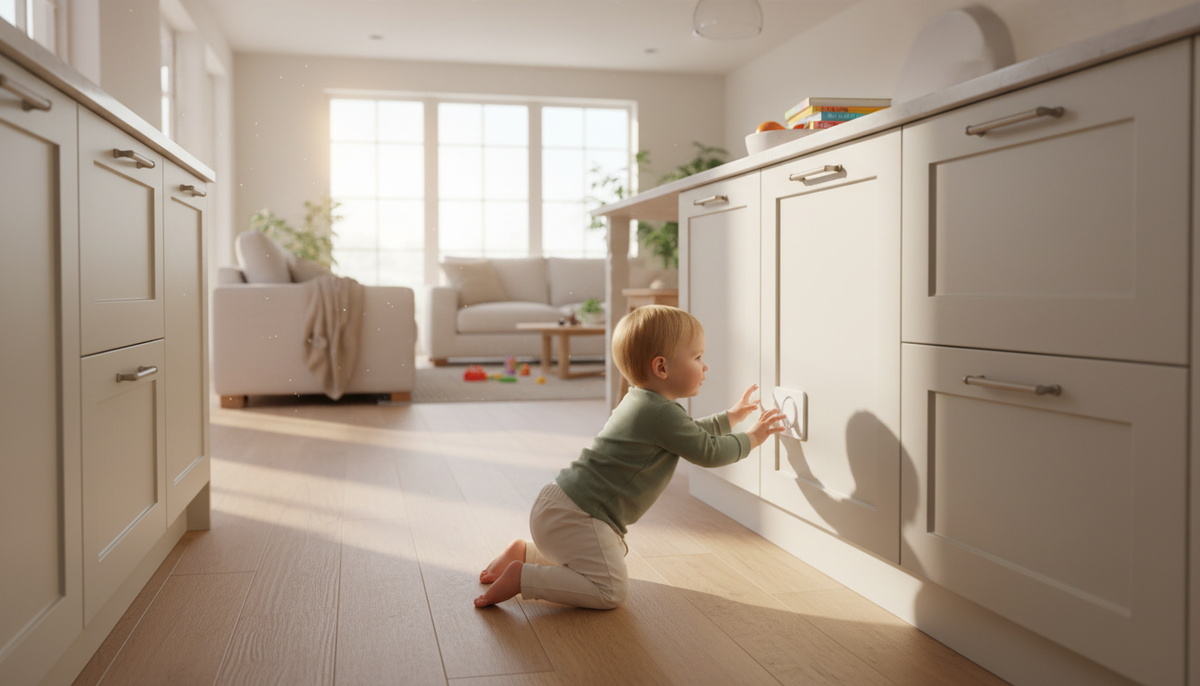
I know because my younger daughter once emptied the entire under-sink cabinet while I answered the doorbell. I was gone maybe ninety seconds. Dish soap, drain cleaner, a spare sponge, and a bottle of vinegar, all across the kitchen floor. That was the day I got serious about renter-friendly solutions that hold.
Start With a Floor-Level Audit
Before you buy anything, get on your hands and knees. Literally. Crawl through your apartment the way your baby will. The view is different down there. You’ll see the cord trailing behind the TV stand, the gap under the bathroom vanity where small fingers fit, the corner of the coffee table that’s exactly at forehead height.
Make a list by room. Note every outlet, every cabinet with anything dangerous inside, every piece of furniture that rocks when you push it, every cord. This takes twenty minutes and saves you from buying the wrong things or missing something obvious.
Your audit should flag five categories: fall hazards, tip-over risks, poisoning access, suffocation and sleep risks, and fire and carbon monoxide. We’ll go through each.
Securing Furniture Without Wall Anchors
This is where renters get stuck, and it’s the most important category to solve. One child dies from furniture tip-overs every two weeks (CPSC), and dressers, bookshelves, and TVs are the most common culprits. The instinct is to anchor everything to wall studs. But you can do a lot without touching the wall.
Furniture feet and floor anchors. Anti-tip furniture straps that anchor to the floor rather than the wall exist, and they work well on hard floors. They use a bracket that slides under a furniture foot and a strap that connects to a floor anchor. On carpet, you can use a furniture anchor plate with a long screw that goes into the subfloor through the carpet. This is a small hole in the floor, not the wall, and most leases either permit it or don’t address it. Worth clarifying with your landlord before you move in.
Low-profile furniture placement. Put the heaviest, tallest pieces against walls that already have something structural behind them. A bookshelf that’s only 36 inches tall is a much smaller tip-over risk than a 60-inch unit. If you’re buying furniture specifically for this apartment stage of life, buy short and wide.
TV stands and low mounts. Wall-mounting a TV requires drilling. But a low, wide TV console that puts the screen at or below adult eye level when seated also puts it much harder for a toddler to pull. Pair it with a TV strap that anchors to the back of the console itself, not the wall. My older daughter defeated an adhesive strap lock at 26 months, so I know these aren’t foolproof. But a console-anchored strap is meaningfully better than nothing, and it satisfies the renter constraint.
Weighted bases and museum putty. For lamps, small shelving units, and decorative items, museum-grade putty (the kind used in earthquake-prone areas) adds real resistance without adhesive damage. It’s not a substitute for strapping a dresser, but it handles the secondary hazards.
Cabinet and Drawer Locks That Don’t Require Drilling
There are three renter-viable approaches, and the right one depends on your cabinet style.
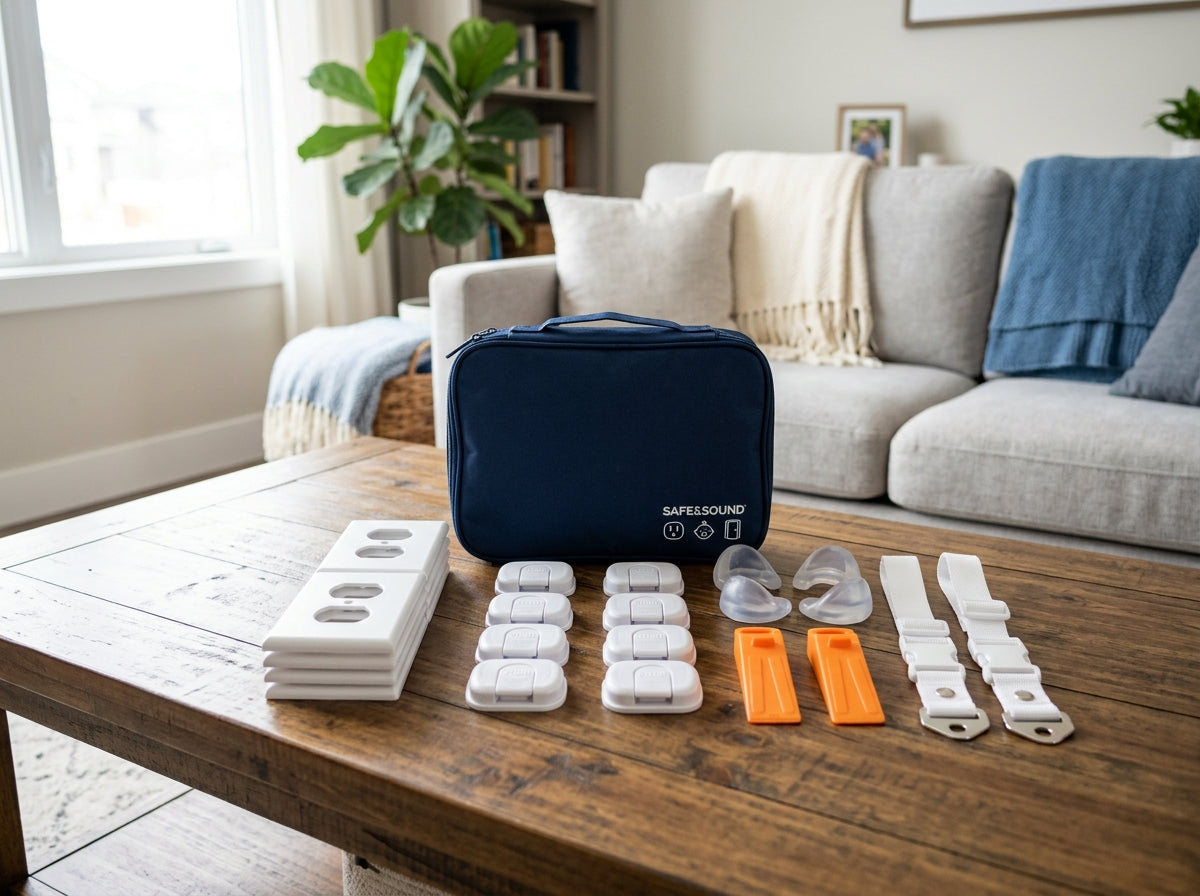
Adhesive magnetic locks. These mount inside the cabinet with adhesive pads rather than screws. A magnetic key held against the outside of the door releases the lock. They work well on smooth cabinet interiors. The failure mode is adhesive bond, which varies by surface. I’ve tested six of these across two kitchens, and the adhesive held on all but one, which was on a slightly textured laminate interior. If you’re not sure about your surface, use the adhesive plus a strip of mounting tape for backup.
Strap locks. These loop around two adjacent knobs or handles and click into a buckle. No installation required. They’re fast to put on, fast to take off, and they work on almost any handle configuration. The downside is that adults find them annoying, which means they sometimes get left unlatched. Decide whether you can live with that friction.
Slide locks for drawers. Some drawer configurations accept a slide lock that wedges into the drawer gap without any adhesive. These are the most renter-friendly option because they leave nothing behind. They’re also the most variable in terms of fit, so check your drawer style before buying.
For the under-sink cabinet specifically, where cleaning products and medications may be stored, use the most secure option you can get to hold. Unsupervised medication exposures send roughly 100 children under five to U.S. emergency departments every day (CDC PROTECT). That number covers medications specifically, not all chemical exposures. The under-sink cabinet earns its own dedicated lock.
Baby Gates: What Works on Stairs vs. Doorways
Gates are where renters make the most consequential mistakes.
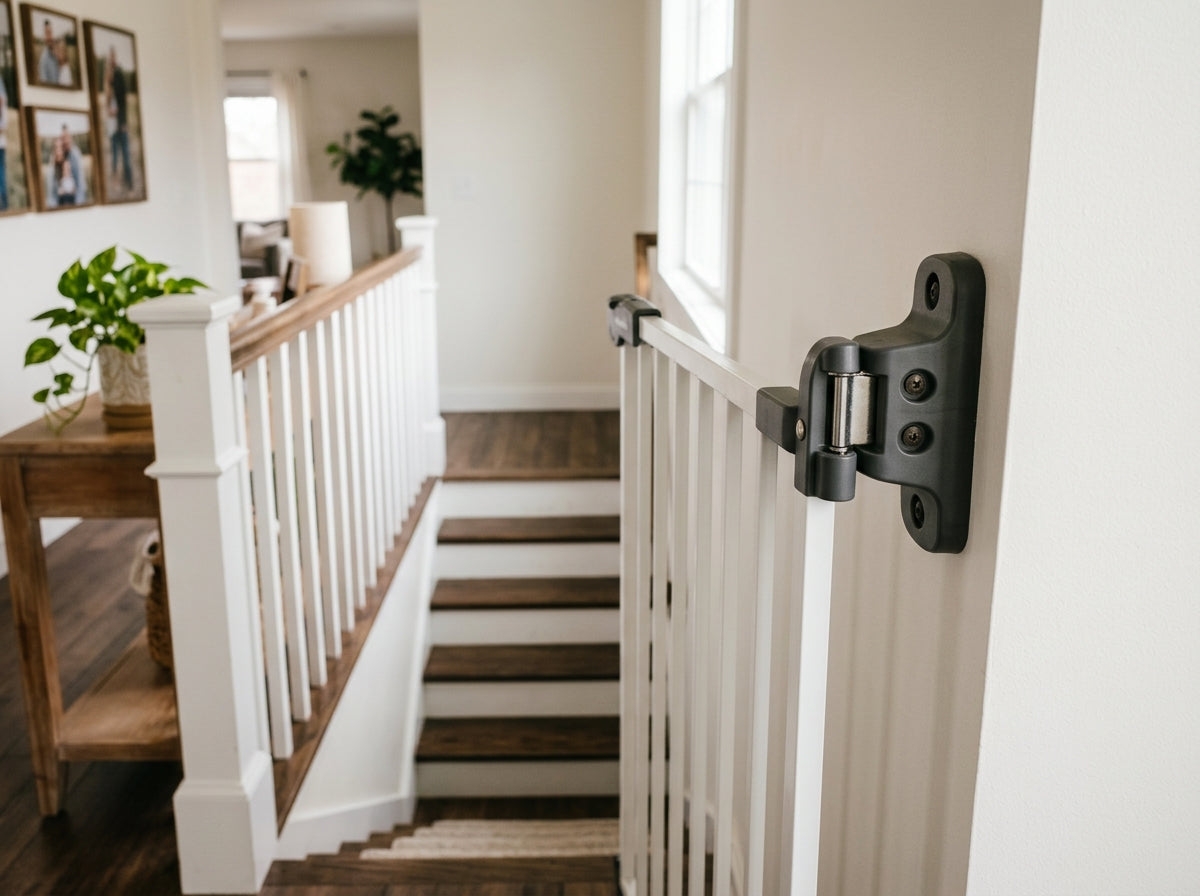
Pressure-mounted gates are not safe at the top of stairs. Full stop. A pressure-mounted gate relies on friction against two walls. A child pushing against it at the top of a staircase can dislodge it. About 93,000 children under 5 are treated in U.S. emergency rooms each year for stair-related injuries (Nationwide Children’s Hospital analysis of CPSC NEISS data). A gate that fails at the top of stairs contributes directly to that number.
At the top of stairs, you need a hardware-mounted gate. This means drilling into the wall or the door frame. For renters, the right move is to talk to your landlord before the baby arrives. Many landlords will permit it for safety reasons, especially if you offer to patch and paint when you leave. Get it in writing.
At the bottom of stairs, in doorways, and between rooms, pressure-mounted gates are appropriate and safe. Look for gates that meet ASTM F1004, the federal safety standard for expansion gates and expandable enclosures, made mandatory under 16 CFR Part 1239 (effective 2021). This standard is on the label. Don’t buy a gate that doesn’t show it.
For doorways where you want to block access without a permanent gate, a freestanding play yard panel can work as a room divider. It’s not a gate in the technical sense, but for a 10-month-old, it’s an effective barrier.
Outlet Covers and Cord Management
Outlet covers are the easiest win in baby proofing. Sliding outlet covers (the kind built into a replacement outlet plate) are the most secure option and require only a screwdriver to install. They replace the existing outlet plate with no drilling, and you reinstall the original when you leave. This is the one area where I’d push every renter to go beyond the cheap plastic plug inserts, which children can remove and which pose their own choking hazard.
Cords are a dual hazard. A cord is a strangulation risk for infants and a tip-over risk when it’s attached to something heavy. Cord shorteners and wind-up cord management clips reduce both. Adhesive cord clips along baseboards keep cords flat against the wall without nails. They peel off cleanly from painted surfaces if you use the right product (look for "removable" or "damage-free" on the packaging).
Window blind cords deserve a specific callout. Corded blinds are a known strangulation hazard for young children. If your apartment has them, contact your landlord about replacing them with cordless versions. Many landlords will do this at no cost because it’s a liability issue for them too. If they won’t, you can buy cordless cellular shades and swap them yourself, storing the originals to reinstall when you move.
Bathroom Safety in a Rental
Drowning is the leading cause of unintentional injury death in children ages 1–4 (CDC). A child can drown in as little as one to two inches of water (AAP). The bathtub is the primary concern, but toilets, buckets, and even pet water bowls matter.
A toilet lock that clamps under the lid requires no tools and no adhesive. It’s one of the cheapest and most underused baby proofing products. Get one.
For the tub, a non-slip bath mat (suction-cup style) goes in on day one. A soft spout cover protects against head injuries from the faucet. Neither requires any modification to the apartment.
Keep the bathroom door closed. A door pinch guard that hangs over the top of the door prevents it from latching fully, which means it stays accessible to adults but can’t be locked by a child from inside. This is a rental-friendly solution that also prevents finger pinches.
Room-by-Room Final Walkthrough
Smoke Alarms and Carbon Monoxide Detectors
Your landlord is likely required by law to provide working smoke alarms. But "provided" and "functioning" are different things. Test every smoke alarm in your apartment when you move in and every month after. Three out of five home fire deaths occur in homes with no smoke alarms or non-functioning ones (NFPA).
CO poisoning kills more than 400 people each year and sends more than 100,000 to U.S. emergency rooms (CDC). Apartments with gas appliances, attached garages, or shared walls with parking structures carry elevated CO risk. A plug-in combination smoke and CO detector adds a layer of protection without any installation. Put one in the bedroom where your baby sleeps.
If your apartment’s smoke alarms are older units that chirp intermittently (usually a low-battery signal), replace the batteries yourself and document it. Don’t wait for the landlord.
A Room-by-Room Checklist Before You Call It Done
Walk through this before you consider the apartment baby-proofed.