

Every year, parents buy the same three things first: a baby monitor, a car seat, and a cute mobile for the crib. Then the baby starts moving, and the real education begins.
Babyproofing is not a single afternoon project. It is a moving target that shifts as your child hits each new developmental stage, and it covers more ground than most checklists suggest.Seasonal context matters here too: the products you need in winter are not the same ones you need in summer, and your child’s capabilities in January may be different from what they were in September.
Why Timing Is Everything
Most parents start thinking about babyproofing around the four-month mark, when the pediatrician mentions it at a well visit. That is too late for some hazards and too early for others. The useful framework is developmental, not calendar-based.
Newborns need safe sleep environments above all else. Crawlers need stair gates, furniture anchors and floor-level hazard removal. Climbers, the ones who scale bookshelves and stand on toilet seats, need a full rethink of what you considered "out of reach."
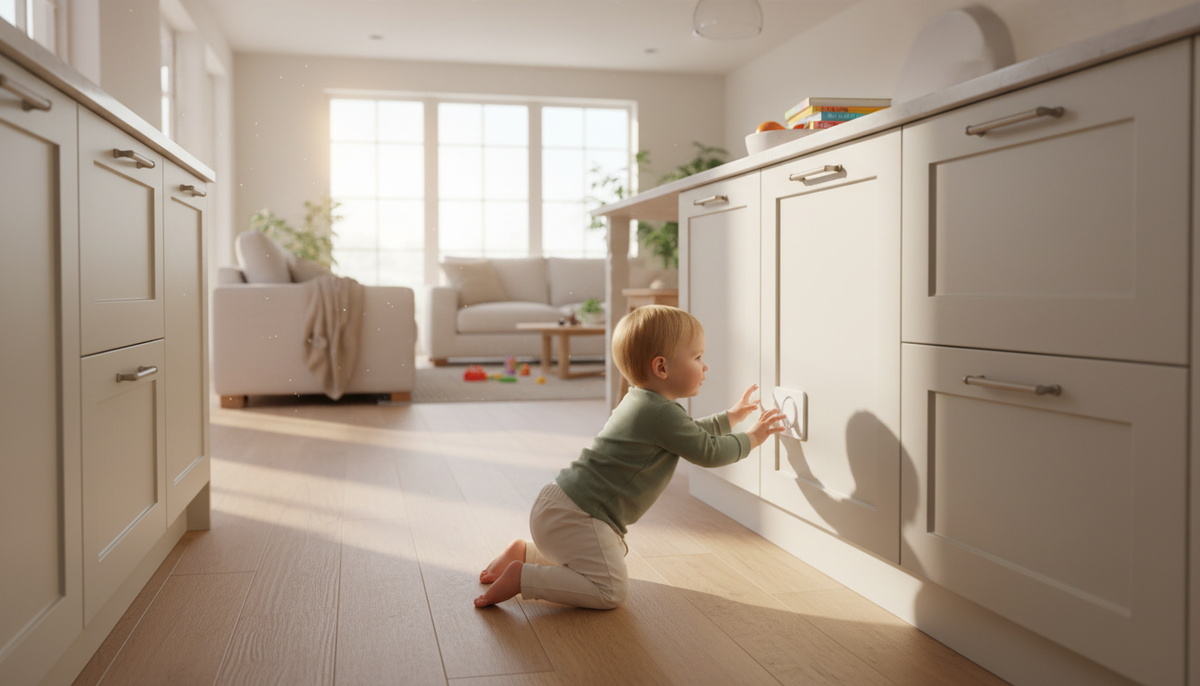
My older daughter was 26 months when she figured out the adhesive cabinet lock on our under-sink cabinet. I had tested it myself, pulled on it hard, and felt confident. She approached it differently: she pushed up on the door first, then pulled, and the adhesive gave at the corner. The cabinet was open in under a minute. The lesson was not that the lock was useless. It was that I had tested it like an adult, not like a toddler.
Seasonally, there are also specific windows to pay attention to. Early spring means windows get opened for the first time since fall, and window fall guards need inspection. Summer brings pools, buckets, and outdoor hazards. Fall is when heating systems come back on and CO detector batteries should be replaced. Winter concentrates everyone indoors near fireplaces, radiators, and space heaters. Each season has its own checklist layer.
Safe Sleep: The Nursery First
Before your baby comes home, the nursery needs to be right. About 3,500 infants die each year from sleep-related causes in the United States (CDC SUID data), and unintentional suffocation kills roughly 1,000 infants under age 1 each year in the United States (CDC). Most of these deaths are preventable.
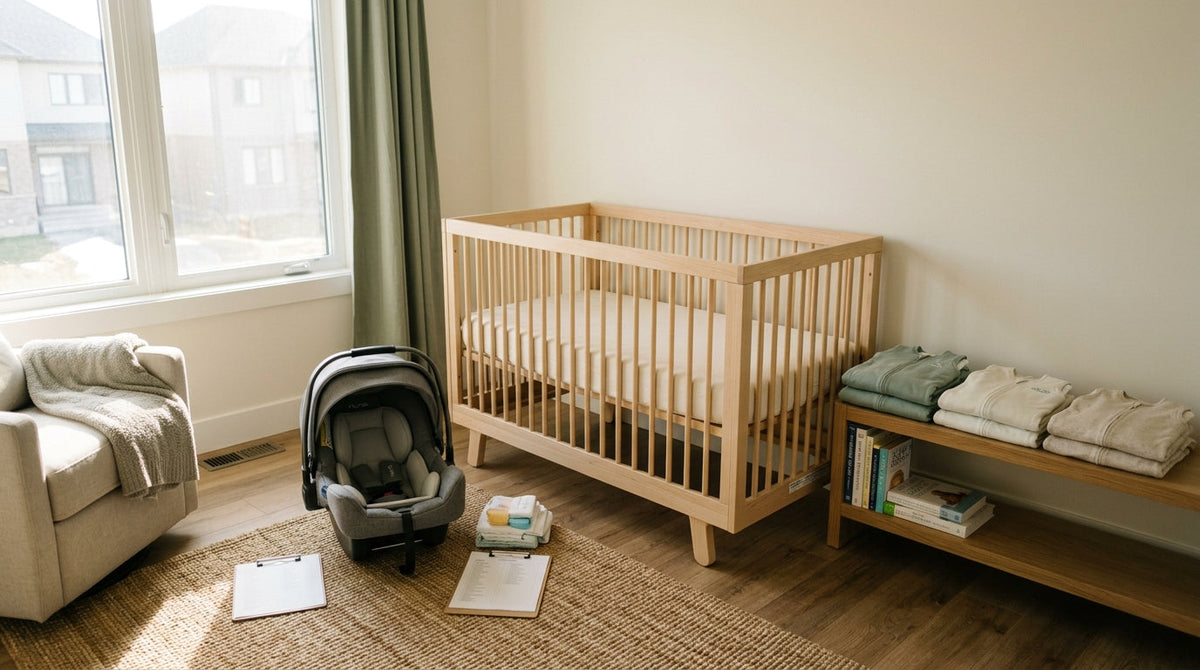
The AAP’s safe sleep guidance is specific: firm, flat sleep surface, no loose bedding, no bumpers, no inclined sleepers, baby on their back every time. The crib itself should meet current federal standards. Check the slat spacing, the mattress fit (no gaps larger than two fingers between mattress and crib rail), and the hardware. If you are using a hand-me-down crib, verify it has not been recalled. The CPSC recall database is searchable and free.
What to do in the nursery:
- Use a firm, flat crib mattress with a fitted sheet only
- Remove all pillows, positioners, stuffed animals, and bumpers
- Keep the crib away from windows, cords, and curtains
- Set the water heater to 120°F (49°C) to prevent scalding during bath time
- Install a smoke detector in or just outside the nursery
Seasonal note: In winter, parents often add blankets or sleep positioners to keep babies warm. Neither is safe. Use a wearable sleep sack instead.
Stair Gates: Getting Them Right
About 93,000 children under 5 are treated in U.S. emergency rooms each year for stair-related injuries, per a Nationwide Children’s Hospital analysis of CPSC NEISS data from 1999–2008. That works out to roughly one child every six minutes. Gates matter.
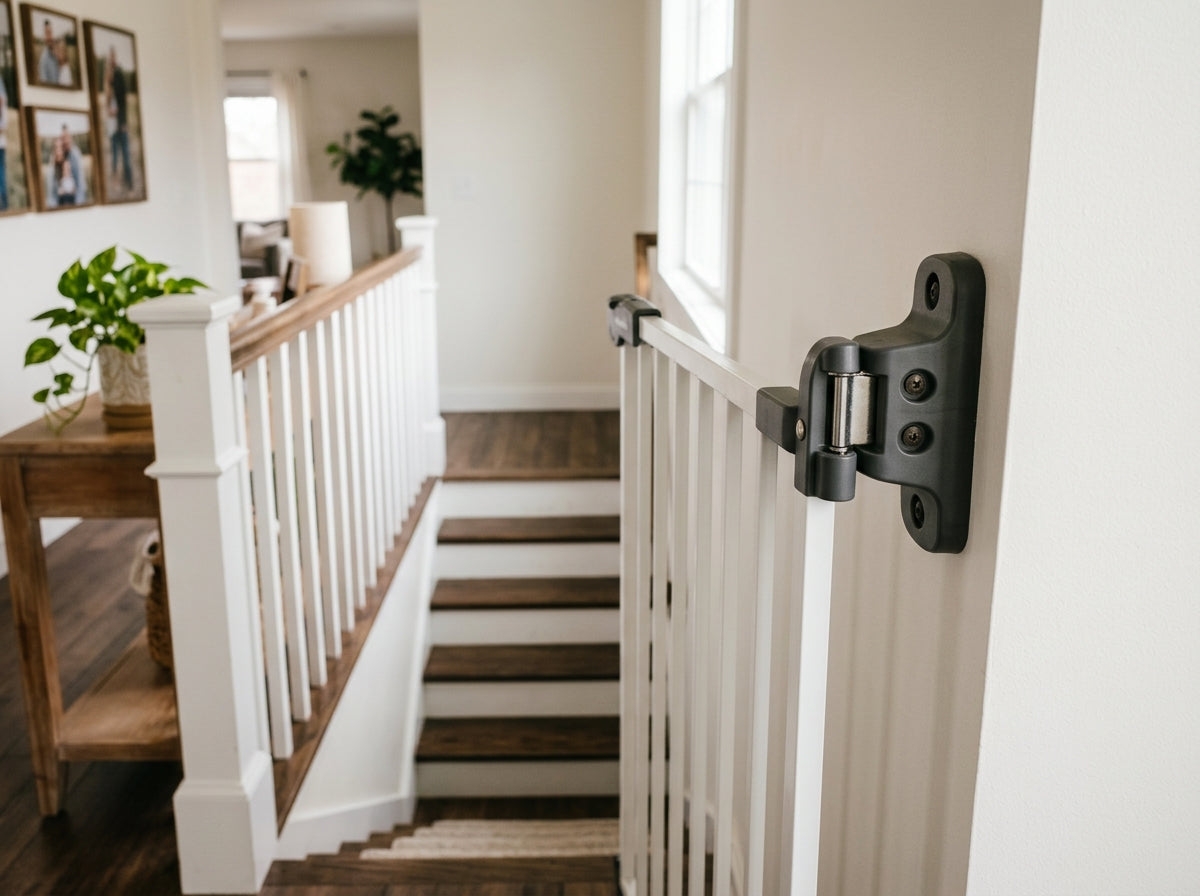
There are two categories: pressure-mounted and hardware-mounted. Pressure-mounted gates are fine for room dividers and low-risk doorways. For the top of stairs, hardware-mounted gates are required. A pressure-mounted gate at the top of stairs can be pushed out by a falling or leaning child.
ASTM F1004 is the federal safety standard for expansion gates and expandable enclosures, made mandatory under 16 CFR Part 1239 (effective 2021). When you are shopping, look for gates that carry this certification. It is not optional.
Installation matters as much as the product. Anchor bolts need to go into studs or solid wood, not just drywall. I have seen gates that looked perfectly installed fail because the screws caught drywall instead of the stud behind it. Use a stud finder. Tug the gate hard after installation. If it moves, reinstall it.
Stair gate checklist:
- Hardware-mounted gate at the top of every staircase
- Pressure-mounted gate acceptable at the bottom of stairs or in doorways
- Gate opens away from the stairs at the top landing
- No horizontal bars that create a climbing ladder
- Check gate hardware every few months for loosening
In spring, when you may be doing home projects and moving furniture, re-check every gate. It is easy to bump a gate during a renovation and not notice the anchor has shifted.
Kitchen and Bathroom: The High-Hazard Rooms
These two rooms account for a disproportionate share of childhood injuries, and they share a common feature: water.
Drowning is the leading cause of unintentional injury death in children ages 1–4 (CDC). A child can drown in as little as one to two inches of water (AAP). That means buckets, bathtubs, toilets, and even dog bowls are hazards for mobile infants and toddlers.
In the bathroom, the rules are simple but strict. Never leave a child alone in the bath, not even for the time it takes to answer the door. I learned this with my younger daughter, who at 14 months emptied the entire under-sink cabinet in the time it took me to sign for a package. She was not near water that day, but the speed of it was a reminder. Thirty seconds is enough time for a toddler to get into serious trouble.
Bathroom checklist:
- Toilet lock installed (many toddlers can lift a standard seat)
- Non-slip mat inside and outside the tub
- All medications locked away, not just on a high shelf
- Cabinet locks on every under-sink cabinet
- Drain empty-standing water from the tub immediately after use
- Water heater set to 120°F (49°C) if not already done
Per CDC PROTECT data, unsupervised medication exposures send roughly 100 children under five to U.S. emergency departments every day. A high shelf is not sufficient. Medications need to be in a locked container or a locked cabinet, including vitamins, supplements, and over-the-counter products. Child-resistant packaging is not childproof, medications must be locked away.
Kitchen checklist:
- Stove knob covers on all burners
- Oven lock if your child can reach the handle
- Cabinet locks on all lower cabinets, especially those with cleaning products
- Refrigerator lock if your child has started pulling it open
- Move sharp utensils to upper drawers or locked storage
- Keep chairs away from counters (a chair is a step stool to a determined toddler)
In summer, add outdoor kitchen hazards to your list: grills, propane tanks, and outdoor refrigerators all need attention.


Furniture Anchoring: The Hazard Most Parents Skip
CPSC reports one child death every two weeks from tip-overs involving furniture, TVs, or appliances. This is one of the most preventable hazards in the home, and it is consistently underestimated.
The mental model most parents have is that heavy furniture is stable furniture. It is not. A tall dresser with an open drawer becomes top-heavy. A bookshelf with books only on the top two shelves is unstable. A flat-screen TV on a low media console can tip forward when a child grabs the screen or pulls on a cord.
Every tall piece of furniture needs to be anchored. That means dressers, bookshelves, wardrobes, media consoles, and filing cabinets. Use anti-tip straps rated to hold at least several times the weight of the furniture piece. Anchor into studs, not drywall. If you are in a rental and cannot put holes in walls, there are furniture feet anchors that brace against the baseboard, though wall anchoring is more reliable.
Furniture anchoring checklist:
- Every dresser, bookshelf, and wardrobe anchored to a wall stud
- TV anchored or mounted, not just sitting on a console
- No heavy items stored in upper drawers or on top of furniture
- Cords and cables routed away from furniture (a child pulling a cord can tip what is attached to it)
- Check anchor hardware twice a year
Fall is a good time to do this audit. You are already thinking about the home as the weather changes and everyone spends more time inside.

- Under-sink cabinet: lock all chemicals
- Medicine cabinet: lock, not just high shelf
- Toilet: install a lid lock
- Tub: non-slip mat inside and outside
Windows, Cords, and Balconies
Window falls are a significant source of childhood injury and death, particularly in spring and summer when windows are opened regularly. Window screens are not fall protection. They are insect barriers. A child leaning against a screen will go through it.
Install window guards or window stops on any window above the first floor. Window stops limit how far a window can open, typically to 4 inches or less. Window guards are grilles that prevent a child from passing through. If you use a window guard, make sure it has a quick-release mechanism for emergency egress.
Blind and curtain cords are a strangulation hazard for infants and toddlers. Cords are tripping hazards and strangulation risks for young children. The safest option is cordless window coverings throughout the home. If you have corded blinds, use cord wind-ups and keep cords secured and out of reach. Keep cribs and beds away from any window with cords.
Window and cord checklist:
- Window guards or stops on all windows above ground floor
- Cordless blinds or secured cords throughout
- No furniture positioned under windows that could help a child climb up
- Balcony railings checked for gaps and structural integrity
- Balcony doors locked with a secondary latch above child height


Smoke, CO, and Fire Safety
Three out of five home fire deaths occur in homes with no smoke alarms or non-functioning ones (NFPA). CO poisoning kills more than 400 people each year and sends more than 100,000 to U.S. emergency rooms (CDC). Both are preventable with the right equipment, properly maintained.
Smoke detectors should be on every level of the home, inside each bedroom, and outside sleeping areas. Test them monthly. Replace batteries annually, or use 10-year sealed-battery models. Replace the entire unit every 10 years.
CO detectors should be on every level and near sleeping areas. CO is odorless and colorless. You will not smell it. By the time symptoms appear, exposure has already been serious. If a CO alarm goes off, get everyone out and call 911. Do not go back in to investigate.
Fire and CO checklist:
- Smoke detector on every level, inside every bedroom
- CO detector on every level and near sleeping areas
- Test all detectors monthly
- Replace batteries every fall (daylight saving time is a useful reminder)
- Fire extinguisher in the kitchen, checked annually
- Family escape plan practiced with children old enough to participate
- Space heaters kept 3 feet clear of anything flammable, never left unattended
In winter, heating-related fires increase. Have your furnace serviced before the cold season. If you use a wood-burning fireplace, install a hearth gate and get the chimney swept annually.
Outdoor and Seasonal Hazards
Summer brings a specific set of risks that require their own checklist layer.
Drowning is the leading cause of unintentional injury death in children ages 1–4 (CDC), and backyard pools are a primary site. If you have a pool, it needs a four-sided fence with a self-latching, self-closing gate. The fence should be at least 4 feet tall with no footholds for climbing. Pool alarms add a layer but do not replace fencing. Flotation devices are not supervision substitutes.
Empty any standing water after use: kiddie pools, buckets, wheelbarrows. A child can drown in as little as one to two inches of water (AAP). It takes less time than most parents imagine.
Outdoor checklist:
- Four-sided pool fence with self-latching gate
- All standing water emptied after use
- Outdoor play equipment checked for sharp edges, loose hardware, and splinters
- Garage chemicals (pesticides, fertilizers, automotive fluids) locked away
- Grill secured and propane stored safely
- Sunscreen, bug spray, and outdoor products locked away from children
In fall, add: check outdoor play equipment for wear before storing for winter, clear leaves from walkways to prevent falls, and inspect any outdoor heating equipment before first use.
A Room-by-Room Seasonal Audit Schedule
The most useful thing you can do with this guide is not read it once and file it away. Build a quarterly audit into your routine.
Spring (March–May):
Check window guards and stops before opening windows for the season. Inspect outdoor play equipment. Audit pool fencing and pool safety equipment. Check that CO detectors are functioning as heating season ends.
Summer (June–August):
Empty standing water daily. Review pool supervision rules with every adult caregiver. Check that sunscreen and outdoor chemicals are locked away. Inspect gate hardware on pool fencing.
Fall (September–November):
Replace smoke and CO detector batteries. Have furnace and fireplace serviced. Install hearth gate if using a fireplace. Re-anchor any furniture moved during summer. Check stair gate hardware.
Winter (December–February):
Audit space heater placement and safety. Check that no cords are near heating vents. Review safe sleep setup as temperatures drop (no extra blankets). Inspect all cabinet locks, since cold and dry air can affect adhesive products.
Putting It All Together
Babyproofing is not a checklist you complete and then forget. It is a practice you return to as your child grows, as the seasons change, and as your home changes. The hazards that mattered most when your baby was four months old are different from the ones that matter at 18 months, and different again at three years.
The good news is that the interventions work. Anchored furniture does not tip. Locked cabinets stay closed. Gated stairs stop falls. The effort is real, but so are the results. Start with the highest-risk areas, the sleep environment, the stairs, the water hazards, and the medication storage, and work outward from there. A home does not have to be perfect to be significantly safer.