

Every year, about 3,500 infants die from sleep-related causes in the United States (CDC SUID data). That number is not a rounding error or a statistical artifact. It is the size of a small elementary school, and almost all of those deaths are considered preventable.
Sleep is the single highest-risk activity in an infant’s day. Not bath time. Not car rides. Sleep. And yet the nursery is often the room parents spend the most money decorating and the least time thinking about from a safety standpoint. The fluffy bumpers, the wedge pillow, the inclined lounger that promises a more peaceful night, these are the products that have contributed to infant deaths, and many of them were sold legally until very recently.
What the evidence says, how to build a sleep environment that reflects it, and what to do when well-meaning family members show up with the wrong gear.
What SIDS and SUID Mean
Parents often use SIDS as a catch-all term, but the clinical landscape is more specific. SIDS (Sudden Infant Death Syndrome) refers to the sudden, unexplained death of an infant under one year old that remains unexplained after a thorough investigation. SUID (Sudden Unexpected Infant Death) is the broader category. It includes SIDS, accidental suffocation and strangulation in bed, and deaths from unknown causes.
The distinction matters because suffocation deaths, unlike true SIDS, are often directly linked to the sleep environment. Unintentional suffocation kills roughly 1,000 infants under age 1 each year in the United States, according to CDC data. Those deaths are the ones most directly addressed by safe sleep practices.
Researchers believe SIDS itself involves a combination of factors: a vulnerable infant, a critical developmental window (most deaths occur between one and four months), and an environmental trigger. The triple-risk model, which the AAP references in its safe sleep guidance, suggests that no single factor causes SIDS but that an unsafe sleep environment can be the tipping point for a biologically vulnerable baby. We cannot yet identify which infants are biologically vulnerable. So the environment is where we focus.
The ABCs of Safe Sleep, and Why They Work
The AAP’s safe sleep framework is built on a few core principles.
Alone. Infants should sleep alone, without other people or pets in the sleep space. Bed-sharing with adults significantly increases suffocation risk, particularly when the adult has consumed alcohol, is a smoker, or is extremely fatigued. A soft adult mattress, heavy bedding, and a sleeping adult’s body position can all create suffocation hazards that a firm crib mattress simply does not.
Back. Back sleeping reduces SIDS risk substantially. The AAP has recommended back sleep since 1992, and SUID rates dropped sharply in the years that followed. Side sleeping is not a safe alternative. Infants placed on their sides can roll to their stomachs, and stomach sleeping is associated with significantly higher SIDS risk, likely because it impairs an infant’s ability to rouse from deep sleep and re-oxygenate.
Crib. The sleep surface matters as much as the position. A firm, flat surface in a safety-approved crib, bassinet, or play yard is the standard. "Firm" means the surface does not conform to the baby’s face or head if they press against it. A mattress that passes that test is firm enough.
These three principles are not arbitrary. Each one addresses a specific, documented mechanism of infant death.


The Safe Sleep for Babies Act: What Changed in 2022
For years, parents could walk into any baby store and buy products that posed direct sleep safety risks. That changed, at least partially. The Safe Sleep for Babies Act (2022) bans padded crib bumpers and infant inclined sleep products with a sleep surface angle greater than 10 degrees.
The inclined sleeper ban is particularly significant. Products like the Fisher-Price Rock 'n Play Sleeper were linked to dozens of infant deaths before their recall. Infants in inclined sleepers can slump their chins toward their chests, compressing the airway. They can also roll to a position where their face presses against the soft fabric sides. The 10-degree threshold in the law reflects the point at which incline becomes a documented hazard.
Padded crib bumpers were banned because they can cause suffocation when an infant’s face presses against them, and because there is no evidence they prevent injury. The mesh "breathable" bumpers that remain on the market are not covered by the ban, but the AAP recommends against those as well. The safest crib has nothing in it except a fitted sheet over a firm mattress.
If you received a hand-me-down inclined sleeper or a crib with a bumper set, those products should not be used for sleep, regardless of how gently they were used before.

- Corded blind within reach of crib
- Artwork mounted directly above sleep surface
- Dresser not anchored to wall
- Inclined sleeper angled over 10 degrees
- No CO detector near sleep area
Building the Safe Sleep Environment
In my experience, setting up a nursery with nothing in the crib except a fitted sheet, no stuffed animals, no rolled blankets, no sleep positioners, feels sparse. Every instinct says to make it cozy. But cozy, in an infant sleep context, is a hazard category.
Here is what a safe sleep environment requires.
The crib or bassinet. Use a product that meets current CPSC safety standards. Vintage cribs, drop-side cribs, and cribs with decorative cutouts in the headboard or footboard are not safe. The slat spacing on a compliant crib is designed so an infant’s head cannot become entrapped. If you cannot verify that a used crib meets current standards, do not use it.
The mattress. It should be firm and fit snugly in the crib frame with no gap at the edges. A gap between the mattress and crib side is an entrapment hazard. Press your palm into the center and the edges of the mattress: it should feel hard, spring back immediately when you lift your hand, and not take the shape of your hand. A waterproof mattress cover is fine, but it should fit tightly and not add softness.
The fitted sheet. One fitted sheet, sized for the mattress. Nothing else. No loose blankets, no pillows, no positioners, no wedges. If you are worried about your baby being cold, use a wearable blanket or sleep sack in the appropriate tog rating for the room temperature.
Room temperature. Overheating is a risk factor for SIDS. Dress your baby in no more than one layer more than you would wear to be comfortable in the room, and check for signs of overheating such as sweating, damp hair, or a hot chest. Many parents aim for roughly 68–72°F (20–22°C), but the AAP does not set a specific room temperature. If you are sweating in the room, the baby is too warm.
Room sharing, not bed sharing. The AAP recommends that infants sleep in the parents’ room, close to the parents’ bed but on a separate sleep surface designed for infants, for at least the first six months. Room sharing without bed sharing reduces SIDS risk. The proximity makes it easier to respond to and feed the baby while keeping the sleep surface safe.


Smoke, CO, and the Nursery Air
The air quality in the nursery is a safety issue.
Secondhand smoke exposure is a significant SIDS risk factor. Infants whose mothers smoked during pregnancy or who are regularly exposed to secondhand smoke after birth have higher SIDS rates. There is no safe level of smoke exposure for an infant. If anyone smokes in your household, that smoke needs to stay entirely out of the home, not just out of the nursery.
Carbon monoxide is a separate, acute hazard. According to the CDC, CO poisoning kills more than 400 people each year and sends more than 100,000 to U.S. emergency rooms. Infants are particularly vulnerable because their respiratory rates are higher and their bodies cannot compensate for CO exposure the way an adult’s can. A CO detector should be installed in or immediately outside the nursery. Check the batteries when you do your smoke alarm checks.
According to the NFPA, three out of five home fire deaths occur in homes with no smoke alarms or non-functioning ones. Smoke alarms belong on every level of your home and inside or immediately outside every sleeping area. The nursery is not an exception.
Window Blind Cords and Furniture Placement
The crib should not be placed near a window with a corded blind. Blind cords are a strangulation hazard for infants and toddlers. The CPSC has documented deaths from blind cord strangulation, and the industry has moved toward cordless designs. If your nursery has older corded blinds, replace them before the baby arrives, or at minimum ensure the crib is positioned so the cord is out of reach.
Keep the crib away from walls where hanging artwork, shelves, or heavy objects could fall. Nothing should be mounted directly above the sleep surface. This includes decorative mobiles attached to the wall rather than the crib itself: if the mounting fails, the object lands in the crib.
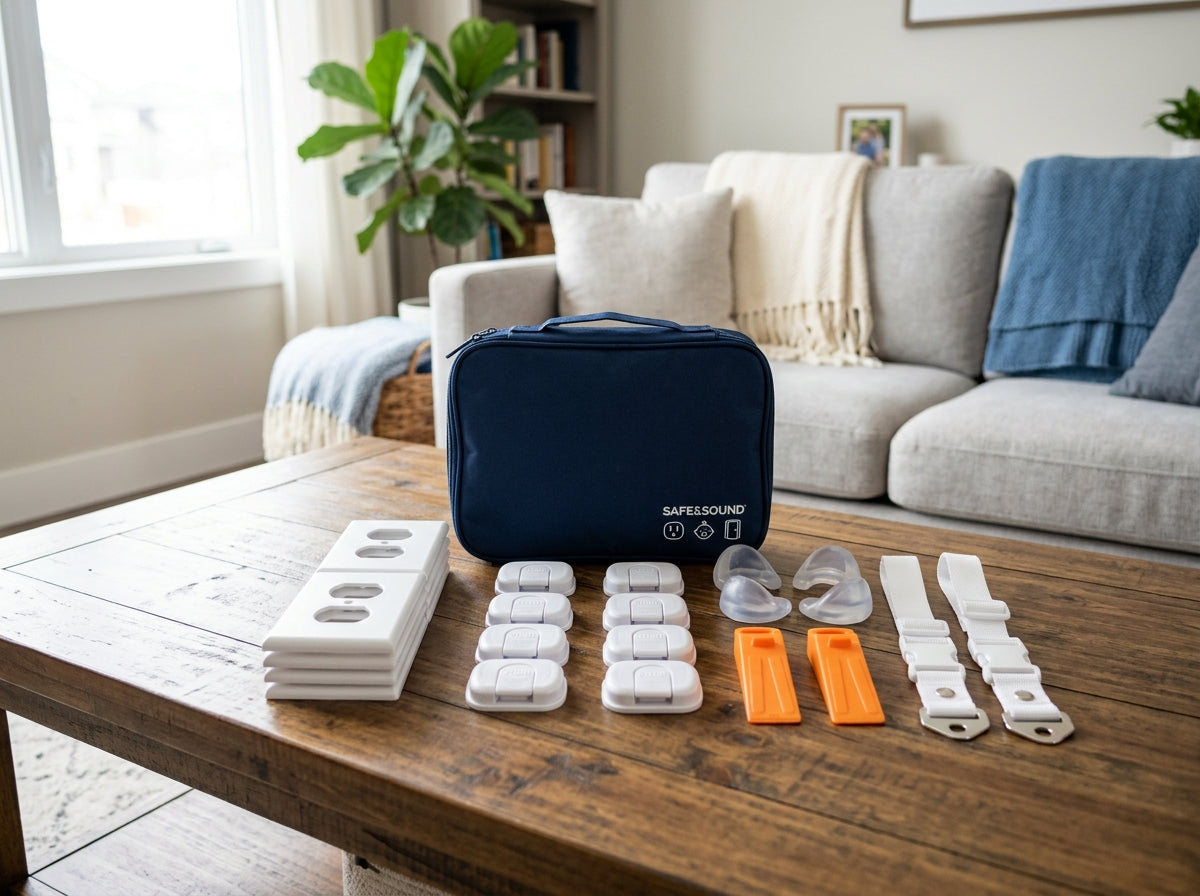
Furniture tip-overs are a risk that extends beyond infancy, but the nursery dresser and bookshelf should be anchored to the wall from day one. According to the CPSC, a child dies every two weeks from furniture, TV, or appliance tip-overs. Anchor straps are inexpensive and take about 20 minutes to install. Do it before the baby is mobile, because once they are pulling up on furniture, the window for an easy fix has already closed.
Swaddles, Pacifiers, and White Noise: What the Evidence Says
Swaddling can be done safely, but it requires attention to two things: hip positioning and transition timing. A swaddle that wraps the legs straight and tight can cause hip dysplasia. The AAP recommends swaddles that allow the hips to flex and spread. More importantly, swaddling should stop when the infant shows signs of rolling, typically around two to four months. A swaddled infant who rolls to their stomach cannot push up or reposition, which creates a suffocation risk.
Pacifiers at sleep time are associated with reduced SIDS risk, according to AAP guidance. The mechanism is not fully understood, but the association is consistent across studies. If you are breastfeeding, the AAP recommends waiting until breastfeeding is well established, around three to four weeks, before introducing a pacifier. Do not attach the pacifier to a clip or cord in the crib. If it falls out after the baby is asleep, do not reinsert it.
White noise has no documented safety risk at appropriate volumes. Keep the device at least a few feet from the crib and at a low volume. The concern with white noise machines placed directly against the crib is potential hearing exposure at high volumes over extended periods, not sleep safety itself.
Safe Sleep Environment Checklist
When Family Pushes Back
My mother-in-law arrived for our older daughter’s first weeks with a beautiful hand-stitched quilt she had made. She wanted it in the crib. This is a common situation, and it is hard, because the person offering the item is doing so out of love.
The most useful framing I found was to separate the object from the sleep space. The quilt lives in the nursery. We use it for tummy time, for photos, for cuddles. It just does not go in the crib. This approach lets people feel that their gift matters, which it does, without creating a negotiation about safety standards.
For grandparents who insist that "we did it this way and you turned out fine," the honest answer is that infant mortality rates were higher in previous generations, and we now understand why. The back-sleep campaign alone is credited with preventing thousands of deaths. This is not overcaution. It is applied evidence.
After the Newborn Stage: Adjusting as Your Baby Grows
Safe sleep is not a static setup. It evolves.
When your infant begins to roll, typically around four to six months, you may find them on their stomach in the crib. Once a baby can roll both ways independently, you do not need to reposition them. Place them on their back to start sleep, and let them find their own position. The risk profile changes once they have the motor control to reposition themselves.
The crib mattress should be lowered before your baby can pull to stand, usually around six to eight months. A standing infant in a crib with a high mattress position can topple over the rail. Check the mattress height setting at every well-child visit as a reminder.
Move your child out of the crib when they reach 35 inches (89 cm) tall, when the crib rail is below about three-quarters of their height (roughly chest level), or when they start climbing out, whichever comes first. A child who climbs out of a crib unsafely is at greater fall risk than a child in a toddler bed with a bed rail. The timing varies widely, but most children make this transition between 18 months and three years.
The nursery you build in the first weeks is a starting point. The goal is a sleep environment that is as safe as the evidence allows, adjusted as your child grows into it.