
Baby Proofing Products: The 20 Must-Have Items for Every Home
The 20 Must-Have Items for Every Home

Every year, parents spend hours researching strollers and nursery paint colors. The cabinet locks get ordered the night a curious ten-month-old nearly pulls a bottle of dish soap off the shelf. I know because that was me, sprinting to my phone at 11 p.m. while my younger daughter sat triumphantly in front of the open under-sink cabinet, surrounded by sponges and a mostly-empty bottle of surface cleaner.
The products below are the ones I’ve installed, tested, and in several cases, watched my own kids defeat. They’re organized by hazard category so you can work through your home systematically rather than panic-buying a random assortment of plastic widgets.
Gates: Your First Line of Defense on Stairs
About 93,000 children under 5 are treated in U.S. emergency rooms each year for stair-related injuries, per a Nationwide Children’s Hospital analysis of CPSC NEISS data. That number puts stairs near the top of every baby proofing priority list, and a good gate is the fix.
For the top of stairs, you need a hardware-mounted gate, full stop. Pressure-mounted gates belong in doorways and room dividers, not anywhere a fall is possible. Look for gates certified to ASTM F1004, the federal safety standard for expansion gates and expandable enclosures, made mandatory under 16 CFR Part 1239 effective 2021. That certification means the gate has passed standardized push-out and slat-force testing.
What to buy: A hardware-mounted gate with a one-hand open mechanism and a swing-clear design. The Munchkin Loft and Regalo Easy Step are reliable mid-range options. For wide openings, the Evenflo Position and Lock Tall Gate handles spans up to 60 inches with extension panels.
Installation note: Mount into studs or use the included wall cups with toggle bolts rated for the job. A gate screwed only into drywall will not hold.
Cabinet and Drawer Locks: Under the Sink and Beyond
My younger daughter cleared the under-sink cabinet in roughly 90 seconds. Cleaning products, a spare sponge, a box of trash bags. The magnetic cabinet locks I installed the next day have held for two years.
There are three main types. Adhesive strap locks are easy to install and work on most cabinet styles, but adhesive fails on textured surfaces and in humid environments like under sinks. My older daughter defeated one at 26 months by simply pulling the strap until the adhesive gave.
Magnetic locks mount inside the cabinet and are invisible from the outside. They require a magnetic key to open, which means you need to keep track of the key. They’re more durable than adhesive straps and work well on cabinets with a flat interior surface for mounting.
Spring-loaded latches are the budget option. They work, but they require more precise installation and can be bypassed by a determined toddler who figures out the angle.
What to buy: For under-sink and cleaning supply cabinets, magnetic locks (Safety 1st Magnetic Cabinet Lock system is widely available). For drawers, adhesive strap locks are usually sufficient since the contents are lower-risk. For corner cabinets with lazy susans, a door knob cover or a separate hasp lock works better than any internal latch.
Furniture Anchors: The Tip-Over Problem
CPSC reports one child death every two weeks from furniture, TV, or appliance tip-overs. Dressers, bookshelves, and TV stands are the most common culprits. The fix costs about $15 and 20 minutes.
Anti-tip straps anchor furniture to wall studs using a metal bracket and a nylon strap. Every piece of tall furniture in your home needs one: dressers, bookshelves, wardrobes, TV consoles, filing cabinets. If it can be climbed or pulled on, anchor it.
What to buy: IKEA’s FIXA strap (included with most IKEA furniture, but often skipped during assembly) is adequate for lighter pieces. For heavier furniture, the Quakehold Furniture Anchor or the Safety 1st Heavy Duty Furniture Strap provides more load capacity. Mount into studs whenever possible. Drywall anchors are a last resort and should be rated for the furniture’s weight.
TV note: A flat-screen mounted to the wall is safer than one sitting on a stand. If wall mounting isn’t possible, anchor both the TV stand and the TV itself using an anti-tip strap rated for electronics.


Outlet Covers and Tamper-Resistant Plates
Standard outlet covers are the small plastic plugs that children can pull out and choke on. Skip them. Modern tamper-resistant outlets (TRO) have internal shutters that only open when equal pressure is applied to both slots simultaneously, which a child’s finger or a single-prong object cannot do. The NEC has required TRO in new residential construction since 2008.
If your home is newer, your outlets may already be tamper-resistant. Check by looking for the letters "TR" stamped between the slots. If they’re not there, the most effective upgrade is replacing the outlet entirely with a tamper-resistant model. It’s a 15-minute job with a screwdriver and costs about $3 per outlet.
What to buy: Leviton and Hubbell both make widely available tamper-resistant outlets. If you’re renting and can’t replace outlets, the sliding plate covers (like the Jool Baby sliding outlet cover) are a better choice than plug-in caps because they can’t be removed and swallowed.


Door Knob Covers and Door Pinch Guards
Two separate problems, two separate products.
Door knob covers prevent toddlers from opening doors to rooms that aren’t safe: bathrooms, garages, utility rooms, home offices with shredders or medications. The standard round-knob cover requires a palm grip to operate, which small hands can’t manage. They don’t work on lever handles. For lever handles, use a lever lock cover or a door handle lock.
Door pinch guards protect fingers from getting caught in the hinge gap or the door edge. Foam pinch guards wrap around the door edge and prevent the door from closing fully. Hinge-side guards cover the pinch point at the hinge. Both are worth having on any door a child uses frequently.
What to buy: Safety 1st Door Knob Covers for round knobs. For pinch protection, the KidCo Door Pinch Guard or a simple foam door stopper that hangs over the door top works well.

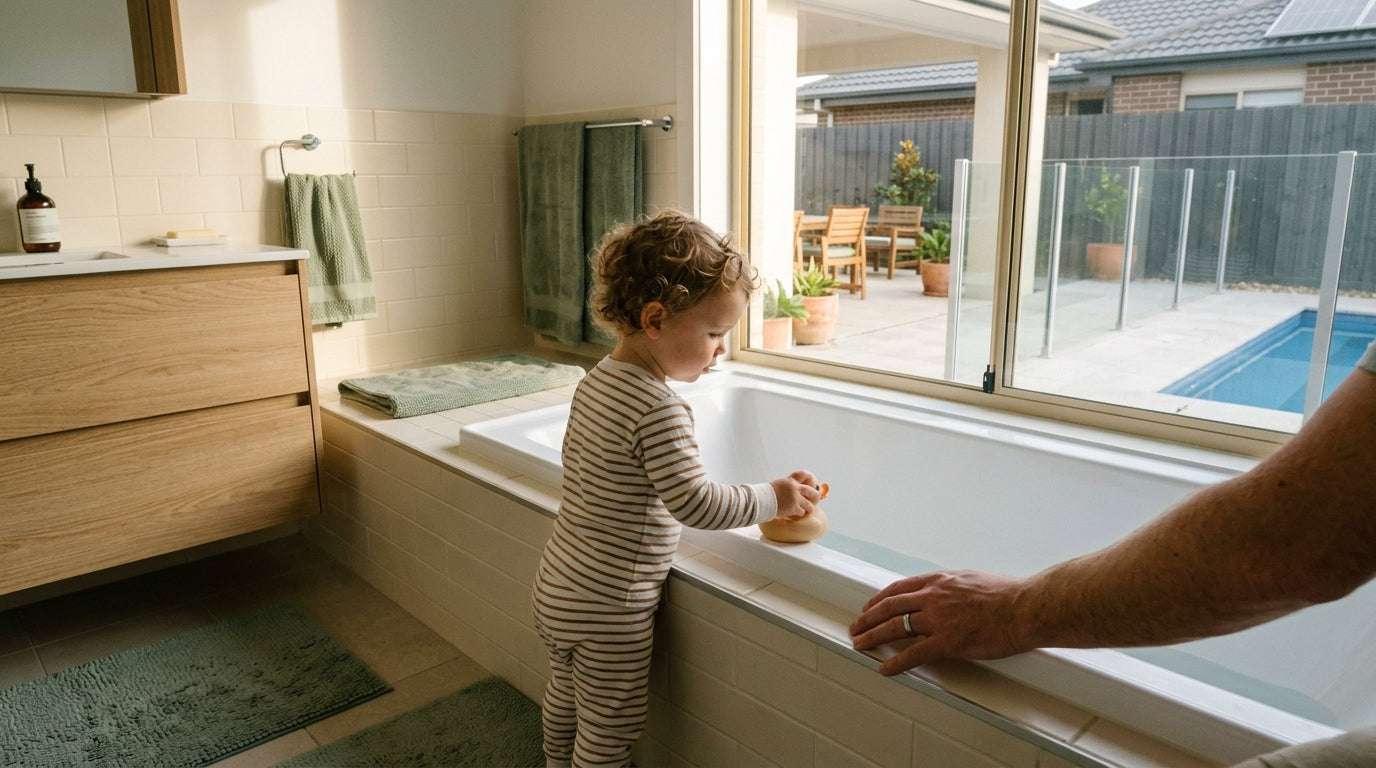
- Toilet: drowning risk, needs lid lock
- Bathtub: scalding and slip hazard
- Faucet spout: head injury risk
- Under-sink cabinet: lock cleaning products
Baby Gates for Room Boundaries
Beyond stair gates, freestanding play yard panels and pressure-mounted doorway gates let you create safe zones and off-limit zones without permanent installation. These are especially useful in open-plan homes where there’s no natural doorway to block.
Pressure-mounted gates work for doorways where a fall isn’t possible. They’re faster to install and easier to move. Just confirm the gate is certified to ASTM F1004 regardless of mounting type.
What to buy: The Regalo Easy Step Extra Wide Walk Thru Gate handles doorways up to 37 inches. For larger open areas, the Regalo Super Wide Adjustable Baby Gate and Play Yard converts between a gate and a freestanding enclosure.
Toilet Locks and Bathroom Safety
Drowning is the leading cause of unintentional injury death in children ages 1–4 (CDC). Most parents think of pools and bathtubs, but the toilet is a real risk for infants and young toddlers. A child can drown in as little as one to two inches of water (AAP).
A toilet lock prevents the lid from being opened without adult intervention. They’re simple, inexpensive, and take about two minutes to install.
What to buy: The Safety 1st Toilet Lock and the KidCo Toilet Lid Lock both use a simple latch mechanism that adults can operate one-handed. Pair a toilet lock with a door knob cover on the bathroom door for layered protection.
Corner and Edge Guards
Coffee tables, hearths, and open shelving are the main offenders. Corner guards are foam or silicone pieces that cushion sharp 90-degree corners. Edge guards are longer strips that protect the full length of a sharp edge, like a brick fireplace hearth.
What to buy: For furniture corners, the Roving Cove soft silicone corner guards have strong adhesive and hold up to cleaning. For fireplace hearths, a full hearth gate (like the Summer Infant Multi-Use Deco Extra Tall Walk-Thru Gate) is more effective than edge foam alone, since it keeps children away from the surface entirely.
Stove Knob Covers and Oven Locks
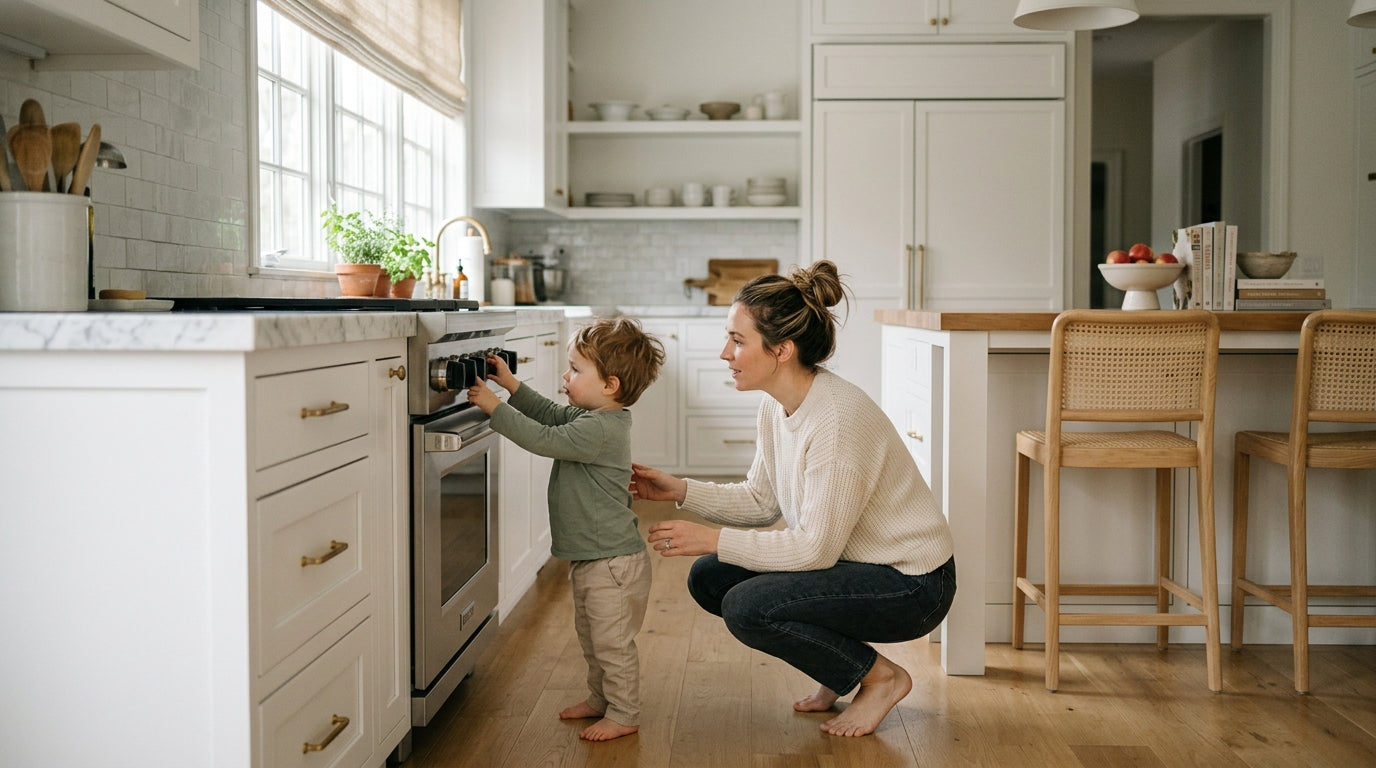
Stove knobs are at exactly the right height for a toddler to grab and turn. Knob covers fit over the knobs and require a squeeze-and-turn motion to operate. They’re not universal, so check your stove model before ordering.
Oven door locks prevent the oven door from being pulled open. The oven exterior also gets hot enough to cause burns, so keeping children away from it entirely is the goal.
What to buy: Skyla Homes Stove Knob Covers fit most standard round knobs. For the oven door, the Oven Door Lock by Jool Baby uses a two-step release that adults can manage quickly.
Refrigerator and Appliance Locks
A refrigerator lock sounds excessive until your child figures out how to open the fridge and help themselves to whatever is on the bottom shelf. It’s also a suffocation hazard if a child climbs inside and the door closes.
The same strap-style locks used for cabinets work on refrigerators. Dishwashers, washing machines, and dryers benefit from similar treatment.
What to buy: The Jool Baby Refrigerator Door Lock uses a flexible strap that works on most fridge styles. For front-loading washers and dryers, appliance-specific locks are available from Safety 1st.
Medication and Poison Storage
Per CDC PROTECT data, unsupervised medication exposures send roughly 100 children under five to U.S. emergency departments every day. Childproof caps are not enough on their own. Medications need to be stored out of reach and out of sight, in a locked container if possible.
What to buy: A small lockbox or a locking medicine cabinet. The Master Lock 7146D portable lock box works for travel and home use. Store all medications, vitamins, and supplements in it, including the ones that seem harmless, like gummy vitamins, which are appealing to children precisely because they taste good.
Smoke and Carbon Monoxide Detectors
Three out of five home fire deaths occur in homes with no smoke alarms or non-functioning ones (NFPA). CO poisoning kills more than 400 people each year and sends more than 100,000 to U.S. emergency rooms (CDC). Both detectors are non-negotiable.
The AAP recommends a smoke detector on every level of the home, inside every bedroom, and outside every sleeping area. CO detectors belong on every level and near sleeping areas.
What to buy: Combination smoke and CO detectors simplify installation. The Kidde Combination Smoke and Carbon Monoxide Detector and the First Alert SCO5CN are both widely available and reliable. Test them monthly. Replace batteries annually, or buy units with 10-year sealed batteries.