Every new parent I know has a registry story. The one where they scanned the fancy wipe warmer, the seventeen-piece bath toy set, the stuffed animal the size of a golden retriever. And then the baby arrived, and none of it mattered, and meanwhile nobody had told them the crib mattress they chose didn’t fit snugly enough, or that the baby monitor cord was routed directly over the changing table.
I was that parent with my first. I built a registry that was heavy on aesthetics and light on safety thinking. By the time my older daughter was mobile, I was doing a panicked second pass through the house, adding cabinet locks and outlet covers and a proper stair gate I should have had from day one. With my second, I started from safety and worked outward. This guide is that second approach, organized for 2026 and updated for the standards in effect right now.
Think of your registry in layers. The first layer is sleep safety. The second is fall and furniture safety. The third is poison and chemical safety. The fourth is water safety. The fifth is fire and air safety. The sixth is car safety. Everything else, including the cute stuff, comes after those six layers are covered.
Within each section below, I’ve noted what to look for on product listings, what certifications matter, and where the current standards stand. Some of this changed recently. Pay attention to the 2026 notes.
Sleep Safety: The Foundation of Everything
About 3,500 infants die each year from sleep-related causes in the United States (CDC SUID data). That number has been stubbornly consistent for years because safe sleep is still widely misunderstood. The registry items that matter most here are also the ones most likely to be given as gifts by well-meaning relatives who learned different rules with their own children.
What to register for:
A firm, flat sleep surface. This means a crib, bassinet, or play yard that meets current CPSC standards. Check the listing for CPSC certification. If a crib was manufactured before June 28, 2011, it likely does not meet the current federal crib standard. Buy new, or check the manufacture date on the crib’s label and search the model at cpsc.gov/Recalls. For a used bassinet or play yard, check the manufacture date on its label and search the model at cpsc.gov/Recalls before using it.
A crib mattress that fits with no more than two fingers of gap between the mattress edge and the crib rail. Measure this. Do not assume.
What to leave off the registry:
Inclined sleepers. Loungers. Any product marketed as a "baby nest," "snuggler," or "co-sleeper insert." The AAP’s safe sleep guidelines are unambiguous: baby sleeps alone, on their back, on a firm flat surface, with no soft objects in the sleep space. No bumpers. No positioners. No pillows. No blankets until the child is well past infancy.
Unintentional suffocation kills roughly 1,000 infants under age 1 each year in the United States (CDC). Many of those deaths involve soft bedding or unsafe sleep surfaces. The quilted crib set can go on the wall as decor.
Baby monitor notes:
Register for a monitor with a long cord or, better, a cord-free plug-in design. If the monitor has a cord, that cord needs to be routed away from the crib, at least three feet. This is not a minor point. Cord strangulation is a documented cause of infant death. The monitor goes on a dresser or wall mount, never on the crib rail.
Stair and Fall Safety: Gates and Anchors
About 93,000 children under 5 are treated in U.S. emergency rooms each year for stair-related injuries (Nationwide Children’s analysis of CPSC NEISS data, 1999–2008). Gates are the primary intervention, and the standard that governs them matters.
ASTM F1004 is the federal safety standard for expansion gates and expandable enclosures, made mandatory under 16 CFR Part 1239 (effective 2021). When you’re shopping, look for this certification on the box or product listing. A gate that doesn’t carry it hasn’t been tested to the federal requirement.
Hardware-mounted vs. pressure-mounted:
For the top of stairs, hardware-mounted only. Pressure-mounted gates are for doorways and room dividers where a fall-through failure means a tumble into a room, not down a flight of stairs.
What to register for:
One hardware-mounted gate for the top of each staircase. One or two pressure-mounted gates for kitchen doorways or other room boundaries. Look for gates with a one-hand adult release that a toddler cannot replicate. The latch mechanism matters more than the color.
Furniture anchoring:
A child dies every two weeks from furniture, TV, or appliance tip-overs (CPSC). Dressers, bookshelves, and TV stands all need to be anchored before your baby is pulling up to stand, which happens earlier than most parents expect. Register for anti-tip furniture straps. They install in minutes and belong on every tall piece of furniture in your home, not just the nursery.
If you’re registering for a dresser or changing table combo, confirm it comes with anti-tip hardware and read the installation instructions before you set it up. Many parents skip the anchoring step because the furniture feels stable. It isn’t stable once a 25-pound child uses a drawer as a ladder.
Cabinet, Drawer, and Outlet Safety
My younger daughter emptied the under-sink cabinet in the time it took me to answer the doorbell. She was 11 months old and crawling fast, and she had the cabinet open and the dish soap out before I made it back to the kitchen. That was the day I stopped thinking of cabinet locks as optional.
What to register for:
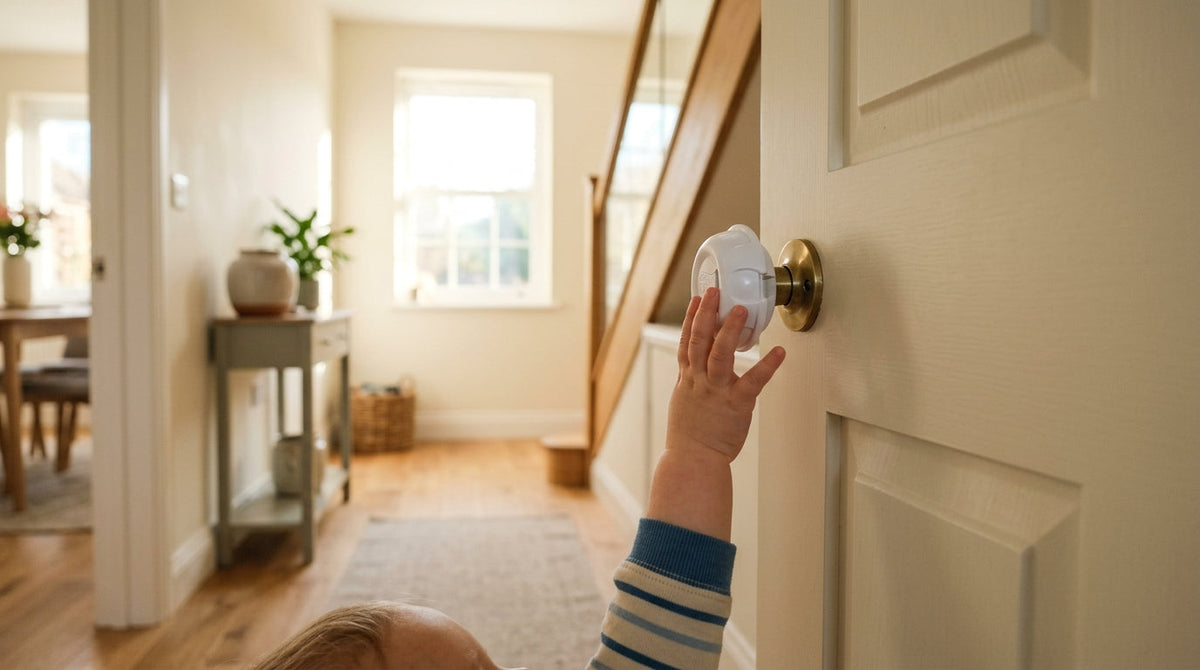
Magnetic cabinet locks for under-sink cabinets and any cabinet containing cleaning products, medications, or sharp objects. Magnetic locks are harder for toddlers to defeat than adhesive strap locks. They require a magnetic key to open, which you keep out of reach.
Adhesive strap locks for lower cabinets and drawers that don’t contain hazardous materials but that you’d prefer to keep closed. Understand that adhesive quality varies by surface. On painted cabinets, test the adhesive on an inconspicuous spot before committing. On textured or unfinished wood, use screws.
Outlet covers or outlet plates. The sliding plate style (where you have to push and rotate simultaneously to open) is more effective than the plug-in cap style, which toddlers can remove. Register for the sliding plate covers and have them installed before your baby is sitting up.
Medication storage:
Approximately 300 children and teens (ages 0–19) are seen in U.S. emergency departments every day for medication-related poisoning (CDC). Medications are not just a cabinet safety issue. They’re a purse-on-the-floor issue, a grandparent’s-visit issue, a pill-left-on-the-counter issue. Register for a lockable medication box or a high cabinet with a childproof latch. Think about where visitors set their bags when they come to your home. That’s often where the exposure happens.
Water Safety
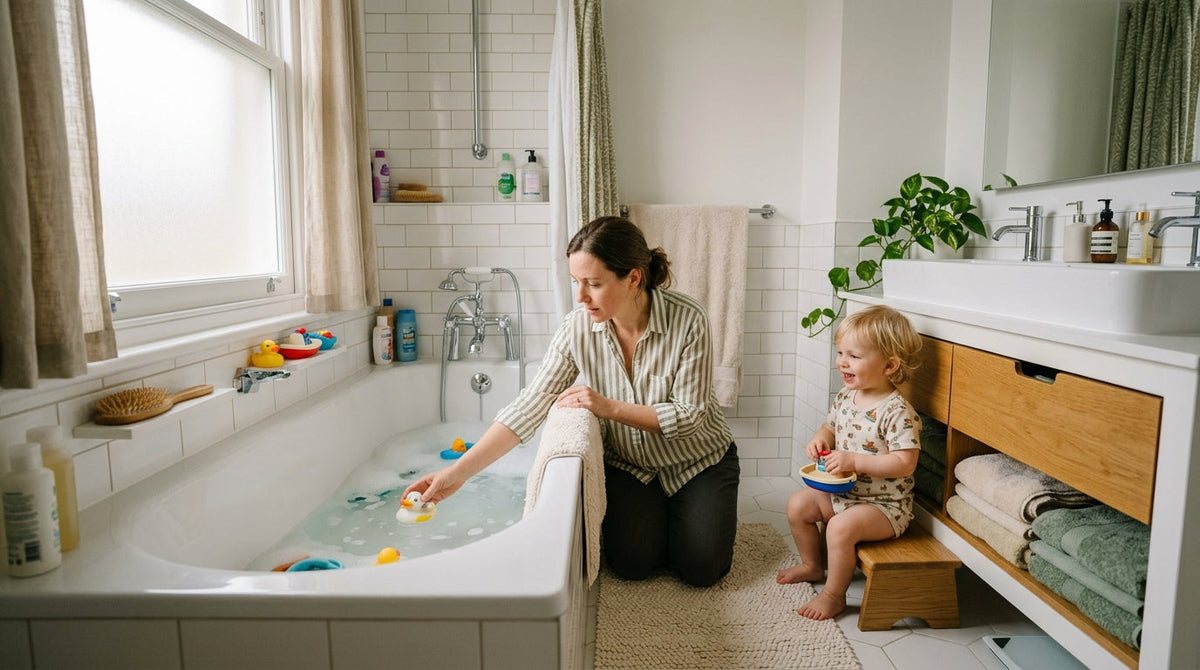
Drowning is the leading cause of unintentional injury death in children ages 1–4 (CDC). A child can drown in as little as one to two inches of water (AAP). This means a bucket, a toilet, a dog bowl, or a baby bathtub left with standing water is a hazard.
What to register for:
A baby bathtub with a non-slip surface and a drain plug you can operate quickly. Look for a design that supports your baby’s head and body so one of your hands can stay on your baby at all times while the other reaches for soap or a washcloth.
A non-slip bath mat for your regular tub for when your child transitions out of the baby tub.
A toilet lock if you have a curious toddler in the house. This sounds excessive until you know the drowning statistic.
What the registry can’t solve:
No product substitutes for supervision. The registry item is the backup. Constant arm’s-reach supervision is the primary protection. Register for the bath products that make supervision easier, not the ones that suggest you can step away. Bath seats and bath rings are convenience items, not safety devices. A child can tip out of a bath ring in seconds.
If you have a pool, a hot tub, or live near any body of water, the conversation about layers of protection (fencing, alarms, door locks, swim lessons at the appropriate age) starts before your baby is born, not after.
Fire, CO, and Air Safety
Three out of five home fire deaths occur in homes with no smoke alarms or non-functioning ones (NFPA). CO poisoning kills more than 400 people each year and sends more than 100,000 to U.S. emergency rooms (CDC). These are not nursery products in the traditional sense, but they belong on your registry as part of auditing your home’s detection systems.
What to register for:
Combination smoke and CO detectors for every level of your home and inside every bedroom. If your current detectors are more than 10 years old, they need to be replaced regardless of whether they still beep during a test. The sensor degrades over time.
A carbon monoxide detector specifically for the nursery if the nursery is on a different floor from your existing detectors. CO is odorless and colorless. You will not know it’s there without a detector.
A note on air quality:
You don’t need a medical-grade air purifier for a healthy baby in a typical home. If you live in an area with high particulate pollution, or have pets and a family history of allergies, a HEPA air purifier for the nursery is a reasonable registry item. Look for one with a sealed HEPA filter and a low noise setting for overnight use. An air purifier cannot protect a baby from tobacco smoke; if anyone in the household smokes, keep the home and car completely smoke-free.
Car Seat Safety: The 2026 Update
Car seats are the most regulated item on this list, and the standards are changing in a meaningful way. FMVSS 213a, the new federal child restraint side-impact standard, takes effect December 5, 2026. This is a new subpart of the existing federal motor vehicle safety standard, and it introduces dedicated side-impact testing requirements for child restraints.
If you are purchasing a car seat in late 2025 or 2026, look for seats that are already certified to FMVSS 213a, or confirm with the manufacturer whether the seat you’re considering will meet the new standard. Seats designed and certified only under the prior standard are not automatically unsafe, but the new testing requirement represents a higher bar for side-impact protection.
What to register for:
An infant car seat or a convertible car seat. Infant seats are convenient for the first year and work well with compatible strollers. Convertible seats last longer and can be more economical, but they are larger and heavier to move between cars. Neither choice is wrong. What matters is correct installation and correct use every single time.
A car seat installation check. Many fire stations and certified Child Passenger Safety Technicians offer free installation checks. Book one before your due date. Real-world car seat installations show a high rate of errors, including harness height, chest clip position, and seat angle. A technician will catch what you missed.
What to skip:
Aftermarket car seat accessories that didn’t come with the seat. Head inserts, strap covers, mirror attachments that clip onto the headrest. If it didn’t come in the box, it hasn’t been crash-tested with that seat. The exception is accessories sold by the seat’s own manufacturer specifically for that model.
Registry Safety Checklist
The Rest of the Registry: Filling In Around Safety
Once your six safety layers are covered, the rest of your registry is flexible. A few practical notes:
Changing table: Register for a changing table with a safety strap and raised sides, or a changing pad with a contoured edge and a strap. Never leave a baby unattended on an elevated surface, even strapped. The strap buys you a second, not a minute.
High chair: Look for a five-point harness, a wide stable base, and a design that is easy to wipe clean. Tip stability matters more than most parents realize. A child rocking in a high chair can tip it. Test the base before you buy.
Baby carrier: Look for the ASTM F2236 certification for soft infant carriers. Follow the T.I.C.K.S. guidelines (Tight, In view at all times, Close enough to kiss, Keep chin off chest, Supported back) for safe babywearing. A carrier is not a substitute for a safe sleep surface.
Bouncer and swing: Fine for supervised awake time, not for sleep. If your baby falls asleep in a swing, move them to their firm flat sleep surface. This is the AAP guidance.
Baby proofing kit: Register for a comprehensive kit that includes corner guards, cabinet locks, outlet covers, and furniture straps. You will use all of it. The corner guards will go on the coffee table at around seven months, when your baby starts pulling up and their forehead is exactly coffee-table-corner height.
Building Your Registry with Intention
The registry is a planning document as much as a wish list. When you add a product, ask yourself where it will live in your home, how it interacts with your baby’s developmental stage, and whether it has a safety certification you can verify. Decorative or convenience-focused products can wait. Products that sit between your baby and a preventable injury belong at the top.
Your pediatrician is a resource here. The 2-week, 2-month, and 4-month well visits are good moments to ask about safe sleep setup, feeding safety, and what to babyproof next as your baby’s mobility develops. The AAP’s HealthyChildren.org is also a reliable reference for any safety question that comes up between visits.
Register for what you need, verify the certifications, and install the safety hardware before your baby comes home. The wipe warmer can wait.