

Every year, parents spend hours researching strollers and minutes thinking about what happens when the baby starts to move. That gap is where children get hurt.
Not anxiety. Evidence.Why "Baby-Proofing" Is the Wrong Frame
The phrase implies a one-time project. You install some cabinet locks, cover the outlets, declare victory. But child safety is a moving target, literally. The hazards that matter at four months are almost entirely different from the ones that matter at fourteen months, and different again at three years. A home that was safe last Tuesday may not be safe today, because your child learned something new overnight.
Think of it as an ongoing assessment, not a checklist you complete and file away. Each developmental leap, pulling to stand, cruising along furniture, climbing, opening doors, changes the risk profile of your home. The goal is to stay one step ahead.
In my experience, this is hard. My older daughter defeated an adhesive cabinet lock at 26 months. I had tested the lock, trusted the adhesive, and moved on. She had other ideas. My younger daughter once emptied the entire under-sink cabinet in the time it took me to answer the front door. Both incidents were my reminder that hardware matters more than adhesive, and that speed matters more than I expected.
Sleep Safety: The Foundation
Before your baby can roll, cruise, or climb, the sleep environment is the primary risk zone. About 3,500 infants die each year from sleep-related causes in the United States (CDC SUID data). That number includes SIDS and other sudden unexpected infant deaths, many of which are associated with unsafe sleep conditions.
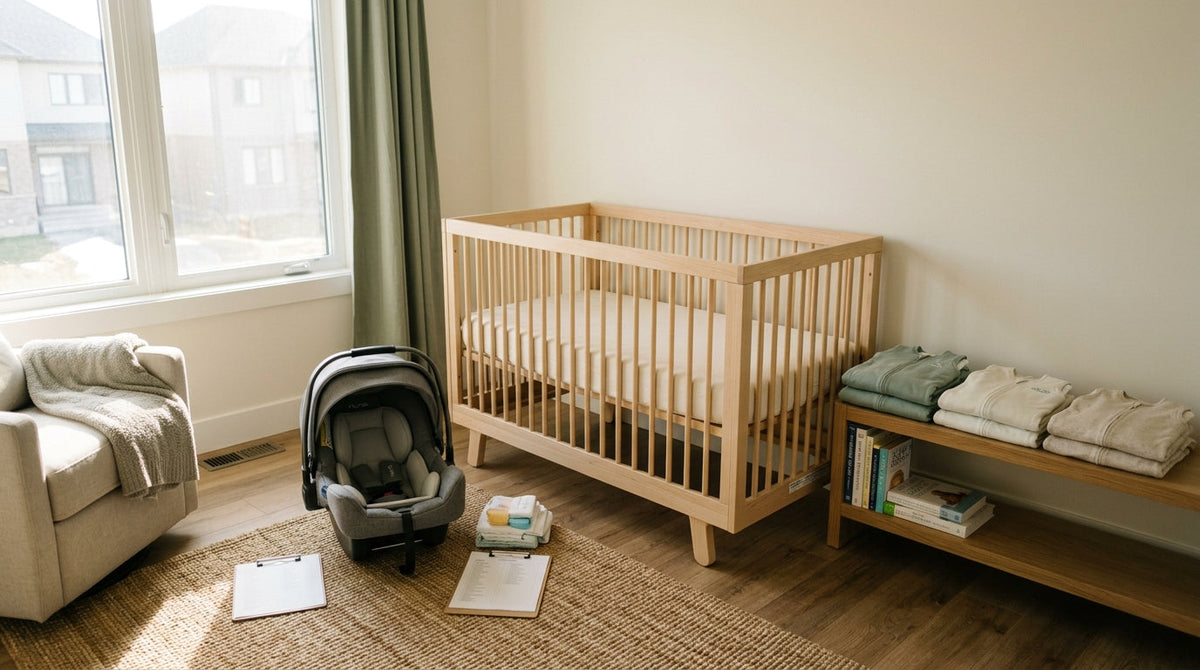
The AAP’s safe sleep guidance is specific and evidence-based. Babies should sleep alone, on their backs, on a firm, flat surface. No soft bedding, no bumpers, no inclined sleepers. The crib or bassinet should meet current CPSC standards, which means no drop-side rails and slats no more than 2 3/8 inches apart.
Unintentional suffocation kills roughly 1,000 infants under age 1 each year in the United States (CDC). Most of those deaths involve soft objects in the sleep space, or infants placed on adult beds, sofas, or recliners. The risk from co-sleeping on a soft surface is real and well-documented.
Room-sharing without bed-sharing is the AAP recommendation for at least the first six months. Your baby in their own sleep space, in your room. That arrangement reduces risk without requiring you to sleep in a separate room from a newborn.
Furniture and TV Tip-Overs: An Underestimated Hazard
Most parents think of tip-overs as a fringe risk. They are not. According to CPSC data, one child dies every two weeks from tip-overs involving furniture, TVs, or appliances. The victims are overwhelmingly toddlers who pulled on a drawer, climbed a dresser, or grabbed a TV stand.
The physics are straightforward. A dresser with open drawers becomes a ladder. A large flat-screen TV mounted on a low stand has a high center of gravity. A bookcase anchored to nothing is a domino waiting to fall.
Anti-tip straps are inexpensive and widely available. Use them on every tall piece of furniture: dressers, bookcases, wardrobes, entertainment units. The strap anchors the top of the furniture to a wall stud. If you cannot find a stud, use a toggle bolt rated for the load, but a stud is always preferable. Mount TVs to the wall when possible. If the TV sits on furniture, secure the furniture to the wall and use a furniture strap to anchor the TV itself.
Check your straps annually. Adhesive anchors degrade. Straps can loosen. This is a five-minute job that belongs on your calendar.


Stair Gates: Standards Matter More Than Price
About 93,000 children under 5 are treated in U.S. emergency rooms each year for stair-related injuries (Nationwide Children’s Hospital analysis of CPSC NEISS data). That works out to roughly one child every six minutes.
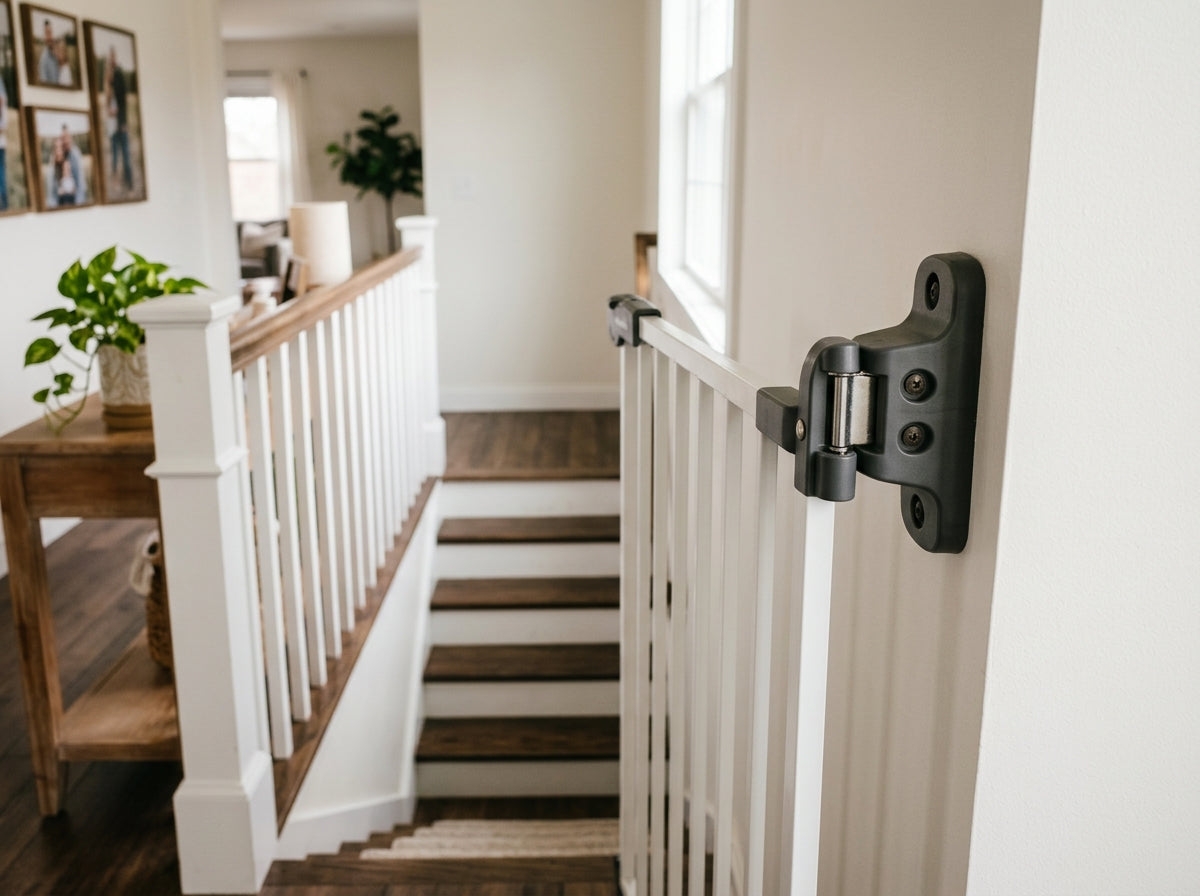
Not all gates are equal. Hardware-mounted gates, the kind you screw into the wall or door frame, are the only appropriate choice for the top of a staircase. Pressure-mounted gates are for doorways and room dividers. They are not designed to stop a child from falling down stairs, because a hard enough push can dislodge them from the wall.
ASTM F1004 is the federal safety standard for expansion gates and expandable enclosures, made mandatory under 16 CFR Part 1239, effective 2021. When you buy a gate, look for compliance with this standard. It means the gate has been tested for structural integrity, including resistance to push-out forces.
Install the gate at the top of the stairs before your baby can pull to stand. That milestone comes faster than most parents expect. The gate at the bottom of the stairs matters too, but it is the top gate that prevents the serious falls.
One practical note: measure your opening carefully before buying. Many gates have a fixed width range, and an opening that falls outside that range will require an extension kit. An improperly extended gate can create gaps wide enough for a child to get stuck.


Drowning: The Hazard That Requires No Warning
Drowning is the leading cause of unintentional injury death in children ages 1 to 4 (CDC). It is silent. A child does not splash or call out. It happens in seconds, in water that most adults would not consider dangerous.
A child can drown in as little as one to two inches of water, according to AAP guidance. That means buckets, pet water bowls, coolers, and decorative fountains are all real hazards for a mobile infant or toddler. Empty them when not in use. Store buckets upside down.
For families with backyard pools, a four-sided isolation fence with a self-closing, self-latching gate is the most effective barrier. "Four-sided" is the key phrase. A fence that uses the house as one wall allows a child to access the pool from inside the home without passing through the gate. The latch should be at adult height, on the pool side of the gate, so a child cannot reach it from outside.
Bathtub drowning is also a significant risk. A toddler can drown in a bathtub in the time it takes to answer a phone. Drain the tub immediately after use. Never leave a young child alone in the bath, even for a moment.
Toilet locks are worth considering for families with infants who are pulling to stand. A curious baby leaning over a toilet bowl can topple in headfirst.


Poisoning and Medication Safety: The Cabinet Problem
According to CDC PROTECT data, unsupervised medication exposures send roughly 100 children under five to U.S. emergency departments every day. That is about 36,000 children per year. The medications involved are often adult prescriptions, over-the-counter pain relievers, and vitamins, things that live in kitchen cabinets, bathroom counters, and purses.
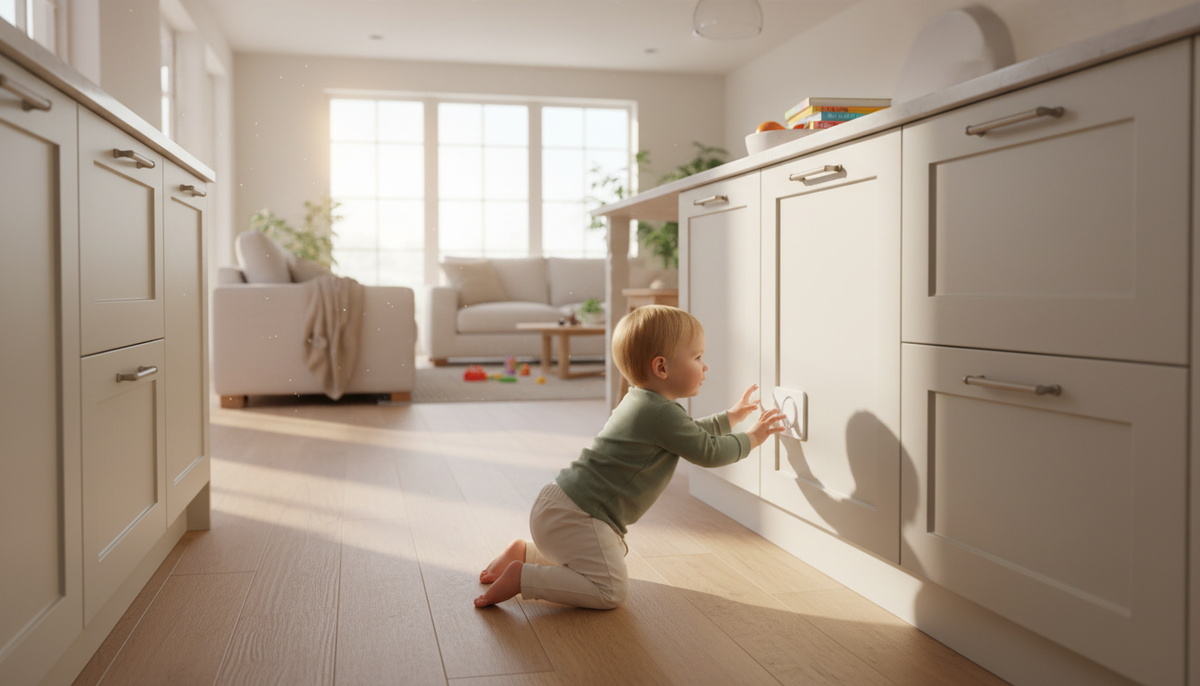
The under-sink cabinet is a particular problem. Cleaning products, dishwasher pods, drain cleaners. In my experience, my younger daughter’s raid on that cabinet was a wake-up call, even though I had a lock on it. The lock was a magnetic type that required a key I had left on the counter. She did not get into the products, but the near-miss was enough to make me rethink the whole system.
For medications specifically: store them in a locked box, not just a high shelf. Children climb. A locked box that requires a combination or key is a real barrier. Keep the Poison Control number (1-800-222-1222) saved in your phone and posted in your kitchen.
For cleaning products under the sink, use a cabinet lock that requires two simultaneous actions to open, such as a push-and-slide or a magnetic lock with the key stored out of reach. Adhesive-only locks are not reliable for cabinets containing hazardous materials.

- Unsecured bookcase, tip-over risk
- TV on low stand, high center of gravity
- Staircase without hardware-mounted gate
- Accessible outlet without TRR protection
- Corded blinds within child’s reach
Carbon Monoxide and Fire Safety: The Invisible Risks
According to CDC data, CO poisoning kills more than 400 people each year and sends more than 100,000 to U.S. emergency rooms. Carbon monoxide is colorless and odorless. Children are more vulnerable than adults because they breathe faster and have less body mass. By the time a child shows symptoms, the exposure may already be serious.
Install CO detectors on every level of your home and outside each sleeping area. Test them monthly. Replace them according to the manufacturer’s schedule, typically every 5 to 7 years. Do not rely on a smoke alarm to detect CO. They are different sensors for different hazards, and a combined unit is only acceptable if it is specifically certified for both.
According to NFPA data, three out of five home fire deaths occur in homes with no smoke alarms or non-functioning ones. Test your smoke alarms monthly. Replace batteries annually, or use 10-year sealed-battery models. Install alarms on every level, inside each bedroom, and outside sleeping areas.
For families with children, interconnected alarms are worth the investment. When one alarm sounds, they all sound. A child sleeping at the back of the house needs to hear the alarm that triggers in the kitchen.
Water heater temperature is a related hazard that often goes unaddressed. Set your water heater to 120°F (49°C). At that temperature, a serious scald takes about five minutes of exposure. At 140°F, it takes about five seconds. Lowering the thermostat costs nothing and eliminates most scalding risk from tap water.
Window and Cord Hazards: Two Separate Problems
Window falls send thousands of children to emergency rooms each year (CDC). Screens are not fall protection. They are designed to keep insects out, not to support the weight of a child leaning against them. Window stops or window guards are the appropriate solution. A window stop limits how far the window opens, typically to four inches or less. A window guard is a grille that installs in the frame. Both are effective. Guards in bedrooms must have a quick-release mechanism for fire escape.
Blind and window covering cords are a strangulation hazard, and a risk for infants and toddlers. Cordless blinds and shades are the safest option. If you have corded blinds, keep cords wound up and out of reach, use cord wind-ups, and never place a crib, bed, or furniture a child can climb near a window with accessible cords.
The CPSC has recalled numerous corded window covering products over the years. If you have older blinds, check the CPSC recall database before assuming they are safe.
Outlet Covers and Electrical Safety
Standard outlet covers, the small plastic plugs, are a choking hazard if a child removes them. And children can remove them. Tamper-resistant receptacles (TRRs) are a better solution. They have spring-loaded shutters inside the outlet that only open when equal pressure is applied to both slots simultaneously, the way a plug works. A child poking a single object into one slot cannot open the shutter.
The National Electrical Code has required TRRs in new residential construction since 2008. If your home was built or substantially renovated after that date, you likely already have them. If not, an electrician can replace standard outlets with TRRs. It is a straightforward job.
Power strips and extension cords deserve attention too. Keep them out of reach or behind furniture. A power strip with a child-proof cover is available from several manufacturers and is worth using in rooms where young children spend time.
Car Seat Safety: The Standard Is Changing
Car crashes are a leading cause of injury death in children. Proper car seat installation and use are the primary protection. The basics: rear-facing as long as possible within the seat’s height and weight limits, then forward-facing with a harness, then a booster with a seat belt.
Installation matters as much as seat selection. A seat that moves more than one inch at the belt path when you push it is not installed correctly. Many fire stations and certified Child Passenger Safety Technicians offer free installation checks.
One thing worth knowing: FMVSS 213a, the new federal child restraint side-impact standard, takes effect December 5, 2026. Some manufacturers are already producing seats that meet this standard ahead of the deadline. If you are buying a new seat, it is worth checking whether it has been tested to 213a.
Putting It Together: A Room-by-Room Approach
The hazards above do not sort neatly by room, but your assessment should. Start where your child spends the most time and work outward.
Nursery and sleep areas: Crib compliance, no soft bedding, CO detector outside the door, smoke alarm inside or adjacent, window stop on any accessible window, no corded blinds.
Kitchen: Cabinet locks on cleaning products and medications, stove knob covers, no tablecloths that can be pulled, refrigerator lock if your child is a climber.
Bathrooms: Toilet lock, cabinet lock on medications, water heater set to 120°F (49°C), non-slip mat in the tub.
Living areas: Furniture anchored to walls, TV secured, outlet covers or TRRs, cords managed, gate at stairs.
Garage and utility areas: Locked storage for chemicals and tools, CO detector if there is an attached garage, water heater thermostat checked.
Revisit each room when your child hits a new developmental milestone. What was out of reach at eight months is accessible at fourteen. What was inaccessible at two years is a climbing challenge at three.
Child safety is not a project with a completion date. It is a habit of attention, backed by the best available evidence, adjusted as your child grows.