

Every room in your house is a different kind of problem. That’s the thing most childproofing guides miss. They hand you a checklist, you buy some outlet covers, and you feel like you’ve handled it. Then your toddler opens the cabinet under the bathroom sink in the thirty seconds it takes you to answer the door.
That happened to me. My younger daughter was maybe eighteen months old. I’d been thorough, I thought. Cabinet locks in the kitchen, gates on the stairs, corner guards on the coffee table. But the bathroom cabinet? I’d told myself I’d get to it. I hadn’t. She pulled out a box of cold medicine, a bottle of mouthwash, and a disposable razor before I made it back down the hall. Nothing happened. But it so easily could have.
Real childproofing is not a single pass through the house. It’s a room-by-room, hazard-by-hazard process that evolves as your child grows. Here’s how to do it systematically.
Why "Good Enough" Isn’t
The instinct to do the obvious things and move on is understandable. Childproofing takes time, costs money, and some of it feels excessive until the moment it isn’t.
But consider the scale of what we’re talking about. About 93,000 children under 5 are treated in U.S. emergency rooms each year for stair-related injuries, per a Nationwide Children’s Hospital analysis of CPSC NEISS data. That’s roughly one child every six minutes. CPSC reports one child death every two weeks from furniture, TV, or appliance tip-overs. Per CDC PROTECT data, unsupervised medication exposures send roughly 100 children under five to U.S. emergency departments every day.
These are not freak accidents. They are predictable events that happen in ordinary homes to parents who thought they’d covered the basics. The difference between a close call and a tragedy is often one unlocked cabinet, one unsecured dresser, one unattended bucket of water.
The goal of this guide is to move you past the basics.
Start With a Hazard Audit, Not a Shopping List
Before you buy anything, walk your home at your child’s eye level. Literally get on your hands and knees. The world looks different from eighteen inches off the ground. Cords you’ve never noticed. Gaps between furniture and walls. The underside of the coffee table. The gap at the bottom of the stair railing.
Write down what you see in each room. Group hazards by type: fall risks, entrapment risks, ingestion risks, tip-over risks, burn and scald risks, suffocation risks. This matters because the interventions are different for each category, and understanding the hazard type helps you choose the right product and install it correctly.
A few things to look for that most parents overlook:
- Window blind cords. Looped cords are a strangulation hazard for children under 6. The fix is either cordless blinds or a cord wind-up device mounted out of reach.
- Furniture arrangement. A couch pushed against a wall near a window becomes a climbing ladder. Rearranging furniture is free.
- Heavy items on low shelves. Books, decorative objects, anything over a few pounds at a child’s reach height is a potential head injury.
- Door stops with removable caps. The spring-style doorstop with the little rubber cap at the end? That cap is a choking hazard. Replace them with one-piece baseboard stops.
- Gaps in stair railings. The AAP recommends spindle spacing of no more than 4 inches. Measure yours.
The audit takes an hour. It will save you from buying products you don’t need and help you see hazards that no product catalog would have flagged.
Stairs and Baby Gates: The Standard That Matters
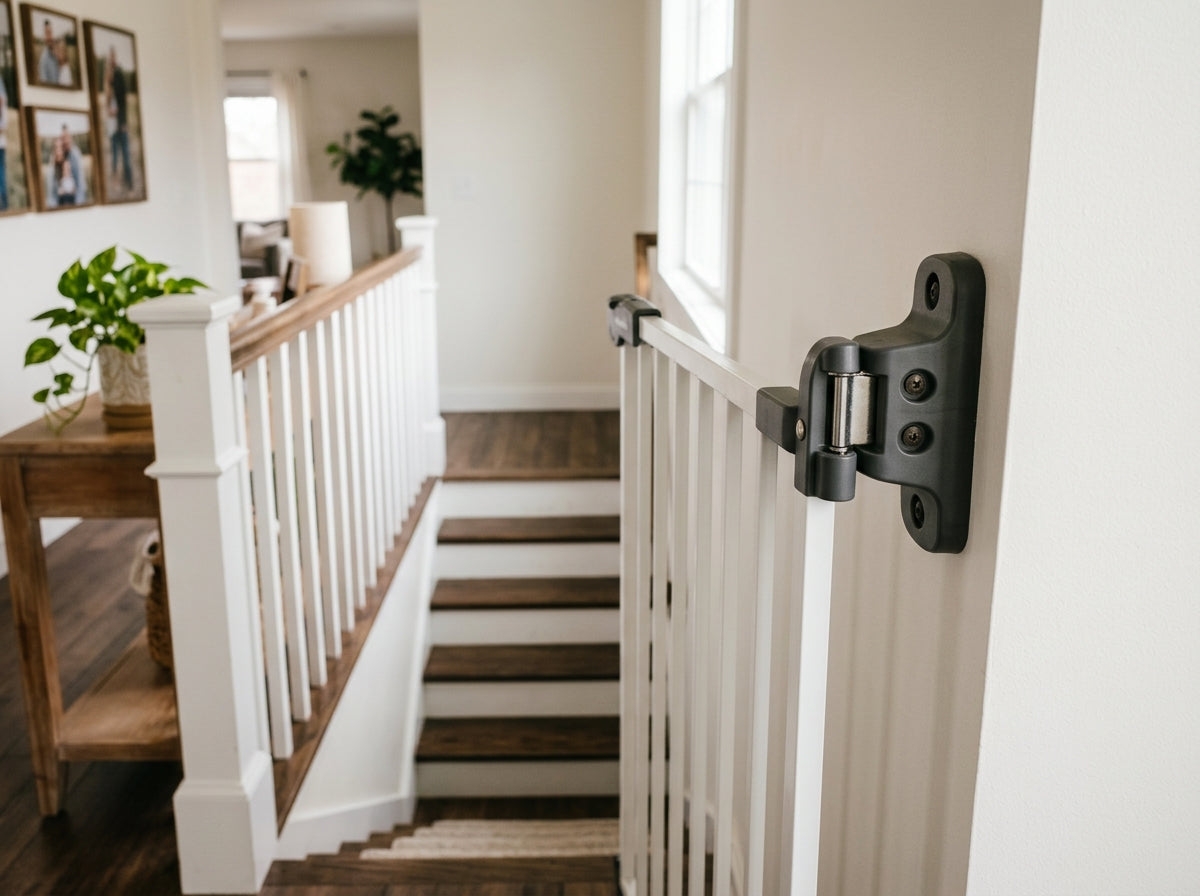
Gates are one of the most purchased childproofing products and one of the most frequently misused. The key distinction is between pressure-mounted and hardware-mounted gates, and using the wrong type in the wrong location is a real safety failure.
Pressure-mounted gates brace against the wall using tension. They’re fine for doorways and room dividers where a fall isn’t the consequence of the gate giving way. They are not appropriate for the top of stairs.
Hardware-mounted gates screw directly into wall studs or a solid door frame. Use these at the top of any staircase. A toddler leaning on a pressure gate at the top of a flight of stairs can push it free. That’s not a hypothetical.
When you’re shopping, look for gates that meet ASTM F1004, the federal safety standard for expansion gates and expandable enclosures, made mandatory under 16 CFR Part 1239 (effective 2021). This standard sets minimum requirements for structural integrity, including push-out resistance. A gate without this certification hasn’t been tested to the same threshold.
In my experience, I made the mistake of using a pressure gate at the top of a short four-step landing because I thought "it’s only four steps." My older daughter tested that logic at 22 months. The gate held, but I replaced it with a hardware-mounted model the next day. Four steps is still four steps.
Install the gate so it swings away from the staircase, not over it. Check the hardware monthly. Tighten anything that’s worked loose.


Furniture Tip-Over Prevention
CPSC reports one child death every two weeks from furniture, TV, or appliance tip-overs. Dressers are the most common culprit, followed by televisions and bookcases. Children climb drawers like ladders. They pull on open drawers to stand up. They reach for something on top and shift the center of gravity.
The fix is anti-tip straps, and they need to go into wall studs, not just drywall. Drywall anchors are not adequate for this application. If you can’t find a stud where you need it, use a wall plate that spans two studs.
Every piece of furniture over about 30 inches tall in a room your child accesses should be anchored. That includes:
- Dressers and chests
- Bookcases
- Wardrobes and armoires
- TV stands (and the TV itself, with a separate strap)
- Filing cabinets
Flat-screen TVs mounted on stands are particularly dangerous because the stand footprint is often narrow relative to the screen’s weight and height. Wall-mounting the TV is the most secure option. If you use a stand, strap both the TV and the stand to the wall.
Check that the straps have slack taken out of them. A strap with six inches of play still allows the furniture to tip far enough to fall on a child before the strap catches.

- Under-sink cabinet needs magnetic lock
- Pot handles should face inward
- Stove knob covers prevent burner access
- Appliance cords must not hang over edge
- Low drawers are climbing footholds
Kitchens and Bathrooms: The Ingestion and Scald Zones
These two rooms share a profile: lots of chemicals, lots of heat, lots of water, and lots of small spaces that children find irresistible.
In the kitchen:
Stove knob covers prevent children from turning on burners. Use the back burners when possible and turn pot handles inward. A stove guard, which is a barrier that runs along the front of the stovetop, adds another layer for families with persistent climbers.
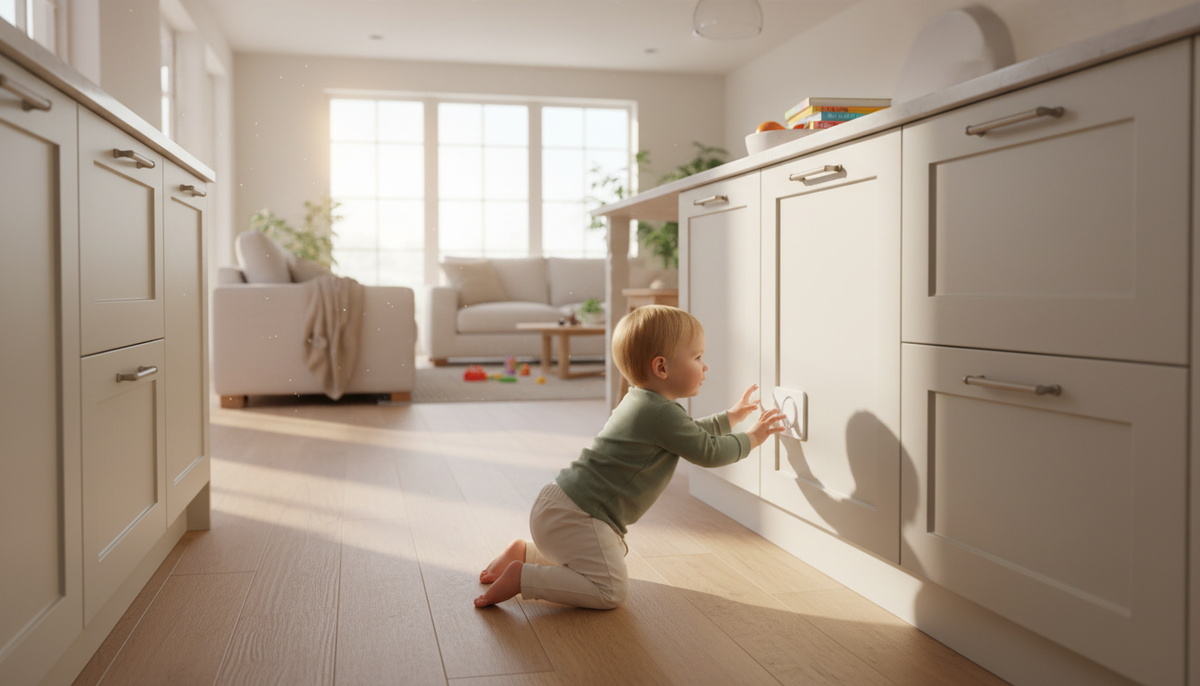
Under-sink cabinets need locks rated for the contents. Cleaning products are among the most common ingestion hazards. A magnetic cabinet lock is harder to defeat than a spring latch. In my experience, my older daughter popped open a spring latch I’d thought was adequate at 26 months. Magnetic locks need a key magnet to open, which makes them harder for a toddler to work out than a spring latch. No lock is completely childproof, though: an adhesive-mounted lock can be pulled loose, so check them regularly and keep the key out of reach.
Set your water heater to 120°F (49°C). At that temperature, a serious scald burn takes about five minutes of exposure. At 140°F (60°C), it takes about six seconds. Most water heaters ship set higher than 120°F. Check yours.
In the bathroom:
The medication cabinet is the most critical point in this room. Per CDC PROTECT data, unsupervised medication exposures send roughly 100 children under five to U.S. emergency departments every day. Medicine cabinets mounted at adult eye level are not sufficient if a child can climb to them. Move all medications, vitamins, and supplements to a locked box or a cabinet with a childproof lock, stored out of reach.
Toilet locks are worth installing for children under 3. A child can drown in as little as one to two inches of water (AAP). A toilet bowl has more than enough.
Bathtub spout covers protect against head injuries from the faucet. Non-slip mats go inside the tub and on the floor beside it. Never leave a young child alone in the bath, even briefly; the AAP advises that children not bathe alone until they are at least 6 years old.


Sleep Safety: The Nursery Environment
About 3,500 infants die each year from sleep-related causes in the United States, per CDC SUID data. Unintentional suffocation kills roughly 1,000 infants under age 1 each year in the United States (CDC). Many of these deaths are preventable with a safe sleep environment.
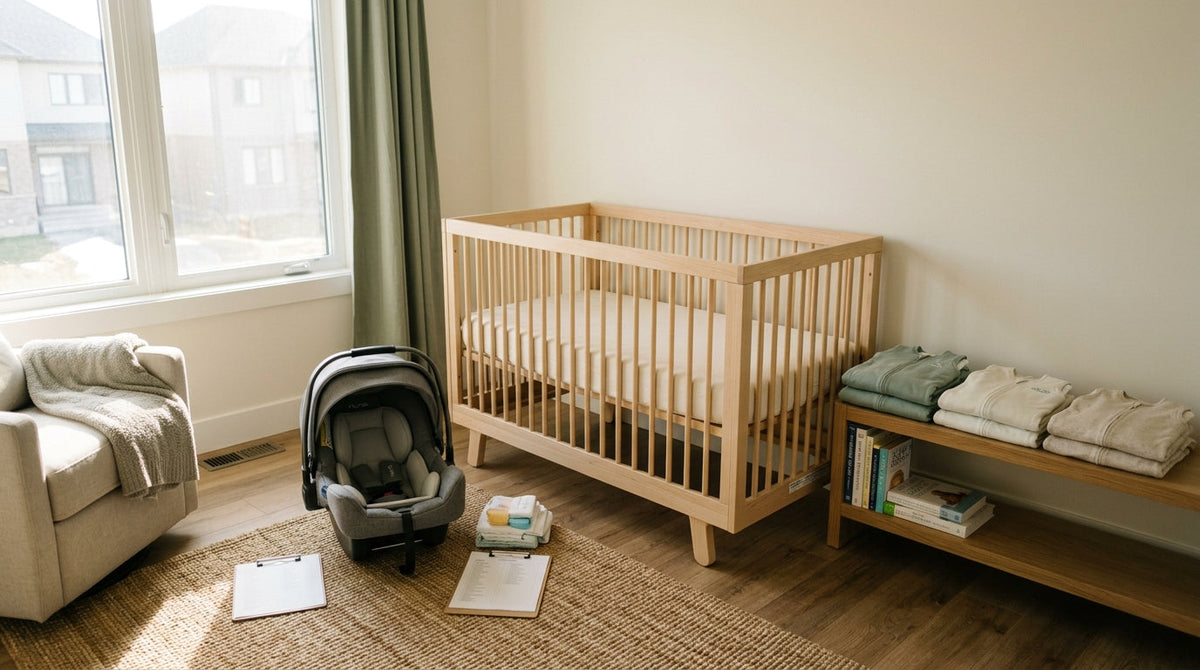
The AAP’s safe sleep guidance is clear: firm, flat sleep surface; no soft bedding, bumpers, or positioners; back to sleep for every sleep; room-sharing without bed-sharing for at least the first six months.
Beyond the crib itself:
- Crib placement. Keep the crib away from windows, blinds, and curtains. Cords and fabric within reach of a standing infant are strangulation hazards.
- Baby monitor cords. Mount the monitor at least three feet from the crib and route the cord out of reach. There have been documented infant strangulations from monitor cords.
- Dresser placement. If a dresser is in the nursery, strap it to the wall. A child who can pull to stand can also pull a drawer open and destabilize the piece.
- Humidifiers and fans. Keep cords managed and devices positioned so a toddler can’t reach them from the crib as the child grows.
Move your child out of the crib when they reach 35 inches (89 cm) tall, when the crib rail is below chest level, or when they start climbing out, whichever comes first. A child who falls from a crib rail is at greater risk than a child on a floor mattress or toddler bed.
Fire, Carbon Monoxide, and Smoke Alarms
Three out of five home fire deaths occur in homes with no smoke alarms or non-functioning ones, per NFPA data. CO poisoning kills more than 400 people each year and sends more than 100,000 to U.S. emergency rooms (CDC).
These are not childproofing products in the traditional sense, but they are the safety layer that protects your whole family when other systems fail.
Smoke alarms should be on every level of the home, inside every bedroom, and outside every sleeping area. Test them monthly. Replace batteries annually, or install 10-year sealed-battery models. Replace the entire unit every 10 years.
Carbon monoxide detectors should be installed near sleeping areas and on every level. CO is odorless and colorless. Children are more vulnerable to CO poisoning than adults because of their faster respiratory rates and smaller body mass. A detector gives you the only warning you’ll get.
Combination units (smoke plus CO) are fine as long as they carry UL certification for both functions. Check the label.
Make sure your children know what the alarm sounds like and what to do when they hear it. Practice a fire escape plan twice a year. Identify two ways out of every bedroom.
Electrical Hazards Beyond Outlet Covers
Outlet covers are the first thing people buy and often the only electrical childproofing they do. They matter, but they’re not the whole picture.
Tamper-resistant receptacles (TRRs) are now required by the National Electrical Code in new construction and renovations. They have built-in shutters that only open when equal pressure is applied to both slots simultaneously, which a child inserting a single object cannot do. If your home was built or renovated recently, you likely already have them. If not, an electrician can replace standard outlets with TRRs. This is more effective than plastic plug covers, which children can remove.
Power strips and extension cords are a bigger hazard than most parents realize. A cord is a tripping hazard, and a strangulation risk for infants. Power strips with multiple open sockets at floor level are attractive to toddlers. Use a cord management box to enclose the strip, or mount it behind furniture.
Appliance cords in the kitchen, particularly for countertop appliances, should be routed so they don’t hang over the edge of the counter. A toddler who grabs a dangling cord can pull a toaster or coffee maker down onto themselves.
Floor lamps are tip-over hazards. If you have floor lamps in rooms your child uses, anchor them or replace them with table or ceiling fixtures.
The Garage, Yard, and Water Hazards
Parents often childproof the living spaces and forget the areas that are "supervised only." But supervision fails. The garage and yard deserve the same systematic approach.
Garage:
Lock the door between the house and garage. The garage contains some of the most dangerous chemicals in most homes: pesticides, herbicides, motor oil, antifreeze, gasoline. Antifreeze is particularly dangerous because it tastes sweet to children. Store all chemicals in a locked cabinet, not just on a high shelf.
Keep the garage door opener out of reach. Children have been injured by automatic garage doors. Make sure the auto-reverse function is working by placing a 2x4 flat on the ground under the door. The door should reverse when it contacts the board.
Yard:
Fence the yard with a self-latching gate. Check the fence perimeter for gaps a child could squeeze through or dig under. Lawn equipment, tools, and chemicals should be locked in a shed.
Water:
Drowning is the leading cause of unintentional injury death in children ages 1–4 (CDC). If you have a pool, a four-sided fence with a self-closing, self-latching gate is the standard recommendation, and in many jurisdictions it’s required by law. The gate latch should be positioned out of a child’s reach, on the pool side of the fence.
Drain kiddie pools immediately after use. Empty buckets, coolers, and any container that holds standing water. A child can drown in as little as one to two inches of water (AAP). This is not a hypothetical depth. It’s a bucket left out after washing the car.
Childproofing as an Ongoing Practice
Your child changes faster than your house does. A latch that stopped a 14-month-old won’t stop a 26-month-old with better fine motor skills and more determination. A gate that was adequate when your child was cruising along furniture needs reassessment when they’re climbing everything in sight.
Schedule a reassessment every three to four months through the toddler years. Walk the house again. Get back on your hands and knees. Look for what’s changed, what’s been defeated, what’s been moved.
The goal is not a perfectly childproofed home. That doesn’t exist. The goal is a home where the hazards that can cause serious injury have been addressed, where the interventions are appropriate for your child’s current developmental stage, and where you’ve bought yourself enough time to respond when something goes wrong.
Because something will always go wrong. The bathroom cabinet will get left unlocked once. The gate will be left open once. The question is whether the consequence of that one lapse is a scare or something worse. Layered, systematic childproofing is what makes the difference between those two outcomes.