
DIY Baby Proofing: 25 Budget-Friendly Hacks That Actually Work
25 Budget-Friendly Hacks That Actually Work

Every parent I know has had the same moment: you look up from your phone, and your baby is somewhere they absolutely should not be. For me, it was the afternoon my younger daughter emptied the entire under-sink cabinet in the time it took me to answer the doorbell. Cleaning supplies on the kitchen floor. She was 14 months old and very proud of herself.
Baby proofing doesn’t have to cost a fortune. Most of the serious hazards in your home can be addressed with hardware-store materials, a few smart purchases under $10, and some techniques that professional childproofers use but rarely share. Here are 25 that I’ve tested and lived with.
The Foundation: Anchoring and Tip-Over Prevention
CPSC reports one child death every two weeks from tip-overs involving furniture, TVs, or appliances. That number has stayed stubbornly consistent for years because anchoring is one of those things parents mean to do and then don’t.
1. Use furniture straps from the hardware store instead of baby-specialty retailers.
L-brackets and furniture straps at a hardware store often cost half what the same product runs at a baby boutique. The key is finding studs. A $10 stud finder is worth it. I’ve anchored six dressers across two houses, and the only time I had trouble was when I tried to skip the stud finder and anchor into drywall alone. Don’t do that.
2. Anchor flat-screen TVs with a strap rated for at least several times the TV’s weight.
Most TV straps list a weight rating on the package. Choose one rated well above your TV’s actual weight. Anchor to a stud, not the drywall.
3. Pull heavy furniture away from the wall just enough to run the strap, then push it back.
Dressers and bookshelves look the same from the front whether they’re anchored or not. There’s no aesthetic cost here.
4. Move heavy items to lower drawers.
This is free. A dresser with heavy clothes in the bottom drawer is harder to tip than one with heavy items at the top. It also makes the dresser less interesting to climb.
Cabinet and Drawer Locks on a Budget
My older daughter defeated an adhesive strap lock at 26 months. She figured out that if she pulled the cabinet door far enough to create slack in the strap, she could work the latch open. It took her about four days. After that, I switched to magnetic locks for anything that mattered.
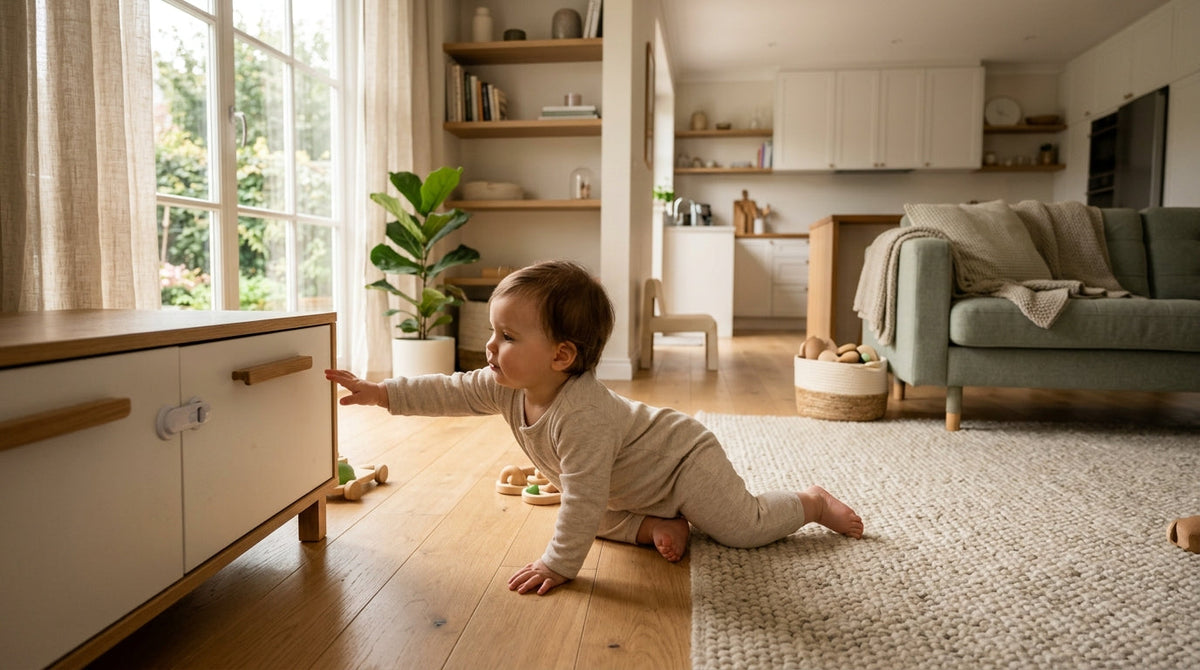
5. Magnetic cabinet locks are the most defeat-resistant option and cheaper than you think.
A pack of 8 magnetic locks with the magnetic key runs $20–$35 and covers most of a kitchen. They require drilling, but the installation takes about 20 minutes per cabinet once you’ve done the first one.
6. For low-priority cabinets, rubber bands work.
A thick rubber band looped around two adjacent knobs creates enough resistance to stop a child under 18 months. It’s not a security system. It’s a speed bump. Use it for cabinets with pots and pans, not cleaning supplies.
7. Relocate dangerous items entirely.
Per CDC PROTECT data, unsupervised medication exposures send roughly 100 children under five to U.S. emergency departments every day. Cleaning supplies and medications don’t need a lock if they’re on a high shelf a child cannot reach. Relocation costs nothing.
8. Use a bungee cord for appliances with doors.
Dishwashers, ovens with bottom drawers, and front-loading washers can all be temporarily secured with a bungee cord when you’re not using them. It’s not pretty, but it works for the 12–18 month window when a child is most likely to climb inside.


Stair and Door Safety Without the Big Spend
About 93,000 children under 5 are treated in U.S. emergency rooms each year for stair-related injuries, per a Nationwide Children’s Hospital analysis of CPSC NEISS data. Gates are the obvious solution, but they don’t have to be expensive.
9. Buy hardware-mounted gates used, but verify the standard.
ASTM F1004 is the federal safety standard for expansion gates and expandable enclosures, made mandatory under 16 CFR Part 1239 (effective 2021). When buying a used gate, look for the ASTM F1004 certification on the label. If the label is missing or the gate predates 2021, skip it. A gate that fails at the top of the stairs is worse than no gate at all.
10. Use pressure-mounted gates only at the bottom of stairs, never the top.
Pressure-mounted gates are fine for doorways and the bottom of a staircase. They are not appropriate for the top of stairs, where a child’s weight can push the gate out of position. This is a free decision that changes the safety profile completely.
11. Door pinch guards are $3–$5 and prevent a nasty injury.
A foam door pinch guard slips over the top of a door and prevents it from closing fully, which means little fingers don’t get caught in the hinge side. They also prevent a child from closing themselves into a room.
12. Door knob covers buy you time, not security.
A standard door knob cover makes it harder for a child under 3 to open a door. It will not stop a determined 3.5-year-old. Use them for rooms you want to delay access to, not rooms where access would be dangerous.
13. Pool noodles on door edges.
Slice a pool noodle lengthwise and fit it over a door’s edge to cushion impact. This is a $2 fix for a common source of head and finger injuries.

- Under-sink cabinet: cleaning supplies
- Oven bottom drawer: climbing risk
- Dishwasher: sharp utensils, climbing
- Counter edge: pulled-down appliances
Water Safety on Zero Budget
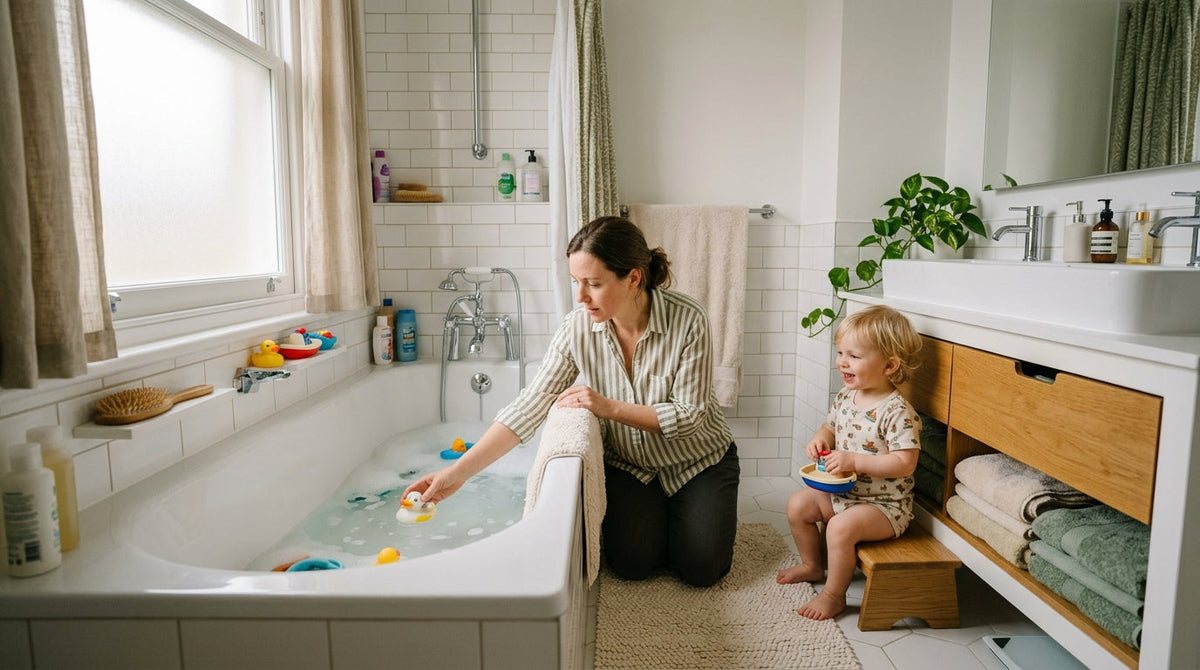
Drowning is the leading cause of unintentional injury death in children ages 1–4 (CDC). A child can drown in as little as one to two inches of water (AAP). That means buckets, bathtubs, and toilets are all hazards, not just pools.
14. Empty everything after every use.
Buckets, baby bathtubs, kiddie pools, and inflatable water tables should be emptied and stored upside down immediately after use. This costs nothing and removes the hazard entirely.
15. Toilet locks are $10–$15 and take five minutes to install.
They look ridiculous. They work. For families with children under 3, they’re worth it.
16. Close bathroom doors always.
A hook-and-eye latch mounted high on the outside of a bathroom door costs under $5 and keeps the door reliably shut. Children cannot reach it. Adults can operate it one-handed. This is the most underrated hack on this list.


Outlet and Cord Safety
17. Sliding outlet covers beat plug-in caps.
Plug-in outlet caps are a choking hazard if a child removes them, and children do remove them. Sliding outlet covers replace the entire outlet plate and require a two-step motion to open. They cost $2–$4 per outlet and are a straightforward upgrade.
18. Cord management: cords are tripping hazards and strangulation risks for infants.
Gather cords with zip ties, route them behind furniture, or use adhesive cord clips ($5 for a pack of 20) to keep them flat against the wall. The goal is to eliminate any loop a child could get a head or neck through.
19. Unplug small appliances when not in use.
A toaster, coffee maker, or hair dryer that isn’t plugged in cannot shock anyone. This is free and takes one second.


Sharp Edges, Small Spaces, and Miscellaneous Hazards
20. Corner guards: foam over clear, unless aesthetics matter more than function.
Clear adhesive corner guards look better but fail faster on textured surfaces. Foam corner guards in a color that matches your furniture are more durable and cost about the same. I’ve tested both across two homes and replaced the clear ones twice as often.
21. Zip ties are the most versatile tool in baby proofing.
Zip ties can secure cabinet doors, bundle cords, keep lids on containers, and attach gates to railings when the gate’s hardware doesn’t quite fit. A bag of 100 mixed-size zip ties costs $5 and lasts years.
22. Non-slip rug pads under every area rug.
A sliding rug is a fall risk for a toddler and an adult carrying a toddler. Non-slip pads cost $10–$20 and make every rug in your house safer.
23. Move chairs away from counters and tables when not in use.
A chair pushed under a table is a climbing ladder. Pulled out and turned sideways, it’s harder to use as a step. This is a habit, not a purchase.
24. Secure floor lamps to the wall with a single furniture strap.
Floor lamps tip easily and are almost never anchored. A single strap through the lamp’s base and into a wall stud takes five minutes and removes a real hazard.
Quick-Start Baby Proofing Checklist
Fire and CO Safety: The Cheapest Hacks Are Also the Most Important
Three out of five home fire deaths occur in homes with no smoke alarms or non-functioning ones (NFPA). CO poisoning kills more than 400 people each year and sends more than 100,000 to U.S. emergency rooms (CDC).
25. Test your smoke and CO alarms monthly, and replace batteries every year.
This is the single highest-impact safety action on this list. Combination smoke and CO detectors are available for under $30. If you have neither, start here before you buy a single cabinet lock.
A Note on Priorities
When I work through a home, I always start with the hazards that can kill quickly and quietly: tip-overs, water, fire, CO, and medications. Then I move to fall prevention. Then sharp edges and pinch points. The budget hacks in the middle of this list are useful, but they matter less if the big hazards aren’t addressed first.
You don’t need to spend $500 on a professional baby proofing service. You need a stud finder, a pack of magnetic locks, a few furniture straps, and an afternoon. Start with the room your child spends the most time in, work outward, and check your smoke alarms on the way out.