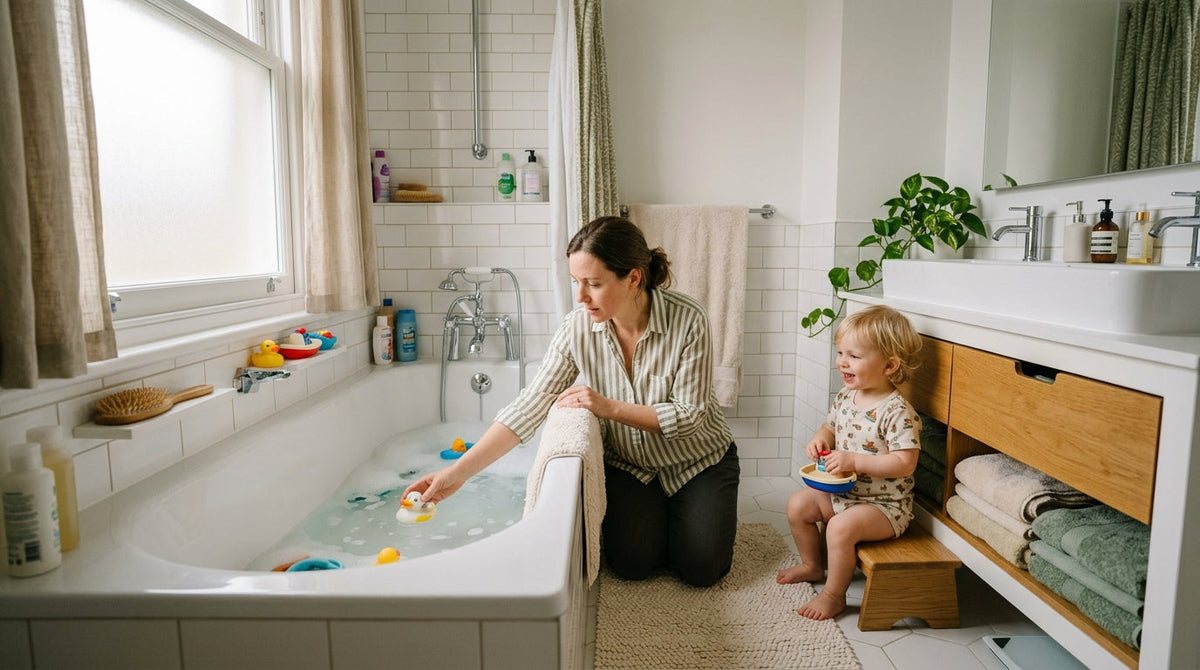


The bathroom is the most dangerous room in your house. Not the kitchen, not the stairs. The bathroom, because it combines water, hard surfaces, medications, and cleaning chemicals in a space roughly the size of a walk-in closet, and your toddler can get there in seconds.
I learned this the hard way when my younger daughter was about 18 months old. I answered the doorbell, was gone maybe two minutes, and came back to find her sitting on the tile floor surrounded by everything that had been under the bathroom sink: a bottle of drain cleaner, two rolls of toilet paper, a box of cotton swabs, and a half-empty bottle of children’s ibuprofen. Nothing had been opened. That time. But the image of what could have happened hasn’t left me.
Here’s how to make sure it doesn’t happen to you.
Start With Water: The Risk You Can’t See Coming
Drowning is the leading cause of unintentional injury death in children ages 1–4 (CDC). That number never stops being shocking. And the mechanism is quieter than most parents imagine. A child can drown in as little as one to two inches of water. That’s a bucket. That’s a toilet. That’s a tub with the drain running slow.
The first rule of bathroom safety is never leave a child alone near water. Full stop. That means if the phone rings while your toddler is in the bath, you either take the child with you or let it ring. No exceptions. Every other product on this list is a backup layer. Supervision is the primary defense.
That said, layers matter.
Toilet locks are the first thing I recommend to parents of crawlers and new walkers. A toddler leaning over a toilet to look at the water can tip in headfirst, and they don’t have the upper body strength to push themselves back out. Toilet locks clamp the lid to the seat and require a two-step release that a child under three typically can’t manage. Most use a lever mechanism on the front of the lid. Look for one with a one-handed adult release, because you will absolutely be trying to open it while holding a toddler on your hip at 2 a.m.
Empty the tub immediately after every bath. Don’t leave two inches of water "to cool down." Drain it. The few seconds it takes is worth it every time.
Tub Mats and Anti-Slip Surfaces
Hard, wet porcelain is a fall waiting to happen, both for your child in the tub and for you lifting them out. A non-slip tub mat is one of the simplest and most effective bathroom safety products you can buy.
Look for mats with strong suction cups across the entire base, not just around the edges. Press on the mat after placing it: if it slides at all, the cups aren’t seating properly on your tub surface. Some textured tub finishes don’t hold suction well. In that case, consider non-slip adhesive strips instead. They’re less comfortable underfoot but more reliable on rough surfaces.
The mat should cover the area where your child stands and sits, not just the drain zone. My older daughter was three when she slipped getting out of the tub and caught the faucet on the way down. She was fine, a small bruise on her shoulder, but it was the moment I added a soft faucet cover to our setup. These foam or rubber covers fit over the spout and the handle hardware and cushion any impact. They also prevent burns from a hot metal faucet.
Speaking of burns: set your water heater to 120°F (49°C) or lower. The AAP recommends this specifically to prevent scalds. At 120°F (49°C), a serious scald takes about five minutes of exposure (CPSC). At 140°F (60°C), a third-degree burn can occur in just five seconds. Most water heaters ship from the factory set at 140°F (60°C). Check yours. Adjust it. This is a five-minute fix with real consequences.
A bath thermometer is also worth having if you have infants or toddlers. The target bath temperature for young children is around 100°F (38°C). Warm, not hot.


Cabinet Locks: Under-Sink and Medicine Storage
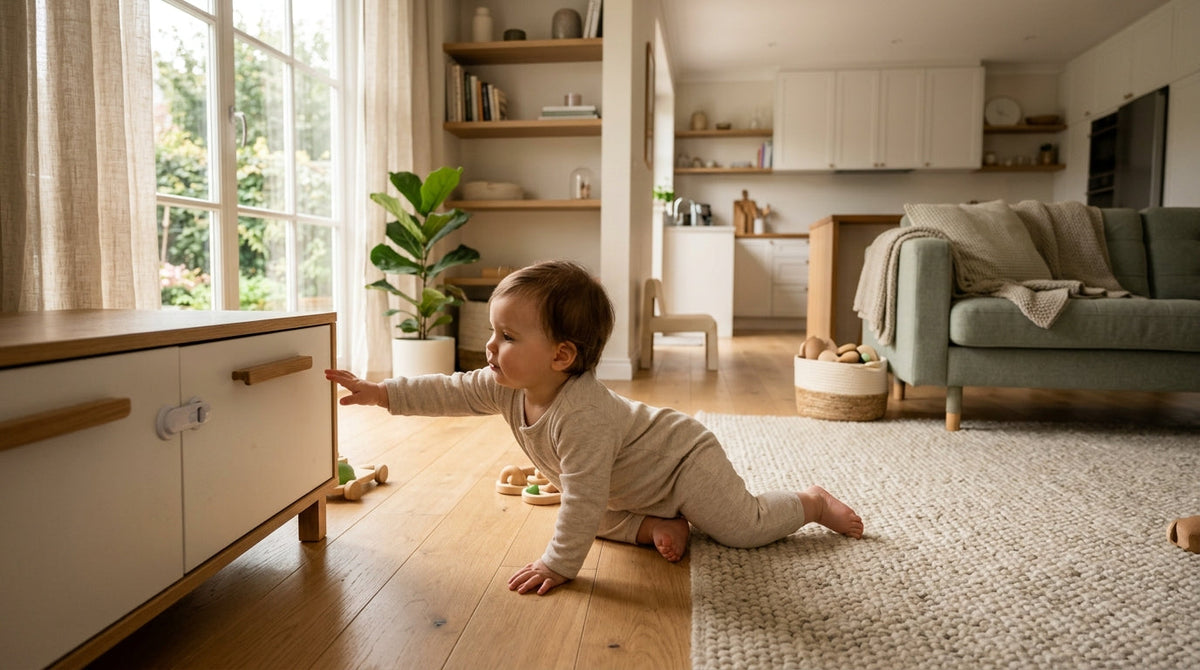
The under-sink cabinet is where most households store the things that can hurt a child fastest: drain cleaners, toilet bowl tablets, cleaning sprays, extra razors. These need a lock that works, not one that looks like it works.
There are two main types: magnetic cabinet locks and spring-loaded latch locks. I’ve installed both in multiple bathrooms.
Magnetic locks mount inside the cabinet door and require a magnetic key held near the door to release. They’re invisible from the outside and very hard for children to defeat. The tradeoff is installation: you need a drill, and you need to keep track of the magnetic key. Lose the key and you’re either buying a replacement or unscrewing the lock. I’ve done both.
Spring-latch locks use an adhesive mount or a screw mount and require pressing a release button while pulling the door. These are easier to install and easier to replace. The adhesive versions are where I’d urge caution. My older daughter defeated an adhesive strap lock at 26 months, not by figuring out the mechanism, but by pulling hard enough that the adhesive gave way on our slightly textured cabinet face. If your cabinet surface is anything other than smooth, painted wood, test the adhesive bond before trusting it. Press it firmly, wait 24 hours, then try to pull the lock off yourself. If you can, your toddler can.
For under-sink storage, I’d recommend screw-mounted locks wherever possible. The extra 10 minutes of installation is worth it.
The medicine cabinet is a separate problem. Unsupervised medication exposures send roughly 100 children under five to U.S. emergency departments every day (CDC). The bathroom medicine cabinet, at eye level for an adult and increasingly reachable for a climbing toddler, is not a safe place to store medications if you have young children. Move all medications, including vitamins and over-the-counter products, to a locked box or a high cabinet with a separate lock. This applies to your own prescriptions as well as children’s medications.

- Medicine cabinet: store meds in locked box
- Under-sink cabinet: use screw-mounted lock
- Toilet: fit a two-step lid lock
- Tub faucet: add foam cover and non-slip mat
- Outlets: GFCI required within 6 feet of sink
Door Locks and Bathroom Access
A child who can’t get into the bathroom unsupervised is a child who can’t encounter the risks inside it. Bathroom door safety works in two directions: keeping children out when you’re not there, and preventing them from locking themselves in.
For the first problem, a simple hook-and-eye latch mounted high on the bathroom door frame keeps toddlers out. These cost a few dollars and take five minutes to install. The latch sits well above a toddler’s reach and can be engaged whenever the bathroom isn’t in use.
For the second problem, most interior bathroom doors have a privacy lock that can be opened from the outside with a coin or a flathead screwdriver. Keep one of these tools on the door frame or nearby. If your lock doesn’t have an emergency release, replace the hardware. A child who locks themselves in a bathroom with a full tub is a scenario you don’t want to manage through a door.
Door pinch guards are worth adding if you have a toddler who follows you everywhere. These foam or rubber sleeves fit over the door edge and prevent the door from latching fully, which means fingers can’t get caught in the hinge gap or the door frame. My younger daughter went through a phase of standing in doorways at exactly the wrong moment. The pinch guard on the bathroom door got used every single day for about four months.


Electrical Safety Near Water
Water and electricity in the same room is a combination that requires specific hardware. Any outlet within six feet of a sink should be a GFCI outlet, which cuts power in milliseconds if it detects a ground fault. If your bathroom outlets don’t have the "Test/Reset" buttons on the face, they’re not GFCI outlets. An electrician can replace them; it’s not an expensive job.
In the meantime, standard outlet covers are a baseline. The sliding plate style is harder for toddlers to defeat than the simple plug-in caps. But GFCI protection is the real safety measure here. The outlet covers are mostly about preventing curious fingers from probing an outlet, not about the water risk.
Keep all plug-in appliances, hair dryers, electric shavers, curling irons, away from the sink and tub when not in use. Unplug them after every use. A hair dryer left plugged in on the edge of a sink is a hazard whether or not a child is in the room.
Bathroom Safety Checklist
Sharp Edges, Razors, and Small Objects
Bathroom counters collect things that can hurt children: razors, nail scissors, tweezers, glass perfume bottles. A quick audit of your counter and vanity drawers will probably turn up more than you expect.
Razors go in a locked drawer or a wall-mounted holder that’s out of reach, not just pushed to the back of the counter. Disposable razors should be disposed of immediately after use, not left on the edge of the tub.
Corner guards on the vanity and any low shelving are worth installing. Bathroom falls tend to happen fast, and the corner of a vanity at toddler head height is a real injury risk. Clear adhesive corner guards are inexpensive and largely invisible.
Check for small objects at floor level regularly. Cotton swabs, hair ties, small soap slivers, and the caps from toothpaste tubes are all choking hazards. Toddlers find them. Keep a small trash can with a lid in the bathroom and use it.
A Room Worth Revisiting Every Few Months
Your child’s reach, speed, and problem-solving ability change fast. A cabinet lock that was adequate at 18 months may not hold at 30 months. A toilet lock your toddler ignored at two may become a puzzle they’re motivated to solve at three.
Walk through your bathroom at your child’s eye level every few months. Get down on the floor. Look at what’s accessible, what’s climbable, what’s within reach. The under-sink cabinet that was locked last year may have a new gap where the door warps in humidity. The outlet cover may have been pulled out and not replaced. These checks take five minutes and they catch the things that routine use makes invisible.
The bathroom will never be zero-risk. But with the right locks, the right habits, and the right hardware, it doesn’t have to be the most dangerous room in your house.