

About 3,300 children age 5 and younger are treated in U.S. emergency rooms each year for window fall injuries (CPSC). That number has stayed stubbornly consistent for years, and the reason is simple: windows are one of the few hazards in your home that parents underestimate. A screen keeps out bugs. It does not stop a child. And the same week I was writing about window safety for this site, my younger daughter pushed a lightweight chair to the sill and had her hands on the frame before I crossed the room.
Windows deserve a real plan. Here is every method, explained.
Why Windows Are Different From Other Hazards
Most baby-proofing involves blocking access to something. Outlet covers, cabinet locks, stair gates: you put a barrier between the child and the danger. Windows are different because the danger is the opening itself, and openings are the whole point of a window.
Windows in homes with young children should not open more than 4 inches (CPSC and AAP). That single number is the foundation of every method below. A child’s head can pass through a gap wider than that, and once the head goes, the body follows. Screens, curtains, and furniture placement do nothing to enforce this limit. Hardware does.
There is also a second hazard: the cords on window blinds. Window blind cord strangulation kills approximately one child every month (CPSC, ages 7 months to 10 years). That is a separate problem from falls, and it requires a separate fix.
Window Stops and Opening Limiters
A window stop is the most direct solution to the 4-inch rule. It is a small device, usually metal or reinforced plastic, that mounts to the window frame or sash and physically prevents the window from opening beyond a set point. Most are adjustable so you can allow more airflow in rooms where children cannot reach the windows.
Installation takes about ten minutes per window with a screwdriver. The key is mounting into solid wood, not just the vinyl track. I learned this on the second window I ever installed one on: the screw went into the vinyl lip instead of the frame, and the stop pulled free the first time I tested it with firm pressure. Remount into the wood frame and the same product held without any movement.
Window stops work on single-hung and double-hung windows. For casement windows (the kind that crank outward), you need a casement limiter, which attaches to the crank arm or hinge and restricts the swing angle. These are less common in hardware stores but easy to find online.
Pros: Inexpensive, unobtrusive, adjustable, and reversible. Cons: Require correct installation into solid material. Test each one with firm lateral pressure before trusting it.


Window Guards
A window guard is a metal grille or bar assembly that mounts inside the window opening. It allows air and light through while preventing a child from falling or climbing out. This is the method required by law in some jurisdictions: NYC Health Code Section 131.15 (1976) requires window guards in apartments where children age 10 or younger reside.
Guards come in two types. Fixed guards are permanent and require a tool to remove. Removable guards have a quick-release mechanism for emergency egress, which is a code requirement in most jurisdictions for windows that serve as a secondary means of escape. Never install a fixed guard on a window that is your only emergency exit from a room. This is not a suggestion. It is a fire safety issue.
When shopping for a window guard, look for one that meets ASTM F2090 standards for load resistance. The bars should be spaced no more than 4 inches apart (consistent with the opening limit above). Measure your window opening width carefully before ordering; most guards are adjustable within a range, but that range matters.
Installation typically involves tension mounting between the window jambs, with additional screws into the frame for security. A guard that relies on tension alone is not sufficient for a determined toddler or an accidental lean.

- Couch within 3 feet of sill
- Window open more than 4 inches
- Looped blind cord hanging low
- Standard sash lock, no secondary latch
Window Locks and Secondary Latches
The locks that come on most residential windows are not designed with toddlers in mind. A standard sash lock can be flipped open by a two-year-old who has watched you do it twice. Secondary window locks add a second point of engagement that requires more dexterity or deliberate action to release.
The most common type is a keyed sash lock, which replaces the existing latch and requires a small key to open. A simpler option is a sliding bolt or pin lock that drops into a drilled hole in the sash, limiting travel to your chosen position. These are the same principle as a door chain: they do not replace the primary lock, they add a second step.
For double-hung windows, you can also use a window wedge: a wedge-shaped block that sits in the lower sash track and prevents the window from opening past it. No tools, no installation, easy to remove for cleaning. My older daughter figured out how to knock a foam wedge loose at around age three, so I switched to the drilled-pin style, which requires lifting the pin before the window moves. She did not crack that one until she was closer to five.


Cordless and Cord-Safe Window Coverings
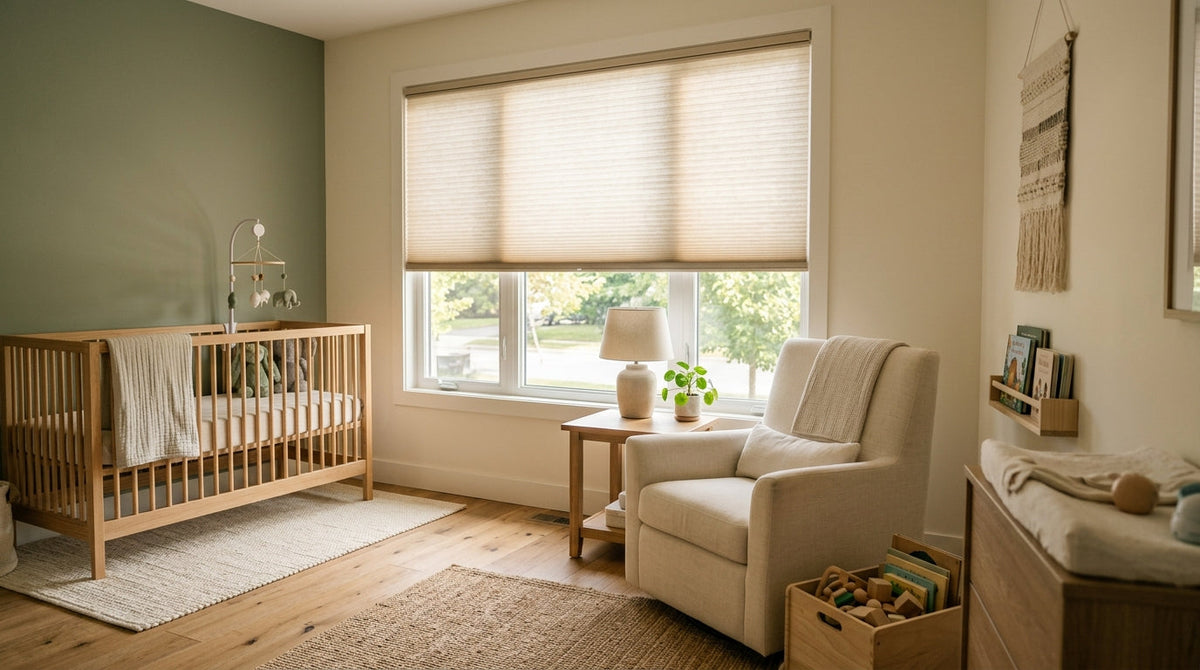
Falls are not the only window hazard. Cords are. In 2022, the CPSC adopted federal safety rules requiring most new residential window coverings to be cordless or have inaccessible cords (16 CFR 1260, effective May 30, 2023). If your blinds predate that rule, or if you have older custom shades, you need to assess them now.
The safest option is to replace corded blinds with cordless ones. Cordless cellular shades, cordless roller shades, and motorized blinds all eliminate the hazard at the source. If replacement is not immediately possible, cord wind-ups and cord cleats can reduce the accessible length of a cord, but these are interim measures, not permanent solutions.
A cord cleat must be mounted high enough that a child cannot reach it even while standing on furniture. This sounds obvious. In practice, most parents mount them at adult arm height, which is still reachable from a dresser. Mount them at least 5 feet from the floor, and on the wall rather than the window frame so the cord runs taut and short.
Cut loop cords. A looped cord (the kind that forms a continuous circle to raise and lower a blind) is more dangerous than a single hanging cord because it can form a noose without any additional action. If your blinds have a loop cord, either replace the blind or contact the manufacturer about a retrofit kit.
Room-by-Room Window Safety Checklist
Furniture Placement and the Climbing Problem
Hardware is your primary defense. Furniture placement is your secondary one. Children fall from windows not because they lean against them but because they climb to them. A couch under a window, a toy chest against the sill, a low bookcase: any of these becomes a launching pad.
Move climbable furniture at least 3 feet from any window. This includes beds in children’s rooms. I know this is inconvenient in small spaces. It is less inconvenient than an emergency room.
This does not mean a clear floor prevents falls. A motivated toddler will drag a step stool across a room in under a minute. Furniture placement reduces opportunity. Hardware eliminates it.
Second-Story and Above: Extra Considerations
Every method above applies to every floor. But second-story and higher windows warrant additional attention because the fall distance is greater and the injury severity increases accordingly.
If your home has a window seat, bay window, or any architectural feature that makes a window more accessible, treat it as a high-priority installation. Window stops and guards are both appropriate here, and in many cases both together make sense: the stop limits daily opening, and the guard provides a backup if the stop is ever removed for cleaning or ventilation and not replaced.
For rental properties, talk to your landlord before installing anything that requires drilling. Many window stops and removable guards use tension mounting or adhesive options that leave no permanent marks. The adhesive versions are less secure than screwed installations, so test them monthly and replace them if adhesion weakens.
What Screens Do (and Don’t Do)
Window screens exist to keep insects out. They are not rated for any load, they are not designed to retain a child, and they will not stop a fall. The CPSC is explicit on this point: a standard fiberglass screen fails under the weight of a leaning toddler.
Do not factor your screens into your window safety plan at all. They are not part of it. Install the hardware, address the cords, move the furniture, and let the screen do its one job: keeping mosquitoes outside where they belong.