No Drill Cabinet Locks: The Best Options for Renters and Homeowners
The Best Options for Renters and Homeowners
Every renter who has ever stood in a hardware store holding a drill, reading the lease clause about "no permanent alterations," knows exactly the problem. You need to lock the cabinets. You cannot put holes in the walls. These two facts feel impossible to reconcile.
They aren’t. No-drill cabinet locks have come a long way from the flimsy adhesive straps that peeled off in a week. There are now several effective categories, each with real tradeoffs worth understanding before you buy.
Why Cabinet Security Matters More Than You Think
Cabinets are where we store the things we least want a toddler to find. Cleaning products, medications, sharp objects, heavy pots. Per CDC PROTECT data, unsupervised medication exposures send roughly 100 children under five to U.S. emergency departments every day. That number is striking because medications are so often stored in bathroom vanities and kitchen cabinets, right at the level a curious two-year-old can reach.
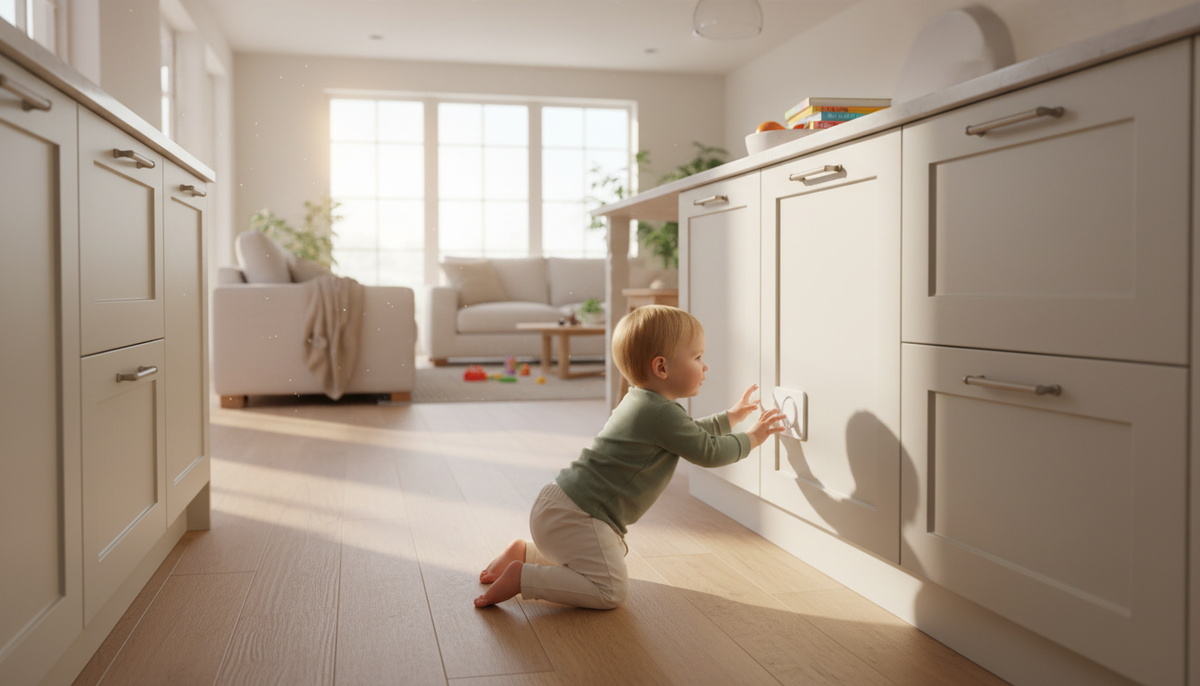
My younger daughter demonstrated this perfectly. I answered the doorbell one afternoon, was gone maybe ninety seconds, and came back to find her sitting on the kitchen floor surrounded by every bottle of dish soap, vinegar, and cleaning spray from the cabinet under the sink. Nothing harmful happened. But it was close enough to make me rethink every cabinet in the house.
The challenge for renters is that most traditional locks require drilling into the cabinet frame or door. That means a security deposit conversation you do not want to have. But even homeowners who simply prefer not to drill, or who have cabinet materials that don’t hold screws well, need alternatives.
The Main Categories of No-Drill Locks
No-drill locks fall into four broad types: adhesive strap locks, magnetic cabinet locks with adhesive mounts, spring-loaded latches with adhesive backing, and external cabinet handle locks. Each works differently and suits different cabinet configurations.
Adhesive strap locks wrap around cabinet knobs or handles and connect with a buckle or slider mechanism. They’re the most universal option because they work regardless of cabinet interior depth. The weak point is the adhesive itself. Surface preparation matters enormously. On painted MDF cabinets, I’ve had straps hold for over a year. On a laminate-finished cabinet in a rental kitchen, one failed at around the four-month mark.
Magnetic locks with adhesive mounts are the closest no-drill equivalent to a traditional installed lock. A latch mounts inside the cabinet with adhesive, and a magnetic key releases it from outside. These feel more permanent and are harder for children to defeat by feel alone. The tradeoff is that the adhesive mount inside the cabinet has to bond to whatever surface is there, which can be raw particleboard, painted wood, or plastic laminate. Results vary.
Spring-loaded adhesive latches mount inside the cabinet and work like a traditional push-to-open latch. They’re inexpensive and low-profile. They’re also the easiest for a determined toddler to defeat, because the mechanism is simple enough that some children figure it out by feel within a few weeks.
Handle and knob locks clamp around the exterior hardware of two adjacent cabinet doors. No adhesive required at all. They’re the most renter-friendly option because they leave zero trace, but they only work on cabinets with paired handles close enough together for the lock to span.

Adhesive Strap Locks: What to Look For
Not all adhesive straps are equal, and the difference matters. Look for locks rated to hold at least 25 pounds of pull force. The strap material should be nylon or reinforced fabric, not thin plastic. Thin plastic straps will stretch over time and eventually allow enough give for a child to access the cabinet even without breaking the adhesive bond.
The adhesive itself should be 3M VHB (Very High Bond) or equivalent. Some budget straps use generic foam tape that looks similar but fails under humidity and temperature changes, which are exactly the conditions under a kitchen sink.
Surface prep is the step most people skip. Clean the cabinet surface with isopropyl alcohol, let it dry completely, then press the adhesive pad firmly for 30 seconds. Wait 24 hours before testing. I know 24 hours feels like forever when you’re baby-proofing in a panic, but the adhesive needs that cure time to reach full strength.
In my experience, the lock mechanism itself matters as much as the adhesive. Look for buckles that require two simultaneous actions, like pressing and sliding, rather than a single push.
Magnetic No-Drill Locks: The Premium Option
Magnetic locks are the strongest no-drill option for cabinet interiors. The latch mounts inside with an adhesive pad, the door closes over it, and the cabinet won’t open without the magnetic key. Children cannot feel or see the mechanism, which means they can’t learn to defeat it the way they can with a visible buckle.
The installation surface inside the cabinet is the critical variable. Most magnetic lock adhesive pads bond well to painted wood and solid wood. They struggle on raw particleboard edges, on cabinets that have been refinished multiple times, or on surfaces that are even slightly greasy from kitchen use. Clean thoroughly, and consider using an additional strip of VHB tape alongside the manufacturer’s pad if you’re mounting to a questionable surface.
Keep the magnetic key somewhere consistent and accessible. In my experience, a small hook inside a high cabinet works well. Pick a system and stick to it.
One practical note: magnetic locks don’t work on cabinets with metal doors or frames, because the magnet can’t reliably pass through or around metal to release the latch. Most residential cabinets are wood, but check before you buy.
Handle Locks: The True Zero-Trace Option
If you’re in a rental and the thought of any adhesive makes you nervous, handle locks are your answer. They clamp around two adjacent cabinet knobs or handles with a rigid plastic or silicone sleeve. No tools. No adhesive. Nothing left behind when you move out.
The limitation is obvious: they only work on cabinets with two handles close enough together. Standard double-door kitchen cabinets with knobs usually qualify. Single-door cabinets, drawers, and cabinets with recessed pulls often don’t.
For the cabinets where they do work, they’re surprisingly effective. The mechanism requires pressing two points simultaneously while rotating or lifting, which is difficult for children under three. They’re also fast for adults once you’re used to them, which matters when you’re cooking and opening the same cabinet twelve times in an hour.
-
Clean the surface
Wipe the mounting area with isopropyl alcohol and let it dry before touching the adhesive. -
Press firmly for 30 seconds
Apply steady, even pressure across the entire adhesive pad to maximize contact with the cabinet surface. -
Wait 24 hours before testing
Adhesive needs a full cure cycle to reach rated hold strength. Do not test or load the lock early. -
Pull-test monthly
Tug each lock firmly every month. Any give in the bond means it’s time to remove, clean, and reinstall. -
Double up on high-risk cabinets
Use both an interior latch and an exterior strap or handle lock on any cabinet storing medications or cleaners.
Matching Lock Type to Cabinet Type
This is where most buying guides go wrong. They recommend a single product without acknowledging that your kitchen probably has three or four different cabinet configurations.
- Under-sink cabinets (single or double door, deep interior): Adhesive strap locks or magnetic locks. Handle locks work if there are paired knobs.
- Upper cabinets with paired doors: Handle locks are ideal here because the height makes adhesive failures less dangerous anyway, and you want something fast to use.
- Drawers: Adhesive strap locks designed for drawers, or magnetic locks mounted to the drawer interior. Spring latches generally don’t work on drawers.
- Bathroom vanities: Magnetic locks or adhesive straps. Humidity is higher here, so use the best adhesive you can find and inspect the bond monthly.
- Cabinets with no exterior hardware: Adhesive straps that wrap around the door itself, or magnetic locks inside. Handle locks won’t work here.
Installation Tips That Matter
No-drill locks fail most often due to improper surface prep or installation on surfaces that won’t hold adhesive long-term, like the raw particleboard edge of an IKEA cabinet interior.
For those surfaces, there’s a workaround. Apply a small piece of smooth, rigid material (a cut piece of thin plywood or a plastic cutting mat scrap) to the surface first, using a strong construction adhesive. Let that cure fully. Then mount your lock adhesive to that surface. It requires extra work, but it means the lock stays put.
Check every lock monthly. Pull on it firmly. If there’s any give in the adhesive, remove it, clean the surface, and reinstall with fresh adhesive. Most manufacturers include replacement adhesive pads, or you can buy VHB tape strips separately.
Don’t rely on any single lock for your highest-risk cabinets. The cabinet under the kitchen sink, where cleaning products live, should have both an interior latch and an exterior strap or handle lock. Redundancy is not paranoia. It’s the difference between a close call and an emergency room visit.
When to Upgrade to Drilled Hardware
No-drill locks are the right call for renters and for lower-risk cabinets. But if you own your home and the cabinet holds medications, sharp tools, or anything else with serious injury potential, drilled hardware is worth considering. A properly installed magnetic lock with screws will outlast any adhesive mount, and the installation damage to a cabinet frame is minimal enough that most homeowners consider it worthwhile.
If you’re renting and facing a high-risk cabinet, talk to your landlord. Many will allow cabinet locks if you agree to fill the screw holes before moving out. The conversation is easier than you think, and the security is meaningfully better.
No-drill locks work. Used correctly, on appropriate surfaces, with good adhesive and monthly checks, they will keep most toddlers out of most cabinets most of the time. That’s a real margin of safety, and for renters, it’s often the best available option.