

Drowning is the leading cause of unintentional injury death in children ages 1–4 (CDC). Not a distant risk. Not something that happens to other families. The number one cause, for the age group that toddles straight toward water without a second thought.
I think about that statistic every time I look out my back window at our neighbor’s pool. We don’t have one ourselves, but we’ve spent enough summers at houses that do to know how fast a toddler can disappear. My younger daughter once made it to a pool gate before I’d finished setting down a bag of towels. She was 22 months old and absolutely purposeful about it.
This article is for parents who have a pool, are getting one, or spend time at homes where one exists. The layers of protection here are not optional extras. They are the difference.
Why Toddlers and Water Are a Specific Emergency
A child can drown in as little as one to two inches of water (AAP). That means a kiddie pool, a bucket left out after washing the car, a decorative fountain. It means a bathtub. Toddlers are top-heavy, they have no fear of water, and they go under silently. There is no splashing, no calling out. Most drownings happen in seconds, not minutes, and most happen in familiar water, in the family pool, at a relative’s house, in a neighborhood they know.
The developmental window between 12 and 48 months is the highest-risk period. Children this age are mobile enough to reach water but have no reliable judgment about it. They are drawn to it. That combination is what makes every layer of protection matter.
The Four-Layer Framework
Pool safety professionals and the CPSC both use a layered approach: barrier, alarm, supervision, and response readiness. No single layer is enough. Fences fail. Alarms malfunction. Supervision lapses for 30 seconds. You need all four working together, because any one of them might be the layer that catches a near-miss.
Think of it as redundancy, the same principle used in aviation. You don’t rely on one system when the stakes are this high.
Fences: The First and Most Important Layer
A fence is not a convenience feature. It is the primary barrier between a toddler and the water, and its specs matter.
CPSC’s Safety Barrier Guidelines for Home Pools call for a fence at least 48 inches tall, no more than 4 inches above grade, with vertical slats no more than 1¾ inches apart when horizontal rails are less than 45 inches apart, and a latch at least 54 inches from the ground. Read that carefully. The slat spacing rule is specific to fence geometry. The grade clearance matters because toddlers are surprisingly good at squeezing under things. The latch height matters because a 3-year-old standing on tiptoe can reach about 42 inches. A latch at 54 inches stays out of reach.
The fence must surround the pool on all four sides, including the side facing the house. This is the part many families skip. They assume the house wall counts as one side of the barrier. It does not, unless every door and window that opens to the pool area has an alarm. A four-sided fence with a self-closing, self-latching gate is the standard. The gate should swing outward, away from the pool, so a child pushing against it can’t accidentally open it.
For removable mesh fencing, which many families use for temporary pools or to store away in winter, look for products certified to ASTM F2286, the performance specification for removable mesh pool fencing. This is the relevant standard for pool barriers. Do not confuse it with ASTM F1004, which covers indoor baby gates, not pool enclosures.
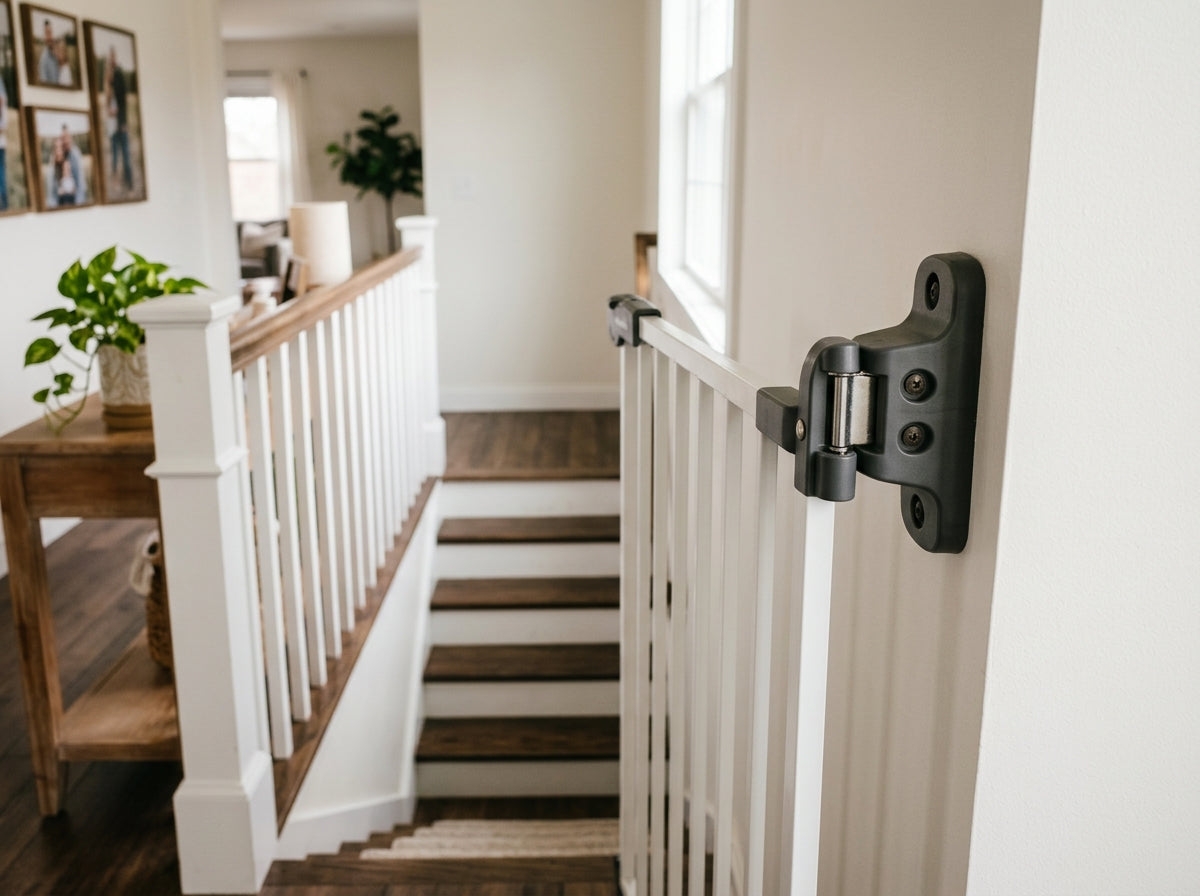
Gaps at the gate hinge are common and often large enough for a toddler to squeeze through, check yours. Also check whether the fence has horizontal rails that a child could use as a ladder. A fence that meets height requirements but has climbable horizontal rails is not doing its job.

- Gate hinge gap wide enough for toddler
- Horizontal rails create climbable ladder
- House door without pool alarm
- Toys left in pool attract children
- Non-safety cover pools water on top
Pool Covers: A Supplement, Not a Substitute
Power safety covers can add a meaningful layer of protection, but they are not a replacement for a fence. A child who falls onto a cover that isn’t fully engaged can still drown in the water that pools on top.
If you use a safety cover, look for one certified to ASTM F1346, the performance specification for safety pool covers. A compliant cover is designed to support the weight of a child and allow them to be rescued, but the rescue still requires someone to notice and respond. That is why a cover works as a supplement to fencing and supervision, not instead of them.
Soft covers, solar covers, and winter covers do not meet this standard. They can trap a child underneath. If you have a non-safety cover on your pool, treat it as a hazard rather than a safeguard.


Pool Alarms: What They Can and Cannot Do
Pool alarms come in a few forms: surface wave sensors that mount to the pool wall, subsurface motion detectors, door and gate alarms, and wearable wristband alarms for children. Each has a role and each has limits.
Door and gate alarms are the most reliable layer in this category. Every door in your home that opens directly to the pool area should have an alarm set to trigger the moment it opens. This gives you a few seconds of warning. It is not a substitute for supervision, but it closes the gap when you’re in another room.
Wearable alarms work by triggering when the wristband gets wet. In my experience, they’re useful as a backup, but they depend on the child wearing the device, and toddlers are talented at removing things. Use one if you have it, but don’t let it replace any other layer.
In-pool alarms detect water movement or subsurface pressure changes. They can be triggered by wind, animals, or debris, which means false alarms are common. That’s not a reason to skip them. A false alarm is annoying. A missed alarm is catastrophic. But calibrate your expectations: these are a last-resort signal, not a primary warning system.
No alarm replaces a fence. The alarm is what catches you when the fence fails.


Supervision Rules That Work
"Active supervision" is a specific thing. It means one adult, undistracted, within arm’s reach of toddlers in or near the water. Not watching from the patio. Not glancing up from a phone. Within arm’s reach, eyes on the child.
The designated watcher role dissolves quickly when other adults are present, everyone assumes someone else is watching. This is called diffusion of responsibility, and it kills children. The fix is explicit: designate one adult as the water watcher for a defined period, then rotate. That person does not drink, does not check their phone, does not have a conversation that takes their eyes off the water. When the rotation changes, you say it out loud.
Rules worth posting and enforcing:
- No child under 5 enters the pool area without an adult present.
- The gate latches every single time, even for a 30-second trip inside.
- Floaties and puddle jumpers are not life jackets. They are not substitutes for supervision.
- If you have to leave the pool area, take the toddler with you.
- Toys left in the pool attract children. Remove them when pool time is over.
Toys left in the pool are a draw, remove them when pool time is over.
Swim Lessons: What the Research Supports
The AAP recommends swim lessons for most children starting at age 1, with the caveat that lessons are a layer of protection, not a guarantee of safety. A toddler who has had swim lessons can still drown. Lessons reduce risk. They do not eliminate it.
What matters is finding lessons that teach water survival skills, floating, rolling to a back float, reaching a wall, not just splashing and kicking. Ask instructors specifically what survival skills they teach and at what age they introduce them. Programs vary significantly.
Swim lessons also build familiarity with water, which matters. A child who has practiced getting their face wet and recovering is in a better position than one who panics immediately. But this is a supplement to every other layer, not a reason to relax any of them.
Pre-Swim Pool Safety Check
Response Readiness: CPR and What to Keep Poolside
Every adult who regularly supervises children near a pool should know infant and child CPR. Not the general idea of it. The actual skill, practiced on a mannequin, with feedback. The AAP and American Red Cross both offer courses. Take one every two years, because skills decay.
Keep a reaching pole and a ring buoy within arm’s reach of the pool. These are not decorative. If a child is in distress, you do not jump in unless you are trained in water rescue. A panicking child can push a rescuer underwater. A reaching pole lets you pull a child to the edge without entering the water.
Post emergency numbers at the pool. When something goes wrong, people freeze. A laminated card with 911 and your address removes one cognitive step in a moment when every second counts.
Before Every Pool Visit: A Quick Checklist
Before your family swims, or before you visit a home with a pool, run through this quickly. It takes 90 seconds. Do it every time.
The fence, the alarm, the supervision, the response plan. None of them alone is enough. All of them together make a pool a place your toddler can enjoy safely, which is the whole point.