Most babies take their first independent steps somewhere between 9 and 12 months. Some walk confidently by 10 months. Others don’t find their footing until 14 or 15 months, and that’s normal. What matters isn’t the exact date on the calendar. It’s what you do with your home before those steps arrive, and how you keep adjusting as your child gets faster, taller, and more determined.
Walking changes everything. A crawler can reach the cabinet under the bathroom sink. A walker can reach the stove knob. A confident toddler who’s been walking for three months can climb a bookshelf. The safety work isn’t a single event. It’s a sequence, tied to where your child is developmentally right now.
The Walking Timeline
The range for independent walking is wide, roughly 9–15 months for most children, with some variation on either end. Before full walking, babies move through a predictable set of stages: pulling to stand, cruising along furniture, standing briefly without support, then taking those first lurching steps.
Each stage introduces new hazards. A baby who just learned to pull to stand will grab anything at counter height. A cruiser will yank on tablecloths, cords, and anything else within arm’s reach while moving along a surface. First walkers fall constantly, which means they fall into corners, edges, and hard surfaces you hadn’t thought twice about.
The AAP recommends consulting your pediatrician if your child is not walking independently by 18 months. Before that point, there’s a wide range of normal. But if you’re seeing no weight-bearing on legs, no pulling to stand, or regression in motor skills at any age, bring it up at your next well-child visit without waiting.
The Pulling-to-Stand Phase: Furniture Tip-Over Risk
Before your baby walks, they’ll use every piece of furniture in your home as a ladder. Dressers, bookshelves, TV stands, nightstands. Anything with a ledge or a drawer becomes a climbing structure.
This is when furniture anchoring becomes urgent. Furniture, TV, and appliance tip-overs kill a child every two weeks (CPSC). This is a consistent, preventable pattern. The dressers that tip are usually ones that were never anchored to the wall, often in a child’s own bedroom.
Anti-tip straps are inexpensive and take about 20 minutes to install. The catch is that they only work if you hit a stud or use the right drywall anchor. A stud finder and a longer strap give you more flexibility. Do this before your baby pulls to stand for the first time. You will not have a calm moment to do it after.
Televisions deserve specific attention. A flat-screen mounted to the wall is far safer than one sitting on a stand. If mounting isn’t possible, anchor the TV stand to the wall and use a TV safety strap to secure the set itself.
Baby Gates: Choosing and Installing Them Correctly
Once your baby is pulling to stand, stairs become an immediate hazard. About 93,000 children under 5 are treated in U.S. emergency rooms each year for stair-related injuries (Nationwide Children’s Hospital analysis of CPSC NEISS data, 1999–2008).
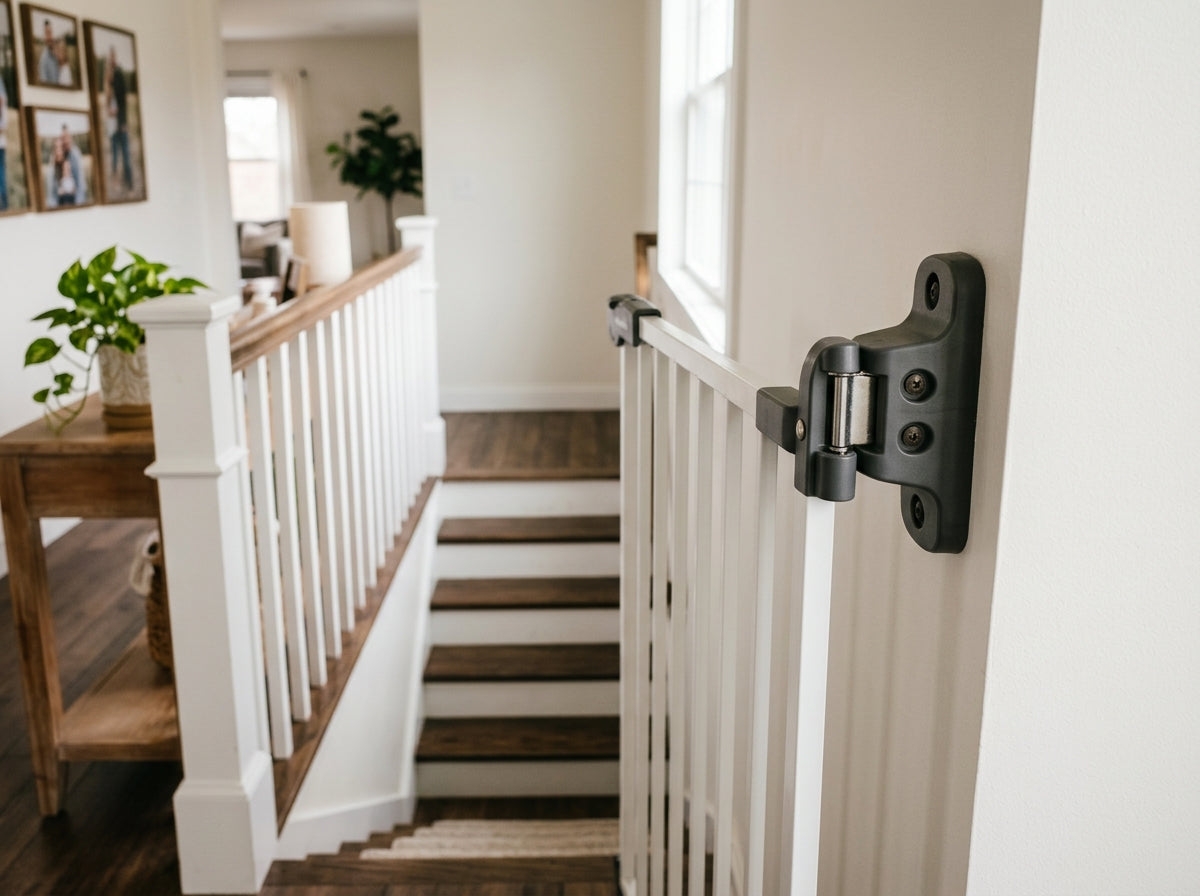
There are two gate types and the distinction matters. Pressure-mounted gates are fine for blocking doorways and room transitions. They are not safe at the top of stairs. For stair tops, you need a hardware-mounted gate, one that screws into the wall or banister. Pressure-mounted gates can be pushed out by a determined toddler, and at the top of a staircase, that’s a fall.
Look for gates that meet ASTM F1004, the federal safety standard for expansion gates and expandable enclosures, made mandatory under 16 CFR Part 1239 effective in 2021. That certification tells you the gate has been tested for the kind of force a toddler generates.
In my experience, mounting into a hollow banister post can fail under pressure. Mounting into the solid newel post with a banister-to-wall kit proved more reliable. Check your mounting points carefully before relying on them.
Cabinet and Drawer Locks: What Works and What Doesn’t
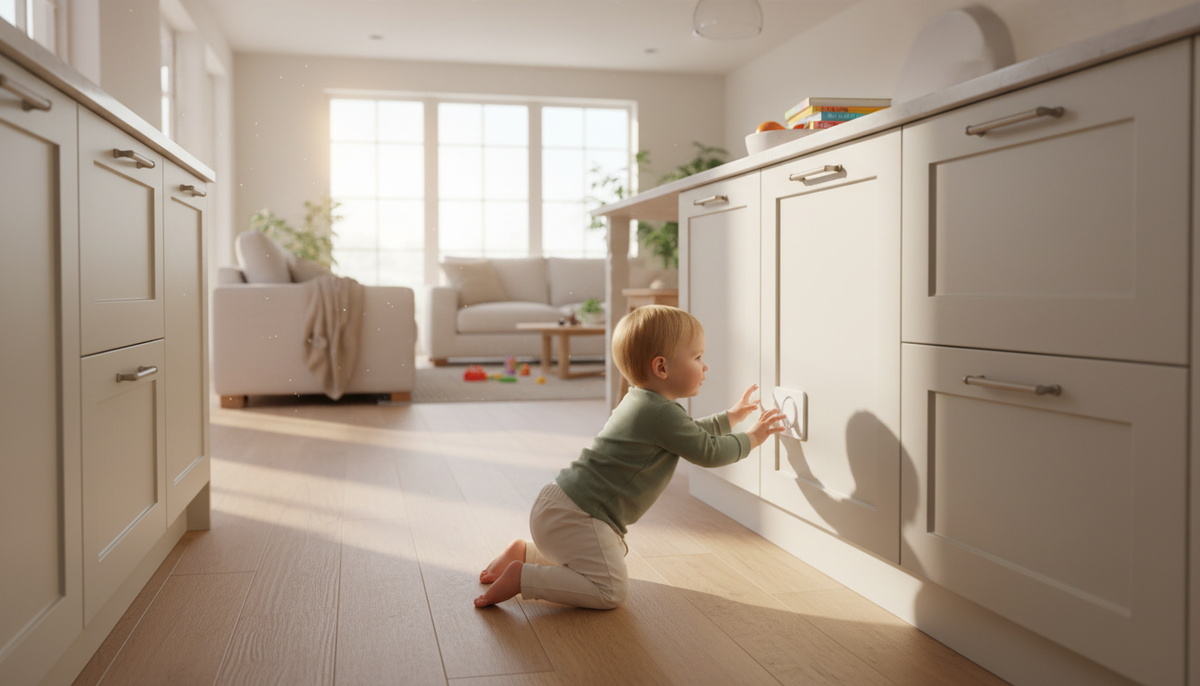
New walkers are also new explorers. The moment a child can move independently, they start opening things. Every cabinet at knee-to-hip height is a target.
The under-sink cabinet is the one that worries me most. Cleaning products, dishwasher pods, drain cleaners. Unsupervised medication exposures send roughly 100 children under five to U.S. emergency departments every day (CDC PROTECT data). Household chemicals follow a similar pattern. The products are accessible, the exposures happen fast, and the consequences can be severe.
Magnetic cabinet locks are highly reliable. They’re invisible from the outside, they don’t slow you down much once you’re used to the magnet, and a toddler cannot defeat them through persistence alone. In my experience, the difference in access is complete.
Adhesive strap locks are cheaper and easier to install, but they have a real failure mode. In my experience, they can be defeated by pulling at the right angle repeatedly until the adhesive gives way. If you use adhesive locks, check the bond every few weeks, especially in humid rooms like bathrooms and kitchens.
Corner and Edge Protection: The Underrated Hazard
First walkers fall. A lot. They fall forward, sideways, and backward. They fall when they’re tired, when they’re excited, when they try to change direction too fast. And they fall into things.
Coffee table corners, hearth edges, and TV console corners are the most common contact points. Foam corner guards and edge bumpers are not glamorous products, but they do their job. Clear silicone options are less visually intrusive and hold up better than foam versions, which compress over time and tend to peel at the corners first.
Remove the coffee table entirely if you can. In my experience, moving it to another room for several months during the early walking phase eliminates a significant hazard. You can bring it back once your child is steadier on their feet and can catch themselves.
Window Safety: A Hazard That Grows With Mobility
Babies who can walk can also climb. And climbing leads to windows.
About 3,300 children age 5 and younger are treated in U.S. emergency rooms each year for window fall injuries (CPSC). Windows in homes with young children should not open more than 4 inches, per CPSC and AAP guidance. Window stops and guards that limit the opening to 4 inches are available for most window types and are straightforward to install.
Window screens are not a safety device. They are designed to keep insects out, not to support the weight of a child. A child who leans against a screen can go through it. This is worth repeating to anyone who watches your child, including grandparents who grew up with screens as the only barrier.
Corded window coverings are a separate and serious concern. About 9 children under age 5 die each year from window-covering cord strangulation (CPSC GoCordless data). Nearly half of more than 200 corded-window-covering incidents involving children up to age 8 between 2009 and 2021 resulted in a death (CPSC). In 2022, the CPSC adopted federal safety rules requiring most new residential window coverings to be cordless or have inaccessible cords (16 CFR 1260, effective May 30, 2023). If you have older corded blinds, replace them or use a cord wind-up device that keeps the cord out of reach. Tying cords up high is not sufficient. Children climb.
Water Hazards: Bathtubs, Toilets, and Beyond
A walking baby can reach a toilet. A toddler can lean over a bathtub edge. A child who wanders into a bathroom alone faces real risk.
Drowning is the leading cause of unintentional injury death in children ages 1–4 (CDC). A child can drown in as little as one to two inches of water (AAP). That means a bathtub with a few inches of water left in it, a bucket left on the back porch, or a dog’s water bowl are all potential hazards for a newly mobile child.
Toilet locks are a product category that gets dismissed as overkill. They’re not. Install them and keep bathroom doors closed. A simple hook-and-eye latch at adult height on the outside of the bathroom door is an effective barrier. Drain the bathtub immediately after use. Empty buckets, kiddie pools, and any containers that collect water.
If you have a backyard pool, the barrier requirements are more significant. Four-sided fencing with a self-closing, self-latching gate is the standard recommendation, with the latch positioned on the pool side so a child cannot reach it from outside.
Water Hazard Checklist
Smoke Alarms, CO Detectors, and Fire Safety
This section belongs in every home safety article, because walking children are also running children, and running children can get further from you faster than you expect.
Three out of five home fire deaths occur in homes with no smoke alarms or non-functioning ones (NFPA). Test your smoke alarms monthly. Replace batteries annually or switch to 10-year sealed-battery models. CO poisoning kills more than 400 people each year and sends more than 100,000 to U.S. emergency rooms (CDC). A CO detector on every level of your home, including near sleeping areas, is the standard.
Once your child is walking, practice matters. Walk the exit routes with them. Make the sound of the smoke alarm familiar so it doesn’t cause panic. Children who have heard the alarm before and know what to do are safer than children who freeze.
Adjusting as Your Child Gets Faster and Taller
The safety setup that worked at 12 months will not be sufficient at 18 months, and it will definitely not be sufficient at 24 months. Children grow into new hazards on a rolling basis.
At 18 months, most children can climb onto furniture. Secure anything they might use as a step stool. At 24 months, many can open lever-style door handles. Consider handle covers or door alarms for rooms that need to stay off-limits. By 3 years, many children can defeat basic cabinet locks if they’ve watched you open them enough times.
Revisit your safety setup every three to four months. Walk through your home at your child’s eye level, literally get down on your knees and look around. The hazards visible from that vantage point are different from what you see standing up.
The goal isn’t a perfectly childproofed home that never needs updating. It’s a habit of looking at your environment with fresh eyes as your child changes, and staying one step ahead of what they can reach, climb, and open next.